
文法Grammar Point
〜ている ongoing action / state: Meaning & Examples
te iru · JLPT N5
JLPT N556 textsQuiz readyStudy card
〜ている means “ongoing action / state”. It is a JLPT N5 pattern: below are its construction, the nuances that trip learners up, and the sentences where real Japanese writers use it.
一枚Study card
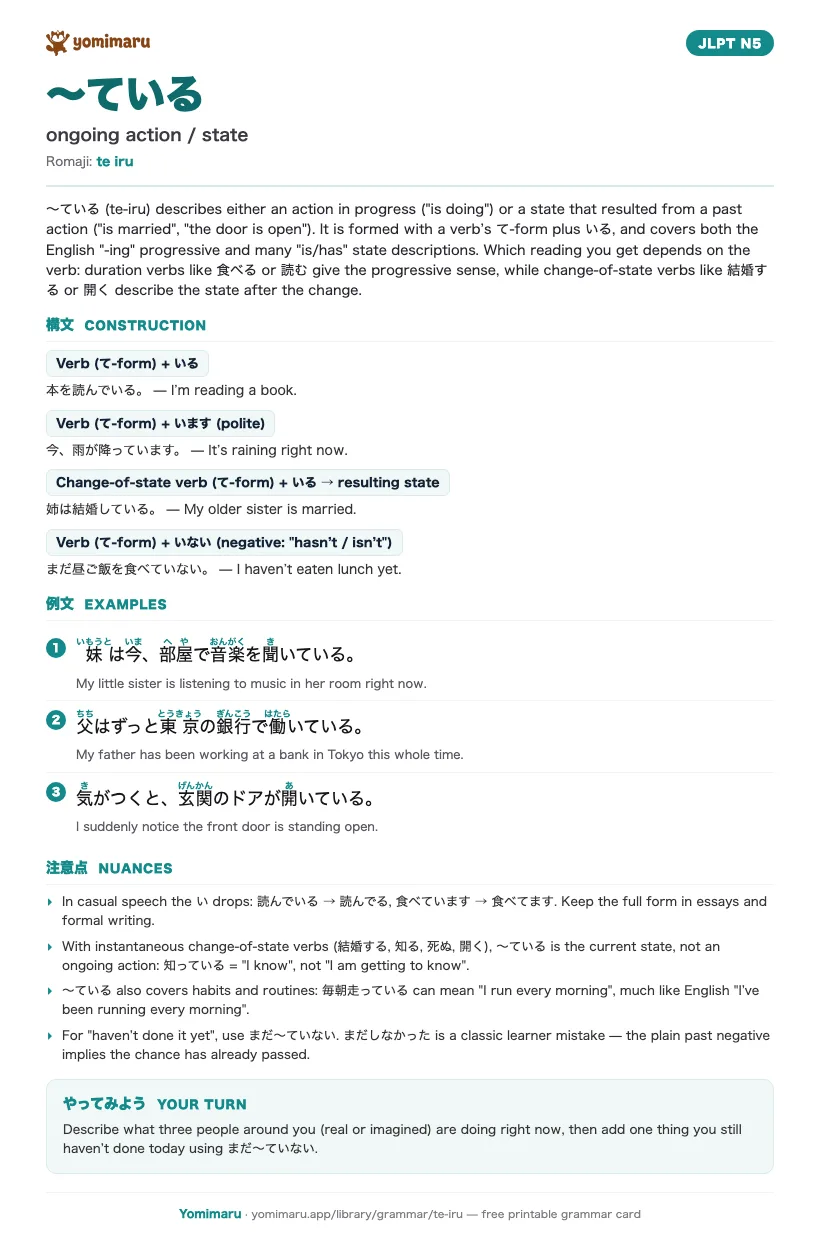
A free one-page study card for 〜ている (ongoing action / state), JLPT N5: what it means, how it attaches, 3 example sentences with furigana, and the nuances that trip learners up. Read it right here, or take the PDF or PNG with you. We never ask for an email for this card.
How 〜ている works
It is formed with a verb’s て-form plus いる, and covers both the English "-ing" progressive and many "is/has" state descriptions. Which reading you get depends on the verb: duration verbs like 食べる or 読む give the progressive sense, while change-of-state verbs like 結婚する or 開く describe the state after the change.
構文Construction
Verb (て-form) + いる
本を読んでいる。 — I’m reading a book.
Verb (て-form) + います (polite)
今、雨が降っています。 — It’s raining right now.
Change-of-state verb (て-form) + いる → resulting state
姉は結婚している。 — My older sister is married.
Verb (て-form) + いない (negative: "hasn’t / isn’t")
まだ昼ご飯を食べていない。 — I haven’t eaten lunch yet.
例文In a sentence
妹は今、部屋で音楽を聞いている。
父はずっと東京の銀行で働いている。
気がつくと、玄関のドアが開いている。
注意点Nuances
- Keep the full form in essays and formal writing.
- With instantaneous change-of-state verbs (結婚する, 知る, 死ぬ, 開く), 〜ている is the current state, not an ongoing action: 知っている = "I know", not "I am getting to know".
- 〜ている also covers habits and routines: 毎朝走っている can mean "I run every morning", much like English "I’ve been running every morning".
- For "haven’t done it yet", use まだ〜ていない. まだしなかった is a classic learner mistake — the plain past negative implies the chance has already passed.
練習Your Turn
Tip
Describe what three people around you (real or imagined) are doing right now, then add one thing you still haven’t done today using まだ〜ていない.

Describe what three people around you (real or imagined) are doing right now, then add one thing you still haven’t done today using まだ〜ていない.
〜ている (ongoing action / state) in real sentences
Each one is quoted from a published Japanese text in this library and links to the story it came from. Some use older spellings, or break off where the sentence carried on. They are transcribed exactly as their authors wrote them.
先生が聞いても、いつもまどを見ている子だ。
— from One Line of Boot Prints (N5)
くるくるくるくる、ぐるぐるぐるぐる、そのお人形はさっきから眼がまわって気分がわるくなっているのでした。
— from The Fainting Doll (N3)
こんなふうに話しあっていると、よいことは起こりません。
— from Two Frogs (N3)
お茶をいれている私のそばである友達が栗の皮をむきながら
— from The Look-Alike (N3)
確認Self-check
 確認
Practise 〜ている: fill in the blank
4 sentences taken from real Japanese texts, with the grammar removed. Pick what belongs in the gap.
Question 1 of 4
-
かたつむりが角を振ってるのを見blankと、王様は…
Answer: ている — from The Snail's Song (N3)
-
どこをみつめblankかわからないまま
Answer: ている — from The Smile (N1)
-
まくらをならべblank正ちゃん
Answer: ている — from The Cat and the Sweet Red Bean Soup (N3)
-
回転しblank調帯の幻影
Answer: ている — from The Buzzing Belt (N2)
Read the texts these came from
0 of 4 correct
Every sentence above came from a free text you can read here in full, with the rest of the story around it.
Appears in 56 of 379 texts in our library.
蔵書The texts
56 texts in the library use 〜ている
Free to read in full. Furigana over every kanji, a dictionary on any word you tap, and an English breakdown of each sentence.
 Read
うちの ねこ
Our Cat's Secret
Original
by Yomimaru
 Read
こうえんの いぬ
The Dog at the Park
Original
by Yomimaru
 Read
質屋の通帳
The Pawnshop Passbook
薄田 泣菫

 Read
暗い花
Dark Flower
林 芙美子
 Read
おやすみ、おつきさま
Goodnight, Moon
Original
by Yomimaru
 85
Read
川の石
Every Morning at the River
Original
by Yomimaru

 Read
夏と人形
Summer and the Doll
坂口 安吾
Read
微笑
The Smile
夢野 久作
Read
五本の指
Five Fingers
ベルトラン ルイ
 84
Read
おれの屋台
Never a Day Off
Original
by Yomimaru
 82
Read
飴だま
The Candy Drop
新美 南吉

 82
Read
店のまど
Wait Here
Original
by Yomimaru
Show the other 44 texts
 81
Read
白いいと
The First Day of Summer
Original
by Yomimaru
 79
Read
三つのふうとう
Three Envelopes
Original
by Yomimaru
 79
Read
雪子さんの泥棒よけ
Yukiko's Burglar Foil
夢野 久作

 78
Read
二ひきの蛙
Two Frogs
新美 南吉
 75
Read
かさを一本
One Umbrella, Please
Original
by Yomimaru
Read
沼辺より
From the Marsh
牧野 信一
 75
Read
泣いてゐるお猫さん
The Crying Cat
村山 籌子
 Read
みじかい音
The Sound the Water Makes
Original
by Yomimaru
 Read
片目のごあいさつ
The One-Eyed Greeting
小川 未明
 Read
虹猫の話
The Story of the Rainbow Cat
宮原 晃一郎
 Read
ツイテ イツタ テフテフ
The Butterfly That Followed
新美 南吉
 Read
賢い秀雄さんの話
The Story of Clever Hideo
宮原 晃一郎

 Read
キューピー
Kewpie
夢野 久作
 Read
ヒント
Hint
織田 作之助
 Read
ライオンの大損
The Lion's Big Loss
村山 籌子
 Read
あと十ぷん
Ten Minutes Left
Original
by Yomimaru
 Read
本と本の間
The Gap on the Shelf
Original
by Yomimaru
 Read
ヌスビトト コヒツヂ
The Thief and the Lamb
新美 南吉
 Read
狐に化された話
The Story of Being Tricked by a Fox
土田 耕平
 Read
ストーブの前で
One Line of Boot Prints
Original
by Yomimaru
 Read
ジェミイの冐険
Jemmy's Adventure
片山 広子
 Read
からすねこと ペルシャねこ
The Crow Cat and the Persian Cat
小川 未明
Read
どろぼう猫
The Thief Cat
夢野 久作
Read
髪床やの大根さん
Mr. Daikon's Barber Shop
村山 籌子
Read
ねことおしるこ
The Cat and the Sweet Red Bean Soup
小川 未明
 Read
ひよりげた
The Straw Sandals
新美 南吉
Read
気絶人形
The Fainting Doll
原 民喜
 Read
しゃしんやさん
The Photographer
小川 未明
 Read
オマツリ
The Festival
村山 籌子
Read
カタツムリノ ウタ
The Snail's Song
新美 南吉
 Read
にはとり は みんな しあわせ
All the Chickens Are Happy
村山 籌子
Read
オホサウヂ
The Big Cleaning
村山 籌子
 Read
ザウサン サルサン
Zausan and Sarusan
村山 籌子
Read
ペンギン鳥の歌
The Penguin Bird's Song
原 民喜
 Read
山の上のへや
The Room on the Mountain
Original
by Yomimaru
Read
こがらしの ふく ばん
The Night the Cold Wind Blows
小川 未明
Read
お鍋とお皿とカーテン
The Pot, the Plate, and the Curtain
村山 籌子
Read
似たひと
The Look-Alike
宮本 百合子
 Read
ミチコサン
Michiko-san
新美 南吉
Read
みみず先生の歌
The Earthworm Teacher's Song
村山 籌子
Read
調帯
The Buzzing Belt
野村 吉哉
Read
ゐろりの中の街
The City in the Hearth
スティーブンソン ロバート・ルイス
Read
ぼろぼろな駝鳥
The Tattered Ostrich
高村 光太郎
 Read
オヤカン ト オナベ ト フライパン ノ ケンクワ
The Quarrel of the Pot, the Pan, and the Frying Pan
村山 籌子
解説Background
Where this 〜ている explanation comes from
〜ている sits at JLPT N5 in the 302-point taxonomy every text in this library is tagged against. Each text is read for the patterns it contains, which is what lets this page list every text that uses 〜ている and pull its example sentences out of them.
The example sentences were not written to demonstrate the rule. They are quoted from published Japanese texts in this library (One Line of Boot Prints and The Fainting Doll among them), and each one links back to the story it came from, so you can read the sentence where it actually happened.
質問Questions
〜ている: questions & answers
What is the difference between 〜ている and 〜てる?
〜てる is the contracted casual form — the い simply drops in speech: 食べている → 食べてる, and politely 食べています → 食べてます. It is perfectly natural in conversation and texting, but stick to the full 〜ている in formal writing.
Why does 結婚している mean "is married" and not "is getting married"?
Verbs like 結婚する, 知る, and 死ぬ describe a change that happens in an instant, so 〜ている expresses the state after that change. To talk about the event itself you say 結婚する (will marry) or 結婚した (got married).
How do I say "I haven’t done it yet" in Japanese?
Use まだ〜ていない: まだ宿題をしていない means "I haven’t done my homework yet." まだしなかった sounds off because the plain past negative frames the timeframe as finished. This pattern appears constantly in native text, so a little reading practice on Yomimaru makes it automatic fast.
Is there a printable 〜ている cheat sheet?
Yes. A free one-page 〜ている (ongoing action / state) study card sits at the top of this page, as both a PDF and a PNG. It carries the JLPT N5 meaning, how the pattern attaches, 3 example sentences with furigana, and the nuances learners get wrong. You do not need an account or an email address to download it.
始めるStart free
Read the grammar you just studied
Yomimaru turns every text in the library into a reading lesson: furigana tuned to your JLPT level, tap-to-look-up on any word, and an English breakdown of the vocabulary and grammar in each sentence. It is all free, and we never ask for a card.