
Learn hiragana & katakana
仮名 かな The course
What is Yomikana?
Yomikana is Yomimaru's free course for learning to read hiragana and katakana, with no account needed. It covers all 208 kana, 104 in each script, in six chapters and 52 short lessons, one row of the kana chart at a time. Every kana comes with a mnemonic and its sound, spoken by your device's Japanese voice, and the 142 single kana also have an animated stroke order. After every two lessons a match game mixes the kana you have learned so far, each chapter ends with a review, and every kana comes back for review on a spaced schedule, sooner when you miss it. Along the way, 11 word stops teach your first Japanese words, five new ones at a time: everyday words you can already read, from a set of 310 in eight themes. At 17 word reviews between lessons, you see the meaning of a word you have met and type the word in rōmaji. Your progress saves in your browser, and a free account syncs it across devices. Four rows in, you can already read your first short story.
Six chapters, 208 kana
Hiragana and katakana spell the same sounds, so each script has the same three chapters. You can switch script at any time with the picker above the trail.
| Chapter | Lessons | Kana | What it covers |
|---|---|---|---|
| Hiragana basics あ い う え お | 10 | 46 | The base sounds, one row per lesson, from the five vowels to ん. |
| Hiragana dakuten and handakuten が ぎ ぐ げ ご | 5 | 25 | The same kana with two ticks for voiced sounds (か → が) or a small circle for p (は → ぱ). |
| Hiragana combinations (yōon) きゃ しゃ ちゃ にゃ | 11 | 33 | Combined sounds, a kana plus a small ya, yu or yo, said as one beat. |
| Katakana basics ア イ ウ エ オ | 10 | 46 | The base sounds, one row per lesson, from the five vowels to ン. |
| Katakana dakuten and handakuten ガ ギ グ ゲ ゴ | 5 | 25 | The same kana with two ticks for voiced sounds (カ → ガ) or a small circle for p (ハ → パ). |
| Katakana combinations (yōon) キャ シャ チャ ニャ | 11 | 33 | Combined sounds, a kana plus a small ya, yu or yo, said as one beat. |
How practice works
One lesson per row
Each lesson teaches one row of the chart. You meet each kana with its mnemonic, its sound and, for single kana, its stroke order, then answer a short drill. Each of the 46 basic hiragana also has a drawing to remember it by.
Your first words, five at a time
From the second lesson on, word stops sit on the trail, 11 in all. Each one teaches up to five new words you can already read: you meet each word with its meaning and its sound, pick its meaning among four, then spell it from kana tiles. A word may hold one kana you have not reached when it is a marked or combined form of one you know, such as が for か, and that kana then shows its reading. Once enough words are open you choose a theme, such as food and drink or places and travel, and the words you met come back at later stops.
Word reviews: type the words you have met
From the な row on, 17 word reviews sit between two lessons. Each asks up to eight words you have met, the ones you are closest to forgetting first. You see a word's meaning and type the word in rōmaji, and it appears in kana as you type: neko becomes ねこ. A right answer checks itself. A miss shows the word, and it comes back once at the end. You can also spell the words from kana tiles instead of typing. With fewer than three words to review, the stop teaches new words instead.
A match game every two rows
After every two lessons, a match game mixes the kana you have learned so far, and never one you have not. After a few games, decoy tiles join the board, so the last pair is never a free guess.
A review to close each chapter
The basics chapters end on a mixed review and the look-alike drill, which asks only kana that are easy to confuse, such as さ and き. The dakuten and combination chapters end on a recall quiz.
Reviews on a schedule
Each kana you study comes back on a schedule that stretches as you remember it: after 1 day, then 3, 7, 21 and 60 days. A correct answer moves it one step, and past the first step at most one a day; a miss moves it two steps back. When 10 or more kana are due, a card at the top of the trail says how many, so a return visit starts with what you are about to forget. You can also leave your email after a lesson to get a reminder when kana are due, with or without an account.
What saves without an account
Your progress saves in this browser: the rows you finished, each kana's review schedule, your daily streak and the trail stops you completed. Clearing your browser data erases it. A free Yomimaru account keeps it with your account, syncs it across your devices and carries the kana you learned into Yomimaru's reading path. The words you meet save in this browser too, and with an account every word you have reviewed is kept in your Yomimaru vocabulary, with its review schedule.
Your first story after four rows
Four rows in, with あ, か, さ and た, you can already read a whole story: くさい たこ (The Stinky Octopus), an original Yomimaru story in seven short lines. Beyond those rows it uses only three more kana: が and だ, which are か and た with two small ticks, and a small っ. It is free to read in the Yomimaru library.
Read くさい たこ (The Stinky Octopus)
Questions about learning hiragana and katakana
Is Yomikana free, and do I need an account?
Yomikana is free and needs no account. Every lesson, quiz and game works in your browser, and your progress saves on this device. A free Yomimaru account keeps that progress with your account and syncs it across devices, but you never need one to learn.
How many hiragana and katakana are there?
Each script has 46 basic kana. Adding the dakuten and handakuten marks (が, ぱ) brings each script to 71, and the combination sounds (yōon) such as きゃ bring it to 104. Yomikana teaches all 104 in both scripts, 208 kana in total. Katakana also has extended combinations for foreign sounds, such as ファ (fa) and ティ (ti), which fall outside these counts.
Should I learn hiragana or katakana first?
Start with hiragana. It writes grammar, particles and word endings, so it appears in every sentence you will read. Katakana mostly writes loanwords, foreign names and sound effects, and it comes easier once you know hiragana, because both scripts spell the same sounds. The course opens on hiragana, and the katakana chapters are there whenever you want them.
How long does it take to learn hiragana and katakana?
It depends on how often you come back, because meeting a kana is quick and remembering it takes days. In Yomikana a kana counts as mastered only after correct answers on three separate days, which is day five if you take each review when it falls due. We are measuring how long Yomikana learners take to finish every row and will publish the figure once enough of them have.
Does Yomikana have audio?
Yes. You can hear every kana and every example word, spoken by your device's built-in Japanese voice (text-to-speech). Because the voice comes from your phone or computer, it can sound different from one device to another.
Does Yomikana teach stroke order?
Yes, for the 142 single kana: all the basic hiragana and katakana and their dakuten and handakuten forms, animated from KanjiVG stroke data. You can replay a kana or step through it one stroke at a time. The combination sounds are two kana you already know, so they have no animation of their own. Writing practice happens on paper: the trainer does not read handwriting.
Is there a free hiragana and katakana quiz?
Yes. The recall quiz asks 10 multiple-choice questions, from kana to rōmaji, from rōmaji to kana, or mixed. Switch on typing to type each kana's sound in rōmaji instead of picking it; questions from rōmaji to kana stay multiple choice. You can quiz all hiragana, all katakana, the hiragana you have not fully learned yet, the kana due for review, or one row from the chart. A miss shows the kana's sound and mnemonic, and the question comes back once at the end of the quiz.
Does Yomikana teach Japanese words, or only the kana?
Both. From the second lesson on, the trail has 11 word stops that teach your first Japanese words, up to five new ones at a time. They come from a set of 310 everyday words in eight themes, such as food and drink, animals and nature and time and weather. A word opens once you can read it, so more words open as you finish rows, and the words you met come back at later stops. At the word reviews between lessons, you type the words you have met in rōmaji, from their meaning.
Which kana look alike?
The classic look-alikes are さ and き; ぬ and め; る and ろ; わ, ね and れ; は and ほ; う and つ; し and つ in hiragana, and シ and ツ; ソ and ン in katakana. Yomikana's look-alike drill asks only these, and every question puts the kana's look-alikes among the answers, so you have to tell the shapes apart instead of guessing by elimination.
Does Yomikana work on my phone?
Yes. It runs in any modern browser on a phone, tablet or computer, with nothing to install. Your progress stays in that browser until you make a free account, which syncs it to your other devices.
What should I read after learning the kana?
Four rows in, you can already read くさい たこ (The Stinky Octopus), a seven-line story built on the あ, か, さ and た rows, free in the library. After that, the library's beginner shelf and the N5 edition of Yominews give you real Japanese with furigana over every kanji.
Keep learning
- Tell シ, ツ, ソ and ン apart: How to tell the four katakana look-alikes apart, with a drill.
- Dakuten, handakuten and small tsu: How two ticks and a circle change a kana, with a drill.
- Free hiragana quiz: Test the 46 basics, dakuten or yōon, by tapping or typing.
- Free katakana quiz: Test yourself on all 104 katakana, then read 30 real loanwords.
- Hiragana vs katakana: What each script is for, and which to learn first.
- A beginner’s guide to hiragana and katakana: What each script does, and a study plan for both.
- What furigana is, and why kana unlock it: The small kana over kanji that let you read before you know them.
- Easy Japanese stories for beginners: Short graded texts with furigana and tap-to-look-up.
- Japanese news at N5: Real news in simple Japanese, with furigana over every kanji.
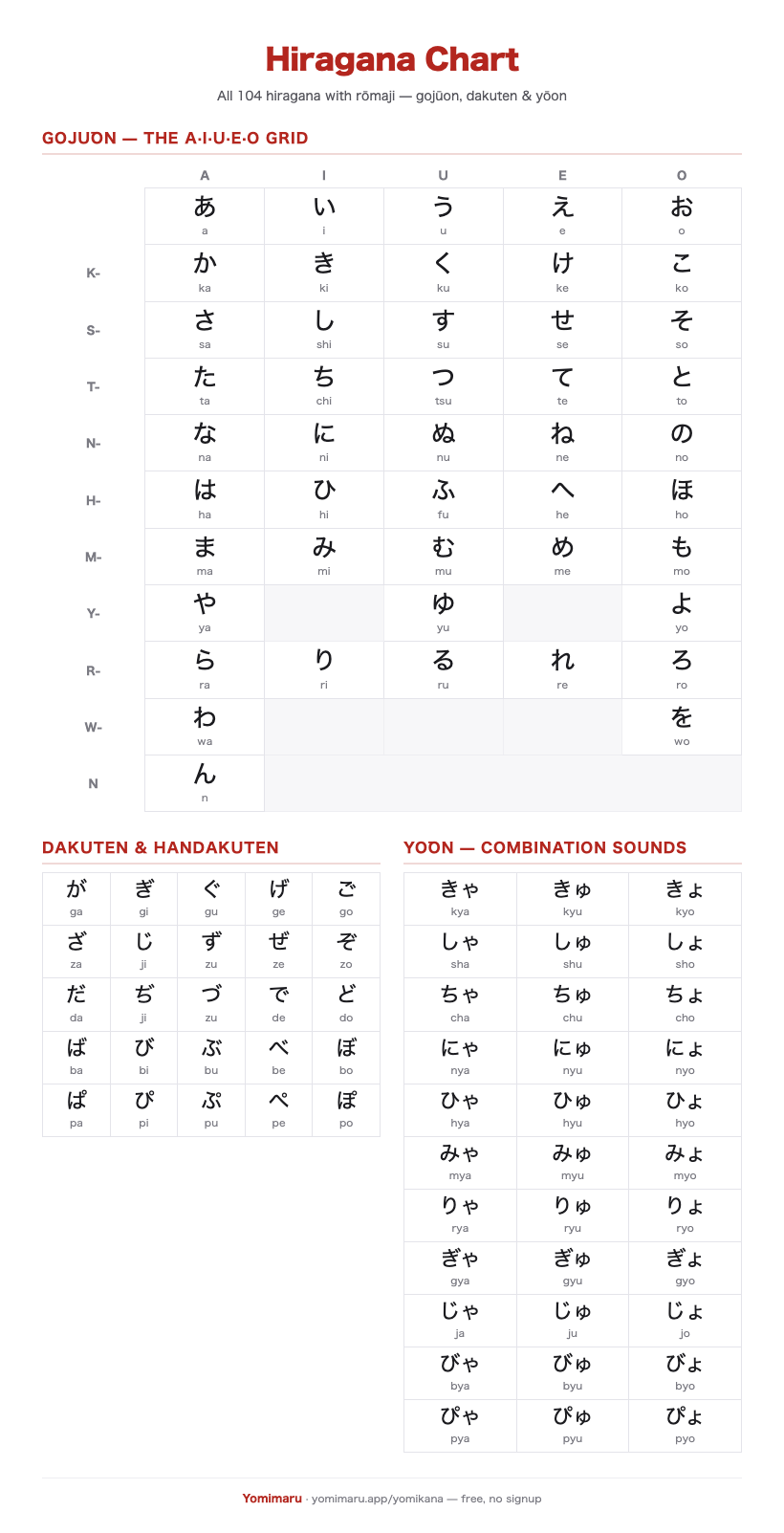
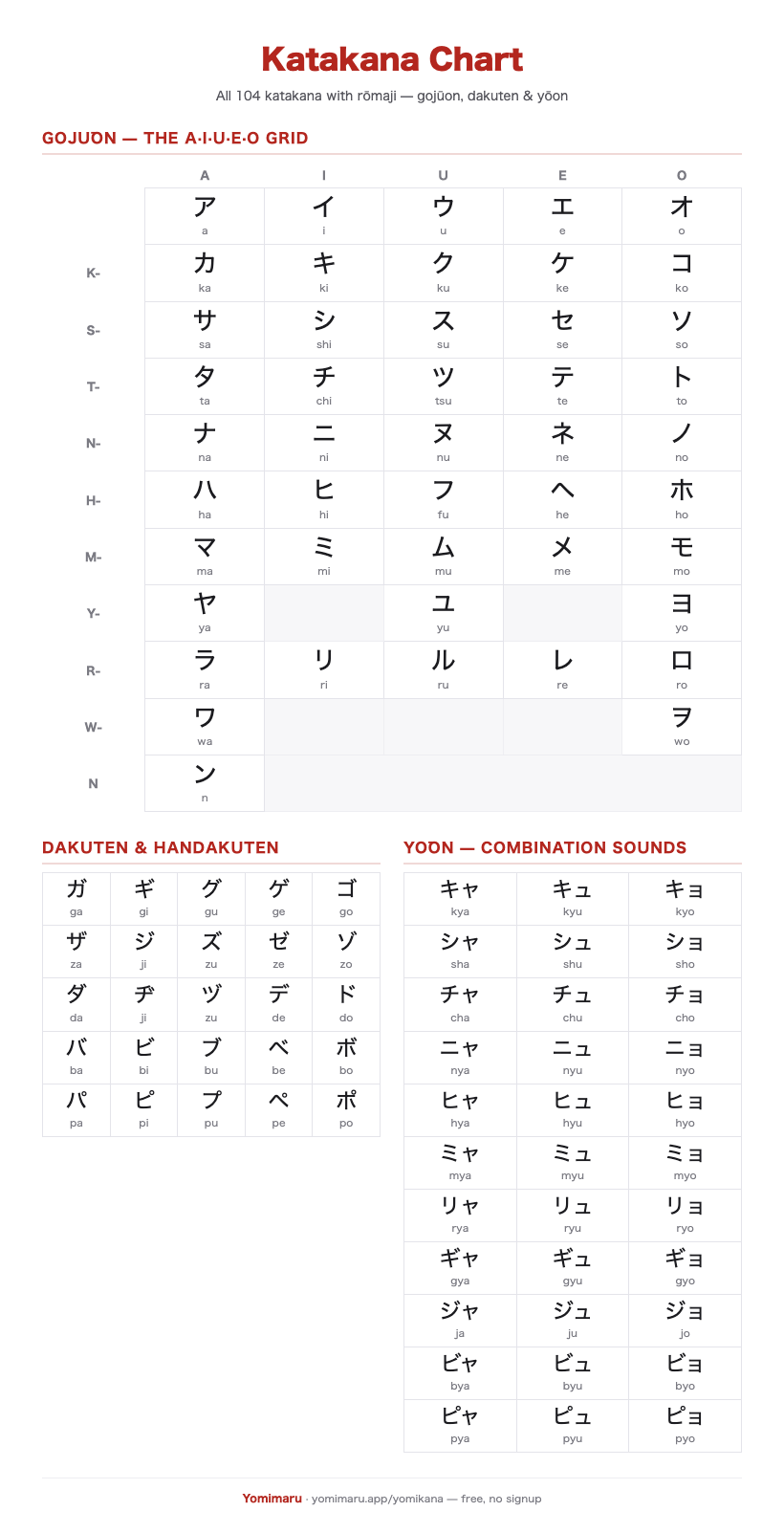
Printable charts: Hiragana chart (PDF) PNG Katakana chart (PDF) PNG
Yomikana is made by Maxime Pitaval, the founder of Yomimaru. Stroke-order data: KanjiVG (CC BY-SA 3.0).
Hiragana chart: all 104 characters
| Kana | Rōmaji | Mnemonic | Example word |
|---|---|---|---|
| Vowels | |||
| あ | a | An apple's stem crosses the top while its peel spirals off in one long ribbon: that curl is あ. | あめ (ame), Rain |
| い | i | Two eels stand on their tails side by side, one tall and one short: the two strokes of い. | いぬ (inu), Dog |
| う | u | A steaming bowl of udon: steam ticks off the top, the bowl curves and hooks under into う. | うみ (umi), Sea |
| え | e | An escalator's steps zigzag up to a single rider's head at the top: those angled steps are え. | えんぴつ (enpitsu), Pencil |
| お | o | An olive on a toothpick, with a red pimento dot peeking out at the top right. That dot makes it お, not あ. | おにぎり (onigiri), Rice Ball |
| K row | |||
| か | ka | A car races down a road that hooks left, with a speed streak slashing across and a puff of exhaust off the top right: か. | かさ (kasa), Umbrella |
| き | ki | An old key stands upright: two crossbars for the grip and a hooked tooth below. き has two bars, not さ's one. | きもの (kimono), Kimono |
| く | ku | A cuckoo bursts from its clock, beak snapped wide open going 'ku-ku'. That sharp beak is く. | くつ (kutsu), Shoes |
| け | ke | A kettle whistles: a tall jet of steam on the left, the handle and hooked spout on the right form け. | けむり (kemuri), Smoke |
| こ | ko | Two koi drift one above the other, their parallel bodies the two strokes of こ. | こころ (kokoro), Heart |
| S row | |||
| さ | sa | A sailboat: the mast crosses the top and one sail bellies out below. さ has one crossbar, not き's two. | さくら (sakura), Cherry Blossom |
| し | shi | A ship's anchor drops on its line and curves into one big hook at the bottom: upright, that's し. | しお (shio), Salt |
| す | su | A curly straw dives into a tall soda and coils into a loop at the bottom: す. | すし (sushi), Sushi |
| せ | se | A seedling, せ: a straight stem crossed by one broad leaf, rising from soil that curls up at the right. | せんせい (sensei), Teacher |
| そ | so | A zigzag of thread being sewn, dropping into a curl at the end: そ. | そら (sora), Sky |
| T row | |||
| た | ta | A gift tag, た: crossed ribbon up on the left and a little folded card hooking off the lower right. | たまご (tamago), Egg |
| ち | chi | A knife rests across a wedge of cheese, its belly curling left. ち is the mirror image of さ. | ちず (chizu), Map |
| つ | tsu | A single wave curls over from left to right, lying flat. That sideways hook is つ. | つくえ (tsukue), Desk |
| て | te | An old telephone hanging on its hook, て: a flat top, then a curved drop. | てがみ (tegami), Letter |
| と | to | A foot mid-step, と: the shin drops straight and the toe curls up, with a pebble stuck to the side. | ともだち (tomodachi), Friend |
| N row | |||
| な | na | A rope tied in a knot, な: strands crossed up top and a small loop dangling from the lower right. | なつ (natsu), Summer |
| に | ni | A bandaged knee, に: the shin on the left and two strips of bandage wrapped across on the right. | にく (niku), Meat |
| ぬ | nu | Noodles twirled on chopsticks, ending in one extra loop: that loop makes it ぬ, not め. | ぬの (nuno), Cloth |
| ね | ne | A bird's nest in a tree, ね: the trunk on the left and twigs coiling into a round loop on the right. | ねこ (neko), Cat |
| の | no | A bull's nose ring, の: one round loop with a little tail. | のり (nori), Seaweed |
| H row | |||
| は | ha | A straw hat on a stand, は: the pole on the left, the brim crossing it and the crown looping on the right. | はな (hana), Flower |
| ひ | hi | The curved heel of a shoe, one smooth swoop: ひ. | ひと (hito), Person |
| ふ | fu | A fountain, ふ: a droplet up top, the spout curving in the middle and a splash to each side. | ふね (fune), Ship |
| へ | he | A hen hunched over, its back a single low peak: へ. | へや (heya), Room |
| ほ | ho | Lay a roof-beam across the top of は and the hat becomes a house: ほ. | ほし (hoshi), Star |
| M row | |||
| ま | ma | A ship's mast, ま: two spars cross the pole, and rope coils into a loop at its foot. ま ends in a loop, not も's hook. | まつ (matsu), Pine Tree |
| み | mi | A hand mirror, み: the round glass loops at the top and the handle crosses down. | みず (mizu), Water |
| む | mu | A cow goes 'muuu'. In む, the loop is its round body and the flick at the top right is its swishing tail. | むし (mushi), Insect |
| め | me | A medal on crossed ribbons: one clean loop and no extra curl. That makes it め, not ぬ. | かめ (kame), Turtle |
| も | mo | A mop stood on its head, も: the handle hooks at the floor, with two streaks of suds crossing it. | もり (mori), Forest |
| Y row | |||
| や | ya | A ball of yarn with a knitting needle stuck through and a loose end flicking out: や. | やま (yama), Mountain |
| ゆ | yu | A unicorn, ゆ: its round head loops and its horn slashes up through it. | ゆき (yuki), Snow |
| よ | yo | A yo-yo on its string, よ: the string drops straight, the yo-yo loops at the bottom, and a short peg sticks out from the string. | よる (yoru), Night |
| R row | |||
| ら | ra | A rabbit sits up, ら: a flick of ear at the top and its round back curving down. | らくだ (rakuda), Camel |
| り | ri | Two ribbon streamers hang side by side, the left one cut short: り. | りんご (ringo), Apple |
| る | ru | A root twists down and curls into a loop at its tip: that loop makes it る, not ろ. | るす (rusu), Absence |
| れ | re | Someone leans back to rest, れ: a straight back and a leg kicking out to the right. れ ends in a kick, not ね's loop. | れきし (rekishi), History |
| ろ | ro | A winding road bends down and just ends, with no loop at the bottom. That makes it ろ, not る. | ろうそく (rousoku), Candle |
| Wa・Wo・N | |||
| わ | wa | A water balloon on a string, わ: the string on the left and the round, open belly on the right. | わた (wata), Cotton |
| を | wo | A wok tosses food: the pan swoops round at the bottom and the food flips across the top. を is only ever a particle, spelled wo in romaji and said o. | ほん を よむ (hon wo yomu), Read a book |
| ん | n | One swoop like a cursive n, tail flicking up: ん hums on its own and never starts a word. | ほん (hon), Book |
| G row | |||
| が | ga | か + ゛ → voiced 'ga'. | かがみ (kagami), Mirror |
| ぎ | gi | き + ゛ → voiced 'gi'. | かぎ (kagi), Key |
| ぐ | gu | く + ゛ → voiced 'gu'. | かぐ (kagu), Furniture |
| げ | ge | け + ゛ → voiced 'ge'. | げんき (genki), Healthy |
| ご | go | こ + ゛ → voiced 'go'. | ごはん (gohan), Meal / Rice |
| Z row | |||
| ざ | za | さ + ゛ → voiced 'za'. | ひざ (hiza), Knee |
| じ | ji | し + ゛ → voiced 'ji'. | じかん (jikan), Time |
| ず | zu | す + ゛ → voiced 'zu'. | みず (mizu), Water |
| ぜ | ze | せ + ゛ → voiced 'ze'. | かぜ (kaze), Wind |
| ぞ | zo | そ + ゛ → voiced 'zo'. | ぞう (zou), Elephant |
| D row | |||
| だ | da | た + ゛ → voiced 'da'. | からだ (karada), Body |
| ぢ | ji | ち + ゛ → 'ji' (rare; usually じ). | はなぢ (hanaji), Nosebleed |
| づ | zu | つ + ゛ → 'zu' (rare; usually ず). | つづく (tsuzuku), To continue |
| で | de | て + ゛ → voiced 'de'. | でんわ (denwa), Telephone |
| ど | do | と + ゛ → voiced 'do'. | まど (mado), Window |
| B row | |||
| ば | ba | は + ゛ → voiced 'ba'. | そば (soba), Soba Noodles |
| び | bi | ひ + ゛ → voiced 'bi'. | へび (hebi), Snake |
| ぶ | bu | ふ + ゛ → voiced 'bu'. | ぶた (buta), Pig |
| べ | be | へ + ゛ → voiced 'be'. | たべる (taberu), To eat |
| ぼ | bo | ほ + ゛ → voiced 'bo'. | ぼうし (boushi), Hat |
| P row | |||
| ぱ | pa | は + ゜ → popping 'pa'. | かんぱい (kanpai), Cheers |
| ぴ | pi | ひ + ゜ → popping 'pi'. | えんぴつ (enpitsu), Pencil |
| ぷ | pu | ふ + ゜ → popping 'pu'. | てんぷら (tenpura), Tempura |
| ぺ | pe | へ + ゜ → popping 'pe'. | ぺこぺこ (pekopeko), Hungry |
| ぽ | po | ほ + ゜ → popping 'po'. | さんぽ (sanpo), A walk |
| Kya・Kyu・Kyo | |||
| きゃ | kya | き + small ゃ → one beat 'kya'. | おきゃく (okyaku), Guest |
| きゅ | kyu | き + small ゅ → one beat 'kyu'. | きゅう (kyuu), Nine |
| きょ | kyo | き + small ょ → one beat 'kyo'. | きょう (kyou), Today |
| Sha・Shu・Sho | |||
| しゃ | sha | し + small ゃ → one beat 'sha'. | でんしゃ (densha), Train |
| しゅ | shu | し + small ゅ → one beat 'shu'. | しゅみ (shumi), Hobby |
| しょ | sho | し + small ょ → one beat 'sho'. | しょくじ (shokuji), Meal |
| Cha・Chu・Cho | |||
| ちゃ | cha | ち + small ゃ → one beat 'cha'. | おちゃ (ocha), Tea |
| ちゅ | chu | ち + small ゅ → one beat 'chu'. | ちゅうい (chuui), Caution |
| ちょ | cho | ち + small ょ → one beat 'cho'. | ちょきん (chokin), Savings |
| Nya・Nyu・Nyo | |||
| にゃ | nya | に + small ゃ → one beat 'nya'. | こんにゃく (konnyaku), Konjac |
| にゅ | nyu | に + small ゅ → one beat 'nyu'. | にゅういん (nyuuin), Hospitalization |
| にょ | nyo | に + small ょ → one beat 'nyo'. | にょうぼう (nyoubou), Wife |
| Hya・Hyu・Hyo | |||
| ひゃ | hya | ひ + small ゃ → one beat 'hya'. | ひゃく (hyaku), Hundred |
| ひゅ | hyu | ひ + small ゅ → one beat 'hyu'. | ひゅうひゅう (hyuuhyuu), Whistling wind |
| ひょ | hyo | ひ + small ょ → one beat 'hyo'. | ひょう (hyou), Leopard |
| Mya・Myu・Myo | |||
| みゃ | mya | み + small ゃ → one beat 'mya'. | みゃく (myaku), Pulse |
| みゅ | myu | み + small ゅ → one beat 'myu' (rare). | みゅう (myuu), Mew (sound) |
| みょ | myo | み + small ょ → one beat 'myo'. | みょうじ (myouji), Surname |
| Rya・Ryu・Ryo | |||
| りゃ | rya | り + small ゃ → one beat 'rya'. | りゃくご (ryakugo), Abbreviation |
| りゅ | ryu | り + small ゅ → one beat 'ryu'. | りゅう (ryuu), Dragon |
| りょ | ryo | り + small ょ → one beat 'ryo'. | りょこう (ryokou), Travel |
| Gya・Gyu・Gyo | |||
| ぎゃ | gya | ぎ + small ゃ → one beat 'gya'. | ぎゃく (gyaku), Reverse |
| ぎゅ | gyu | ぎ + small ゅ → one beat 'gyu'. | ぎゅうにく (gyuuniku), Beef |
| ぎょ | gyo | ぎ + small ょ → one beat 'gyo'. | ぎょうざ (gyouza), Gyoza |
| Ja・Ju・Jo | |||
| じゃ | ja | じ + small ゃ → one beat 'ja'. | じゃがいも (jagaimo), Potato |
| じゅ | ju | じ + small ゅ → one beat 'ju'. | じゅぎょう (jugyou), Class / Lesson |
| じょ | jo | じ + small ょ → one beat 'jo'. | じょせい (josei), Woman |
| Bya・Byu・Byo | |||
| びゃ | bya | び + small ゃ → one beat 'bya'. | さんびゃく (sanbyaku), Three hundred |
| びゅ | byu | び + small ゅ → one beat 'byu'. | びゅうびゅう (byuubyuu), Howling wind |
| びょ | byo | び + small ょ → one beat 'byo'. | びょういん (byouin), Hospital |
| Pya・Pyu・Pyo | |||
| ぴゃ | pya | ぴ + small ゃ → one beat 'pya'. | ろっぴゃく (roppyaku), Six hundred |
| ぴゅ | pyu | ぴ + small ゅ → one beat 'pyu'. | ぴゅうぴゅう (pyuupyuu), Whistling wind |
| ぴょ | pyo | ぴ + small ょ → one beat 'pyo'. | ぴょんぴょん (pyonpyon), Hopping |
Katakana chart: all 104 characters
| Kana | Rōmaji | Mnemonic | Example word |
|---|---|---|---|
| Vowels | |||
| ア | a | An axe: the blade bends down at the top right and the handle drops through the middle. マ's second stroke flicks right instead. | アイス (aisu), Ice Cream |
| イ | i | A lean-to shelter: one roof beam slants down to the left and a straight post holds it up. | インク (inku), Ink |
| ウ | u | Hiragana う's steaming udon bowl, made boxy: the steam tick on top, the bowl hooking down. Without the tick it is ワ. | ウサギ (usagi), Rabbit |
| エ | e | A steel I-beam for the engineer: a short top bar, a post, a longer base. It looks like a capital I. | エアコン (eakon), Air Conditioner |
| オ | o | An opera singer: arms thrown wide across, body straight down, one leg sweeping back to the left. | オレンジ (orenji), Orange |
| K row | |||
| カ | ka | Hiragana か without its puff of exhaust on the right. It also looks like the kanji 力, power. | カメラ (kamera), Camera |
| キ | ki | An old key with two teeth: two crossbars and a slanted shaft, and no hook at the bottom. Hiragana き keeps the hook. | キウイ (kiui), Kiwi |
| ク | ku | An arm bent at the elbow like a 7, ready to cook. Add a dash inside and it is タ; add a crossing leg and it is ケ. | クラス (kurasu), Class |
| ケ | ke | A leaning letter K: a short slash, a bar out to the right, and a long leg dropping from the bar's middle. | ケーキ (keeki), Cake |
| コ | ko | The corner of a box, open on the left. Close that side and it becomes ロ. | コーヒー (koohii), Coffee |
| S row | |||
| サ | sa | A saddle: one long crossbar resting on two legs, the right leg sweeping back to the left. | サラダ (sarada), Salad |
| シ | shi | A smiling face lying on its side: two dots stacked on the LEFT, and the smile sweeps UP to the right. ツ's dots sit on top. | シーソー (shiisoo), Seesaw |
| ス | su | A runner in mid-stride: the body bends forward and one leg kicks out behind. In ヌ the second stroke cuts through the body. | スポーツ (supootsu), Sports |
| セ | se | Hiragana せ with only one post: the bar hooks down at the right and the stem curls to the right at the foot. | センター (sentaa), Center |
| ソ | so | A needle sewing: a small stitch at the top left, then the needle plunges DOWN from the top right. ン's long line rises instead. | ソーダ (sooda), Soda |
| T row | |||
| タ | ta | ク with a small dash inside, like the kanji 夕, evening. Plain ク has nothing inside. | タクシー (takushii), Taxi |
| チ | chi | A cheerleader: a tilted cap, arms straight across, one leg swinging left. It looks like the kanji 千, thousand. テ has a flat cap. | チーズ (chiizu), Cheese |
| ツ | tsu | Two raindrops fall side by side from the TOP edge, and one long stream runs DOWN to the left. シ's drops sit on the left and its line rises. | ツアー (tsuaa), Tour |
| テ | te | A TV antenna on a roof: two flat bars and one cable drooping down to the left. | テスト (tesuto), Test |
| ト | to | A totem pole with a single twig sticking out to the right. | トイレ (toire), Toilet |
| N row | |||
| ナ | na | The top-left corner of hiragana な on its own: a bar across and a leg bending down to the left. メ has no flat bar. | ナイフ (naifu), Knife |
| ニ | ni | Two lines, like the kanji 二, two. They are also the right half of hiragana に. | ニュース (nyuusu), News |
| ヌ | nu | Noodles in a bowl: the rim bends down to the left and one chopstick stabs through it. In ス the stroke only kicks out below. | ヌードル (nuudoru), Noodles |
| ネ | ne | A necktie on a peg: the knot tick on top, the tie bending left, a stripe down the middle and a small one on the right. | ネクタイ (nekutai), Necktie |
| ノ | no | A single slash, as if crossing out a word to say no: it runs from the top right down to the left. Add a tick and it becomes ソ. | ノート (nooto), Notebook |
| H row | |||
| ハ | ha | Two strokes bursting apart like a laugh: manga writes 'ha ha ha' as three of them in a row. It comes from the kanji 八, eight, and looks just like it. | ハム (hamu), Ham |
| ヒ | hi | A hiker resting: back upright, legs stretched out along the ground, one arm pointing to the right. | ヒーロー (hiiroo), Hero |
| フ | fu | One stroke across and then down to the left, like the edge of a hood. ワ adds a post on the left; ス and ヌ add a kick. | フランス (furansu), France |
| ヘ | he | The same single low peak as hiragana へ. The two look almost identical, so the words around them tell you which script it is. | ヘリ (heri), Helicopter |
| ホ | ho | The kanji 木, tree, with its two lower branches cut into short stumps on either side. | ホテル (hoteru), Hotel |
| M row | |||
| マ | ma | A mat folded over: the top bends down to the left and the end flicks out to the right. ア's second stroke drops through the middle. | マスク (masuku), Mask |
| ミ | mi | Three slanted dashes, like the kanji 三, three, blown sideways. 'Three' is mittsu. | ミルク (miruku), Milk |
| ム | mu | A small tent pitched on the ground, with a peg at its right corner. | ムービー (muubii), Movie |
| メ | me | A big X marking the spot on a treasure map. ナ has a flat bar across instead of a slash. | メロン (meron), Melon |
| モ | mo | Hiragana も straightened out: two bars across, and the stem drops then turns right along the floor. | モニター (monitaa), Monitor |
| Y row | |||
| ヤ | ya | Hiragana や without its small tick: the knitting needle and the curve of yarn are all that is left. | ヤシ (yashi), Palm Tree |
| ユ | yu | A letter U knocked over onto its side, with the bottom line running past the corner: 'yu'. | ユニコーン (yunikoon), Unicorn |
| ヨ | yo | A capital E facing backwards. Take out the middle bar and it becomes コ. | ヨーグルト (yooguruto), Yogurt |
| R row | |||
| ラ | ra | Hiragana ら made angular: a short lid on top, then the back bending down to the left. ワ has a post on the left instead of a lid. | ラジオ (rajio), Radio |
| リ | ri | Almost the same as hiragana り, only straighter: two streamers, the left one short. | リボン (ribon), Ribbon |
| ル | ru | Two tree roots side by side: the left one bends away and the right one curls up at its tip. レ is that right root alone. | ルール (ruuru), Rule |
| レ | re | A checkmark: a stroke down that kicks up to the right. It is the right half of ル. | レモン (remon), Lemon |
| ロ | ro | A closed box, like the kanji 口, mouth. Open its left side and it becomes コ. | ロボット (robotto), Robot |
| Wa・Wo・N | |||
| ワ | wa | ウ without the tick on top: a short post on the left, then a roof that bends down. Remove the post and it is フ. | ワイン (wain), Wine |
| ヲ | wo | フ with an extra bar through the middle and a slash down. Katakana almost never uses it: loanwords write the sound with オ. | ヲタ (wota), Geek (slang spelling) |
| ン | n | A shooting star: a small spark at the top left, then its long tail flies UP to the right. ソ's long line falls DOWN. | ラーメン (raamen), Ramen |
| G row | |||
| ガ | ga | カ + ゛ → voiced 'ga'. | ガラス (garasu), Glass |
| ギ | gi | キ + ゛ → voiced 'gi'. | ギター (gitaa), Guitar |
| グ | gu | ク + ゛ → voiced 'gu'. | グラム (guramu), Gram |
| ゲ | ge | ケ + ゛ → voiced 'ge'. | ゲーム (geemu), Game |
| ゴ | go | コ + ゛ → voiced 'go'. | ゴルフ (gorufu), Golf |
| Z row | |||
| ザ | za | サ + ゛ → voiced 'za'. | ピザ (piza), Pizza |
| ジ | ji | シ + ゛ → voiced 'ji'. | ラジオ (rajio), Radio |
| ズ | zu | ス + ゛ → voiced 'zu'. | チーズ (chiizu), Cheese |
| ゼ | ze | セ + ゛ → voiced 'ze'. | ゼロ (zero), Zero |
| ゾ | zo | ソ + ゛ → voiced 'zo'. | ゾーン (zoon), Zone |
| D row | |||
| ダ | da | タ + ゛ → voiced 'da'. | サラダ (sarada), Salad |
| ヂ | ji | チ + ゛ → 'ji' (very rare in katakana; the sound is usually written ジ). | チヂミ (chijimi), Korean savoury pancake |
| ヅ | zu | ツ + ゛ → 'zu' (very rare in katakana; the sound is usually written ズ). | ツヅク (tsuzuku), To continue (stylised spelling) |
| デ | de | テ + ゛ → voiced 'de'. | デート (deeto), Date |
| ド | do | ト + ゛ → voiced 'do'. | ドア (doa), Door |
| B row | |||
| バ | ba | ハ + ゛ → voiced 'ba'. | バス (basu), Bus |
| ビ | bi | ヒ + ゛ → voiced 'bi'. | ビール (biiru), Beer |
| ブ | bu | フ + ゛ → voiced 'bu'. | テーブル (teeburu), Table |
| ベ | be | ヘ + ゛ → voiced 'be'. | ベッド (beddo), Bed |
| ボ | bo | ホ + ゛ → voiced 'bo'. | ボタン (botan), Button |
| P row | |||
| パ | pa | ハ + ゜ → popping 'pa'. | パン (pan), Bread |
| ピ | pi | ヒ + ゜ → popping 'pi'. | ピアノ (piano), Piano |
| プ | pu | フ + ゜ → popping 'pu'. | プール (puuru), Pool |
| ペ | pe | ヘ + ゜ → popping 'pe'. | ペン (pen), Pen |
| ポ | po | ホ + ゜ → popping 'po'. | ポスト (posuto), Mailbox |
| Kya・Kyu・Kyo | |||
| キャ | kya | キ + small ャ → one beat 'kya'. | キャンプ (kyanpu), Camp |
| キュ | kyu | キ + small ュ → one beat 'kyu'. | キューブ (kyuubu), Cube |
| キョ | kyo | キ + small ョ → one beat 'kyo'. | キョロキョロ (kyorokyoro), Looking around restlessly (sound word) |
| Sha・Shu・Sho | |||
| シャ | sha | シ + small ャ → one beat 'sha'. | シャツ (shatsu), Shirt |
| シュ | shu | シ + small ュ → one beat 'shu'. | シュート (shuuto), Shoot |
| ショ | sho | シ + small ョ → one beat 'sho'. | ショップ (shoppu), Shop |
| Cha・Chu・Cho | |||
| チャ | cha | チ + small ャ → one beat 'cha'. | チャンス (chansu), Chance |
| チュ | chu | チ + small ュ → one beat 'chu'. | チューブ (chuubu), Tube |
| チョ | cho | チ + small ョ → one beat 'cho'. | チョコ (choko), Chocolate |
| Nya・Nyu・Nyo | |||
| ニャ | nya | ニ + small ャ → one beat 'nya'. | ニャー (nyaa), Meow |
| ニュ | nyu | ニ + small ュ → one beat 'nyu'. | ニュース (nyuusu), News |
| ニョ | nyo | ニ + small ョ → one beat 'nyo'. | ニョッキ (nyokki), Gnocchi |
| Hya・Hyu・Hyo | |||
| ヒャ | hya | ヒ + small ャ → one beat 'hya'. | ヒャッホー (hyahhoo), Yahoo! (cheer) |
| ヒュ | hyu | ヒ + small ュ → one beat 'hyu'. | ヒューズ (hyuuzu), Fuse |
| ヒョ | hyo | ヒ + small ョ → one beat 'hyo'. | ヒョウ (hyou), Leopard |
| Mya・Myu・Myo | |||
| ミャ | mya | ミ + small ャ → one beat 'mya'. | ミャンマー (myanmaa), Myanmar |
| ミュ | myu | ミ + small ュ → one beat 'myu'. | ミュージック (myuujikku), Music |
| ミョ | myo | ミ + small ョ → one beat 'myo'. | ミョウガ (myouga), Japanese ginger (plant names use katakana) |
| Rya・Ryu・Ryo | |||
| リャ | rya | リ + small ャ → one beat 'rya'. | リャマ (ryama), Llama |
| リュ | ryu | リ + small ュ → one beat 'ryu'. | リュック (ryukku), Backpack |
| リョ | ryo | リ + small ョ → one beat 'ryo'. | リョコウバト (ryokoubato), Passenger pigeon (animal names use katakana) |
| Gya・Gyu・Gyo | |||
| ギャ | gya | ギ + small ャ → one beat 'gya'. | ギャラリー (gyararii), Gallery |
| ギュ | gyu | ギ + small ュ → one beat 'gyu'. | ギューッ (gyuu), Squeeze (sound) |
| ギョ | gyo | ギ + small ョ → one beat 'gyo'. | ギョーザ (gyooza), Gyoza |
| Ja・Ju・Jo | |||
| ジャ | ja | ジ + small ャ → one beat 'ja'. | ジャム (jamu), Jam |
| ジュ | ju | ジ + small ュ → one beat 'ju'. | ジュース (juusu), Juice |
| ジョ | jo | ジ + small ョ → one beat 'jo'. | ジョギング (jogingu), Jogging |
| Bya・Byu・Byo | |||
| ビャ | bya | ビ + small ャ → one beat 'bya'. | ビャクシン (byakushin), Juniper |
| ビュ | byu | ビ + small ュ → one beat 'byu'. | ビュッフェ (byuffe), Buffet |
| ビョ | byo | ビ + small ョ → one beat 'byo'. | ビョーン (byoon), Boing (a spring's sound) |
| Pya・Pyu・Pyo | |||
| ピャ | pya | ピ + small ャ → one beat 'pya' (rare in katakana). | ピャッ (pya), A startled squeak (sound word) |
| ピュ | pyu | ピ + small ュ → one beat 'pyu'. | ピューマ (pyuuma), Puma |
| ピョ | pyo | ピ + small ョ → one beat 'pyo'. | ピョンピョン (pyonpyon), Hopping |
Extended katakana for foreign sounds
Beyond the 104 core katakana, modern Japanese spells sounds it did not have with a large kana followed by a small vowel kana: フ plus a small ァ makes ファ, fa. You meet them mostly in recent loanwords.
| Kana | Rōmaji | Mnemonic | Example word |
|---|---|---|---|
| Fa・Fi・Fe・Fo | |||
| ファ | fa | フ + small ァ → one beat 'fa'. | ファン (fan), Fan (a supporter) |
| フィ | fi | フ + small ィ → one beat 'fi'. | フィルム (firumu), Film |
| フェ | fe | フ + small ェ → one beat 'fe'. | カフェ (kafe), Café |
| フォ | fo | フ + small ォ → one beat 'fo'. | フォーク (fooku), Fork |
| Va・Vi・Vu・Ve・Vo | |||
| ヴァ | va | ヴ + small ァ → one beat 'va'. | ヴァイオリン (vaiorin), Violin |
| ヴィ | vi | ヴ + small ィ → one beat 'vi'. | ヴィーガン (viigan), Vegan |
| ヴ | vu | ウ + ゛ → 'vu', the one dakuten vowel. | ヴードゥー (vuuduu), Voodoo |
| ヴェ | ve | ヴ + small ェ → one beat 've'. | ヴェール (veeru), Veil |
| ヴォ | vo | ヴ + small ォ → one beat 'vo'. | ヴォーカル (vookaru), Vocals |
| Ti・Di・Tu・Du・Dyu | |||
| ティ | ti | テ + small ィ → one beat 'ti'. | パーティー (paatii), Party |
| ディ | di | デ + small ィ → one beat 'di'. | ディナー (dinaa), Dinner |
| トゥ | tu | ト + small ゥ → one beat 'tu'. | タトゥー (tatuu), Tattoo |
| ドゥ | du | ド + small ゥ → one beat 'du'. | ヒンドゥー (hinduu), Hindu |
| デュ | dyu | デ + small ュ → one beat 'dyu'. | デュエット (dyuetto), Duet |
| Wi・We・Wo | |||
| ウィ | wi | ウ + small ィ → one beat 'wi'. | ウィスキー (wisukii), Whisky |
| ウェ | we | ウ + small ェ → one beat 'we'. | ウェブ (webu), Web |
| ウォ | wo | ウ + small ォ → one beat 'wo'. | ウォーター (wootaa), Water |
| She・Che・Je・Tsa | |||
| シェ | she | シ + small ェ → one beat 'she'. | シェフ (shefu), Chef |
| チェ | che | チ + small ェ → one beat 'che'. | チェック (chekku), Check |
| ジェ | je | ジ + small ェ → one beat 'je'. | ジェット (jetto), Jet |
| ツァ | tsa | ツ + small ァ → one beat 'tsa'. | モーツァルト (mootsaruto), Mozart |
Katakana also uses the long-vowel mark ー (chōonpu), which holds the vowel before it for one more beat: コーヒー is kōhī, coffee, and ラーメン is rāmen. Hiragana lengthens a vowel by adding a vowel kana instead.
Gojūon chart: the a, i, u, e, o grid
The same base kana as the traditional gojūon (五十音) grid: five vowel columns across the top, consonant rows down the side. The blank squares are sounds modern Japanese does not have (yi, ye, wu, wi, we).
| a | i | u | e | o | |
|---|---|---|---|---|---|
| (vowel) | あ a | い i | う u | え e | お o |
| k- | か ka | き ki | く ku | け ke | こ ko |
| s- | さ sa | し shi | す su | せ se | そ so |
| t- | た ta | ち chi | つ tsu | て te | と to |
| n- | な na | に ni | ぬ nu | ね ne | の no |
| h- | は ha | ひ hi | ふ fu | へ he | ほ ho |
| m- | ま ma | み mi | む mu | め me | も mo |
| y- | や ya | ゆ yu | よ yo | ||
| r- | ら ra | り ri | る ru | れ re | ろ ro |
| w- | わ wa | を wo | |||
| n | ん n | ||||
| a | i | u | e | o | |
|---|---|---|---|---|---|
| (vowel) | ア a | イ i | ウ u | エ e | オ o |
| k- | カ ka | キ ki | ク ku | ケ ke | コ ko |
| s- | サ sa | シ shi | ス su | セ se | ソ so |
| t- | タ ta | チ chi | ツ tsu | テ te | ト to |
| n- | ナ na | ニ ni | ヌ nu | ネ ne | ノ no |
| h- | ハ ha | ヒ hi | フ fu | ヘ he | ホ ho |
| m- | マ ma | ミ mi | ム mu | メ me | モ mo |
| y- | ヤ ya | ユ yu | ヨ yo | ||
| r- | ラ ra | リ ri | ル ru | レ re | ロ ro |
| w- | ワ wa | ヲ wo | |||
| n | ン n | ||||
Free printable hiragana and katakana chart (PDF)
The full 104-character hiragana and 104-character katakana charts, with the rōmaji for every kana, laid out as the gojūon grid plus the dakuten, handakuten and yōon sounds. Free, no signup, no email required. Print it on A4 or keep the image on your phone.
How rōmaji maps to kana: the tricky readings
Most kana read the way their rōmaji looks: か is ka, ま is ma. A few break the pattern:
- し = shi (not si), ち = chi (not ti), つ = tsu (not tu) and ふ = fu (not hu), the exceptions in the s, t and h rows.
- Small っ (sokuon) doubles the next consonant: きって is kitte, にっき is nikki. It is written smaller than つ and is never read on its own.
- Katakana ー (chōonpu) lengthens the vowel before it: コーヒー is kōhī. Hiragana adds a vowel kana instead.
- づ and ぢ are read zu and ji, like ず and じ, but are rare and appear mostly in compound words such as つづく (tsuzuku).
How to type hiragana and katakana on your keyboard
You do not type kana directly. You type rōmaji on a normal keyboard and a Japanese input method (IME) turns it into kana as you go.
Turn on a Japanese IME
- Windows: add the Japanese language, which installs the Microsoft IME, then switch to it from the taskbar or with Windows + Space.
- macOS: in System Settings, Keyboard, Input Sources, add Japanese with the Romaji input mode, then switch with Control + Space.
- iOS and Android: add a Japanese keyboard in settings; its rōmaji layout works the same way.
The special cases
- ん: type
nn, or a singlenbefore a consonant (kanjigives かんじ). - Small っ: double the consonant (
kittegives きって), or typextu. - Long katakana vowel ー: the minus key.
ko-hi-in katakana mode gives コーヒー. - Small vowels: prefix with
xorl(xagives ぁ);fagives ファ.
Press the space bar to turn kana into kanji and Enter to confirm, or Enter alone to keep the kana.
Stroke order for common kana
Writing a kana in the right order makes it faster to write and easier to read. The pair beginners confuse most is シ and ツ, and stroke direction is what separates them.
- あ (a), 3 strokes: a short bar across the top, a line down through it, then one sweep that loops across and ends at the lower right.
- き (ki), 4 strokes: two short bars, a long diagonal crossing both, then the separate curve at the bottom.
- ね (ne), 2 strokes: a short vertical line, then one continuous stroke that curls into a loop on the right.
- シ (shi), 3 strokes: two short dots stacked on the left, then a long stroke written UPWARD from the lower left.
- ツ (tsu), 3 strokes: two short strokes side by side along the top, then a long stroke written DOWNWARD from the upper right.