- Japanese
- ろくろ首 (ろくろくび)
- Means
- pulley neck
- Also called
- nukekubi (抜け首), hitōban (飛頭蛮), rokurokkubi
- Found in
- Inns, houses and pleasure quarters in Edo tales; a village deep in the mountains of Yoshino
What does a rokurokubi look like?
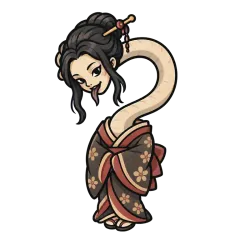
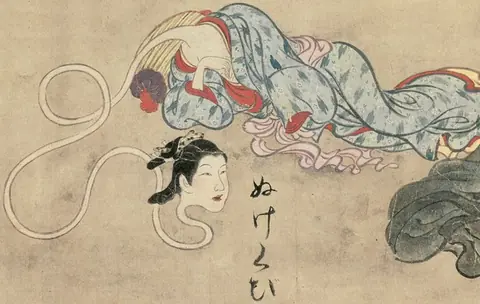
By day a rokurokubi looks like anyone else, and that is the point of her: the tales say she is an ordinary person, usually a woman, whose head behaves strangely only at night [5]. There are two kinds. In one, the neck stretches while she sleeps; in the other, the nukekubi (抜け首), the head comes off and flies about on its own [5]. The flying head is thought to be the older form [5].
Some tellers gave the flying kind a mark. A ring or line round the neck shows where the head comes away [5]. An Edo essay, the Seikai Zokudan, borrowing from Chinese books, says the flying head has a red line on the nape and flies at night using its ears as wings [6]. Hearn's judge in Kwaidan finds "strange red characters" on the nape of a rokurokubi's head [1].
The stretching neck may itself be a drawing that was misread. The head and body of a nukekubi were said to stay joined by a thin spiritual thread, and when artists drew that thread, it looked like a long neck [5].
What does a rokurokubi do?
In most tales a rokurokubi does no harm: her neck stretches while she sleeps, and someone sees it. In an essay of 1789, a family in Tsuruga in Echizen hear their maid groaning late at night, go to see, and find her head climbing a folding screen a foot or two, falling and climbing again [2]. A poet in the Yoshiwara, Edo's pleasure quarter, paid for a woman rumoured to be a rokurokubi and watched her neck stretch a foot as she slept; the master of the house fed him well and asked him to keep quiet [3].
The most famous story is the maid in the Kasshi Yawa, the essays of Matsura Seizan. Her master, hearing she was a rokurokubi, watched her sleep: a vapour rose from her chest, and her neck stretched until her head rested against the transom [4][5]. When she turned over, it was normal again. She was ordinary apart from a pale face, but he dismissed her, and she was sent away from every house she served [5].
The flying heads are another matter. Some tales say they attack people at night and drink blood [5]. In Hearn's "Rokuro-Kubi", a priest who was once a samurai shelters with a woodcutter's family in the mountains of Kai and finds five headless bodies in the night [1]. The heads are outside, eating worms and insects and planning to eat him [1]. He knows from an old book that a head can't rejoin a body that has been moved, so he moves its body [1]. The head flies at him and dies with its teeth in his sleeve [1].
Is the rokurokubi evil?
The stretching-neck rokurokubi is rarely evil: in the Edo essays she is an unlucky person with an odd body or illness, often a maid or a courtesan. Ban Kōkei explained his Yoshiwara woman as someone whose neck skin simply stretched [3]. The writer of the Tsuruga story called it an illness in which the soul leaves the body in sleep and takes the shape of a head [5].
Most stories still end badly for her, because being seen is enough. The maid in the Kasshi Yawa loses place after place [5]. A woman in one Edo collection shaves her head and leaves her husband [5]. Only the flying heads of the older tales, like Hearn's, are clearly out to kill [1].
Where does the rokurokubi come from?
The flying head is said to have come from China, where books describe a flying-head people and a creature called the luotou whose head flies off at night [5]. The Japanese name hitōban (飛頭蛮), "flying-head barbarian", is the Chinese one [5]. Edo essays retold the Chinese details, such as the red line at the nape and the ear-wings [6].
In Japan the flying head was in ghost-story books by the 1660s, in the Sorori Monogatari (1663) and the Shokoku Hyaku Monogatari (1677), and the stretching neck became common in Edo essays later [5][7]. By the Bunka era (1804 to 1818) it was a popular tale, and a long-necked man drew crowds as a rokurokubi at a sideshow in Ueno in 1810 [5]. Some modern writers suggest the tales were made up to satisfy a taste for the strange [5].
The name has several explanations. Rokuro is a pulley, such as the one on a well, which a lengthening neck suggests; others point to the feel of a potter's wheel, or to the slider of an umbrella [5]. Hearn's tale retold the old flying head in English [1][7].
Stories about the rokurokubi

The rokurokubi in Japanese
The name rokurokubi (ろくろ首) joins rokuro, a pulley or a potter's wheel, to 首, the neck. It is often written in kana, and sometimes as 轆轤首, where 轆轤 is the pulley [5]. In Yomimaru, an app for learning Japanese, its words come from the Yomimaru 6k vocabulary deck: to stretch is 伸びる, to sleep is 寝る.
Six words from its tales, and the levels where you learn them:
- 首くびneckLevel 2 · Kasa-obake
- 長いながいlong (distance, length)Level 1 · Kitsune
- 伸びるのびるto stretchLevel 8 · Rokurokubi
- 寝るねるto sleep (lying down)Level 1 · Kitsune
- 夜よるnightLevel 1 · Kitsune
- 女おんなwomanLevel 1 · Kitsune
Yomimaru 6k vocabulary deck words 1,751 to 2,000
These are the 250 Japanese words of level 8. Complete the level in Yomimaru to unlock the Rokurokubi. By JLPT level: 45 N5, 31 N4, 98 N3, 69 N2 and 7 outside the JLPT lists. The easiest come first.
| Rank | Word | Reading | Meaning | JLPT |
|---|---|---|---|---|
| 1,955 | 醤油 | しょうゆ | soy sauce | N5 |
| 1,956 | お手洗い | おてあらい | toilet | N5 |
| 1,957 | グラム | gram | N5 | |
| 1,958 | 角 | かど | corner | N5 |
| 1,959 | はい | yes | N5 | |
| 1,960 | 留学生 | りゅうがくせい | overseas student | N5 |
| 1,961 | 昨夜 | ゆうべ | last night | N5 |
| 1,962 | 会社員 | かいしゃいん | company employee | N5 |
| 1,963 | スリッパ | slipper | N5 | |
| 1,964 | 晩御飯 | ばんごはん | dinner | N5 |
| 1,965 | 八百屋 | やおや | greengrocer | N5 |
| 1,966 | おにぎり | onigiri | N5 | |
| 1,967 | お大事に | おだいじに | take care of yourself | N5 |
| 1,968 | 中 | ちゅう | medium (size) | N5 |
| 1,969 | 方 | かた | direction | N5 |
| 1,970 | 時 | じ | o'clock; hour | N5 |
| 1,971 | 万年筆 | まんねんひつ | fountain pen | N5 |
| 1,972 | 嫌い | きらい | disliked | N5 |
| 1,973 | 九つ | ここのつ | nine | N5 |
| 1,974 | 行ってきます | いってきます | I'm off | N5 |
| 1,975 | 年 | ねん | year | N5 |
| 1,976 | 失礼します | しつれいします | excuse me | N5 |
| 1,977 | 何時 | なんじ | what time | N5 |
| 1,978 | 日 | にち | nth day (of the month); counter for days | N5 |
| 1,979 | 十四 | じゅうよん | fourteen | N5 |
| 1,980 | いただきます | thank you (for the meal just served) | N5 | |
| 1,981 | 何曜日 | なんようび | what day? | N5 |
| 1,982 | ごちそうさま | thank you (for the meal) | N5 | |
| 1,983 | 一昨年 | おととし | year before last | N5 |
| 1,984 | 早く | はやく | early | N5 |
| 1,985 | 四本 | よんほん | four (long cylindrical things) | N5 |
| 1,986 | こちらこそ | it is I who should say so | N5 | |
| 1,987 | ください | please (give me) | N5 | |
| 1,988 | カタカナ | katakana | N5 | |
| 1,989 | いってらっしゃい | have a good day | N5 | |
| 1,990 | 大勢 | おおぜい | crowd of people | N5 |
| 1,992 | じゃあね | see you | N5 | |
| 1,993 | Tシャツ | ティーシャツ | T-shirt | N5 |
| 1,994 | 土 | つち | earth | N5 |
| 1,995 | ひらがな | hiragana | N5 | |
| 1,996 | 再来年 | さらいねん | year after next | N5 |
| 1,997 | キログラム | kilogram | N5 | |
| 1,998 | またね | bye | N5 | |
| 1,999 | キロメートル | kilometer | N5 | |
| 2,000 | シャープペンシル | mechanical pencil | N5 | |
| 1,766 | お金持ち | おかねもち | rich person | N4 |
| 1,782 | 祈る | いのる | to pray | N4 |
| 1,792 | 光る | ひかる | to shine | N4 |
| 1,802 | それでは | well, ... | N4 | |
| 1,811 | 都合 | つごう | circumstances | N4 |
| 1,829 | エンジン | engine | N4 | |
| 1,830 | ゴミ | rubbish | N4 | |
| 1,832 | 厚い | あつい | thick | N4 |
| 1,845 | ガス | gas (as a fuel) | N4 | |
| 1,846 | 真ん中 | まんなか | middle | N4 |
| 1,847 | 回 | かい | counter for occurrences | N4 |
| 1,848 | 世話 | せわ | care | N4 |
| 1,850 | 間 | あいだ | space (between) | N4 |
| 1,851 | いらっしゃる | to come | N4 | |
| 1,853 | 太る | ふとる | to put on weight | N4 |
| 1,859 | 丁寧 | ていねい | polite | N4 |
| 1,860 | 両 | りょう | both (hands, parents, sides, etc.) | N4 |
| 1,869 | 舌 | した | tongue | N4 |
| 1,872 | お客様 | おきゃくさま | guest | N4 |
| 1,879 | 湖 | みずうみ | lake | N4 |
| 1,882 | 巻く | まく | to wind | N4 |
| 1,896 | 景色 | けしき | scenery | N4 |
| 1,900 | 社長 | しゃちょう | company president | N4 |
| 1,910 | 米 | こめ | (husked grains of) rice | N4 |
| 1,921 | 割れる | われる | to break | N4 |
| 1,925 | 出席 | しゅっせき | attendance | N4 |
| 1,931 | 泥棒 | どろぼう | thief | N4 |
| 1,939 | 眠い | ねむい | sleepy | N4 |
| 1,949 | 一度 | いちど | once | N4 |
| 1,952 | 先に | さきに | previously | N4 |
| 1,954 | 連れる | つれる | to take (someone) with one | N4 |
| 1,752 | 仲 | なか | relation | N3 |
| 1,755 | せっかく | with trouble | N3 | |
| 1,759 | 翌日 | よくじつ | next day | N3 |
| 1,761 | 混乱 | こんらん | disorder | N3 |
| 1,764 | 稼ぐ | かせぐ | to earn (income) | N3 |
| 1,765 | 販売 | はんばい | sale | N3 |
| 1,767 | 替える | かえる | to replace | N3 |
| 1,768 | 似合う | にあう | to suit | N3 |
| 1,769 | 許可 | きょか | permission | N3 |
| 1,771 | スピード | speed | N3 | |
| 1,772 | だいぶ | considerably | N3 | |
| 1,774 | 作品 | さくひん | work (e.g. book, film, painting, composition) | N3 |
| 1,775 | 向ける | むける | to turn (towards) | N3 |
| 1,781 | 笑顔 | えがお | smiling face | N3 |
| 1,784 | 作家 | さっか | author | N3 |
| 1,786 | 沈む | しずむ | to sink | N3 |
| 1,788 | 運 | うん | fortune | N3 |
| 1,790 | 人類 | じんるい | mankind | N3 |
| 1,791 | 振り返る | ふりかえる | to turn one's head | N3 |
| 1,795 | 集中 | しゅうちゅう | concentration (on a task) | N3 |
| 1,797 | 書類 | しょるい | document | N3 |
| 1,799 | 大統領 | だいとうりょう | president (of a country) | N3 |
| 1,800 | 市場 | しじょう | market (financial, stock, domestic, etc.) | N3 |
| 1,801 | 義務 | ぎむ | duty | N3 |
| 1,803 | 好み | このみ | liking | N3 |
| 1,807 | 連続 | れんぞく | continuation | N3 |
| 1,808 | エネルギー | energy | N3 | |
| 1,809 | 男女 | だんじょ | men and women | N3 |
| 1,810 | 製 | せい | make | N3 |
| 1,813 | 隅 | すみ | corner | N3 |
| 1,816 | 列 | れつ | row | N3 |
| 1,819 | 数える | かぞえる | to count | N3 |
| 1,820 | 苦しい | くるしい | painful | N3 |
| 1,827 | 地面 | じめん | ground | N3 |
| 1,835 | システム | system | N3 | |
| 1,836 | あんなに | to that extent | N3 | |
| 1,838 | 思わず | おもわず | unconsciously | N3 |
| 1,839 | 平気 | へいき | cool | N3 |
| 1,840 | 賛成 | さんせい | approval | N3 |
| 1,842 | 棒 | ぼう | pole | N3 |
| 1,843 | 大いに | おおいに | very | N3 |
| 1,849 | 訓練 | くんれん | training | N3 |
| 1,854 | 利益 | りえき | profit | N3 |
| 1,855 | 帰宅 | きたく | returning home | N3 |
| 1,857 | 飛ばす | とばす | to let fly | N3 |
| 1,862 | 独立 | どくりつ | independence | N3 |
| 1,863 | 次々 | つぎつぎ | in succession | N3 |
| 1,864 | なんだか | (a) little | N3 | |
| 1,866 | そっくり | all | N3 | |
| 1,870 | 頬 | ほお | cheek (of the face) | N3 |
| 1,871 | 刺す | さす | to pierce | N3 |
| 1,873 | 下す | くだす | to make a decision | N3 |
| 1,876 | 長年 | ながねん | many years | N3 |
| 1,878 | クラブ | club | N3 | |
| 1,880 | 飛び出す | とびだす | to jump out | N3 |
| 1,881 | 仲良く | なかよく | on good terms (with) | N3 |
| 1,883 | 基本 | きほん | basics | N3 |
| 1,884 | 商品 | しょうひん | commodity | N3 |
| 1,885 | 弁護士 | べんごし | lawyer | N3 |
| 1,887 | 一瞬 | いっしゅん | instant | N3 |
| 1,888 | 大会 | たいかい | mass meeting | N3 |
| 1,889 | 賢い | かしこい | wise | N3 |
| 1,890 | 済ませる | すませる | to finish | N3 |
| 1,892 | 移る | うつる | to move (house) | N3 |
| 1,894 | 医師 | いし | doctor | N3 |
| 1,895 | 女子 | じょし | woman | N3 |
| 1,897 | 組 | くみ | class (of students) | N3 |
| 1,898 | 疲れ | つかれ | tiredness | N3 |
| 1,899 | ルール | rule | N3 | |
| 1,903 | 煙 | けむり | smoke | N3 |
| 1,905 | あちこち | here and there | N3 | |
| 1,906 | 板 | いた | board | N3 |
| 1,907 | 加わる | くわわる | to be added to | N3 |
| 1,909 | 関連 | かんれん | relation | N3 |
| 1,911 | 餌 | えさ | (animal) feed | N3 |
| 1,912 | 立ち上がる | たちあがる | to stand up | N3 |
| 1,913 | 今頃 | いまごろ | about this time | N3 |
| 1,914 | 実に | じつに | indeed | N3 |
| 1,915 | 怪しい | あやしい | suspicious | N3 |
| 1,916 | わざと | on purpose | N3 | |
| 1,919 | 時刻 | じこく | time | N3 |
| 1,920 | 釣り | つり | fishing | N3 |
| 1,923 | こいつ | he | N3 | |
| 1,924 | 伸びる | のびる | to stretch | N3 |
| 1,926 | 積む | つむ | to pile up | N3 |
| 1,927 | 観光 | かんこう | sightseeing | N3 |
| 1,928 | 賞 | しょう | prize | N3 |
| 1,929 | 植物 | しょくぶつ | plant | N3 |
| 1,930 | 知れる | しれる | to become known | N3 |
| 1,932 | 苦手 | にがて | poor (at) | N3 |
| 1,934 | がっかり | to be disappointed | N3 | |
| 1,937 | または | or | N3 | |
| 1,940 | 皮 | かわ | skin | N3 |
| 1,945 | 香り | かおり | aroma | N3 |
| 1,947 | 制服 | せいふく | uniform | N3 |
| 1,948 | 用事 | ようじ | business | N3 |
| 1,953 | 沸かす | わかす | to boil | N3 |
| 1,991 | 虹 | にじ | rainbow | N3 |
| 1,753 | 指示 | しじ | indication | N2 |
| 1,754 | 心臓 | しんぞう | heart | N2 |
| 1,756 | 作業 | さぎょう | work | N2 |
| 1,757 | 天 | てん | sky | N2 |
| 1,758 | 資格 | しかく | qualifications | N2 |
| 1,760 | ばら | rose | N2 | |
| 1,762 | 深刻 | しんこく | serious | N2 |
| 1,763 | 妙 | みょう | strange | N2 |
| 1,770 | 永遠 | えいえん | eternity | N2 |
| 1,776 | 誤解 | ごかい | misunderstanding | N2 |
| 1,777 | 全力 | ぜんりょく | all one's power (strength, energy, efforts) | N2 |
| 1,778 | 必死 | ひっし | frantic | N2 |
| 1,779 | 地位 | ちい | (social) position | N2 |
| 1,780 | 滞在 | たいざい | stay | N2 |
| 1,783 | 何とも | なんとも | really | N2 |
| 1,785 | 闇 | やみ | darkness | N2 |
| 1,787 | 生える | はえる | to grow | N2 |
| 1,789 | 世 | よ | world | N2 |
| 1,793 | 目立つ | めだつ | to be conspicuous | N2 |
| 1,794 | 契約 | けいやく | contract | N2 |
| 1,796 | 同意 | どうい | agreement | N2 |
| 1,798 | いったん | once | N2 | |
| 1,804 | 奇妙 | きみょう | strange | N2 |
| 1,805 | 維持 | いじ | maintenance | N2 |
| 1,806 | 保護 | ほご | protection | N2 |
| 1,812 | 懐かしい | なつかしい | dear (old) | N2 |
| 1,814 | 費用 | ひよう | cost | N2 |
| 1,815 | 巻き込む | まきこむ | to roll up | N2 |
| 1,817 | 広げる | ひろげる | to spread | N2 |
| 1,818 | 主義 | しゅぎ | doctrine | N2 |
| 1,821 | 今や | いまや | now (esp. in contrast to the past) | N2 |
| 1,822 | 命じる | めいじる | to order | N2 |
| 1,824 | 批判 | ひはん | criticism | N2 |
| 1,825 | 相変わらず | あいかわらず | as usual | N2 |
| 1,826 | 職 | しょく | job | N2 |
| 1,828 | 非難 | ひなん | criticism | N2 |
| 1,831 | 印象 | いんしょう | impression | N2 |
| 1,833 | 意志 | いし | will | N2 |
| 1,834 | 速度 | そくど | speed | N2 |
| 1,837 | いかに | how | N2 | |
| 1,841 | 解釈 | かいしゃく | interpretation | N2 |
| 1,852 | 分析 | ぶんせき | analysis | N2 |
| 1,856 | 範囲 | はんい | extent | N2 |
| 1,858 | 操作 | そうさ | operation | N2 |
| 1,861 | 経営 | けいえい | management | N2 |
| 1,865 | 傾向 | けいこう | tendency | N2 |
| 1,867 | 依頼 | いらい | request | N2 |
| 1,868 | 跡 | あと | trace | N2 |
| 1,874 | 増やす | ふやす | to increase | N2 |
| 1,875 | 重大 | じゅうだい | serious | N2 |
| 1,877 | 追いかける | おいかける | to chase | N2 |
| 1,886 | 神経 | しんけい | nerve | N2 |
| 1,891 | 霧 | きり | fog | N2 |
| 1,893 | 何事 | なにごと | what | N2 |
| 1,901 | 末 | すえ | end | N2 |
| 1,902 | 本来 | ほんらい | originally | N2 |
| 1,904 | 単に | たんに | simply | N2 |
| 1,908 | およそ | about | N2 | |
| 1,917 | 死亡 | しぼう | death | N2 |
| 1,922 | 特徴 | とくちょう | feature | N2 |
| 1,933 | 冷静 | れいせい | calmness | N2 |
| 1,935 | ものすごい | terrific | N2 | |
| 1,936 | 悪魔 | あくま | devil | N2 |
| 1,938 | 及び | および | and | N2 |
| 1,941 | 安定 | あんてい | stability | N2 |
| 1,942 | 放つ | はなつ | to fire (gun, arrow, questions, etc.) | N2 |
| 1,943 | 陥る | おちいる | to fall into (e.g. a hole) | N2 |
| 1,944 | 世紀 | せいき | century | N2 |
| 1,946 | すなわち | that is (to say) | N2 | |
| 1,751 | そうした | such | ||
| 1,773 | 支援 | しえん | support | |
| 1,823 | 数日 | すうじつ | few days | |
| 1,844 | 大量 | たいりょう | large quantity | |
| 1,918 | イギリス | United Kingdom | ||
| 1,950 | 着替える | きがえる | to change (one's clothes) | |
| 1,951 | 風邪をひく | かぜをひく | to catch a cold |
Sources
- Classic textLafcadio Hearn, "Rokuro-Kubi", in Kwaidan (1904), Project Gutenberg
- Archive recordNichibunken yokai database, card 3680007, 轆轤首, from Tachibana Nankei, Hokusō Satan, in Nihon Zuihitsu Taisei (1974 edition)
- Archive recordNichibunken yokai database, card 3170028, 轆轤首, from Ban Kōkei, Kanden Kōhitsu, in Nihon Zuihitsu Taisei (1976 edition)
- Archive recordNichibunken yokai database, card 0700550, 轆轤首, from Maesaka Hideki, "轆轤首考", Kinki Minzoku (2001)
- EncyclopediaJapanese Wikipedia, "ろくろ首"
- Archive recordNichibunken yokai database, card 3200012, 飛頭蛮, from Ōde Tōka, Seikai Zokudan, in Nihon Zuihitsu Taisei (1976 edition)
- EncyclopediaEnglish Wikipedia, "Rokurokubi"
- EncyclopediaJapanese Wikipedia, "百怪図巻" (Sawaki Sūshi's scroll, 1737, Fukuoka City Museum)
The art on this page was drawn for Yomimaru.
Questions
What does a rokurokubi do?
In most Edo tales she does nothing worse than frighten whoever sees her neck stretch while she sleeps, and she often doesn't know it happens. The older flying-head kind is more dangerous: in Lafcadio Hearn's tale the heads hunt travellers. See what a rokurokubi does.
Is a rokurokubi a ghost or a living person?
A living person. Edo writers treated it as an illness or an odd body: one called it a soul that leaves the body in sleep, another a woman whose neck skin could stretch. See whether the rokurokubi is evil.
What is the difference between a rokurokubi and a nukekubi?
Both are called rokurokubi. The nukekubi's head comes right off and flies, while the better known kind keeps its head joined by a stretching neck. The flying head is thought to be the older form. See what a rokurokubi looks like.