
Vocabulary
How your Japanese vocabulary grows in Yomimaru
Yomimaru teaches new Japanese words in short daily lessons and brings each one back in spaced-repetition reviews, with six Lantern tiers that show how long you remember it. A word counts as learned once it holds for a week (Glow). The words you learn show up in what you read: learned words lose their furigana in stories and news, and count toward each JLPT level.
By Maxime Pitaval. Updated . 13 min read.
On this page
Where do your words come from?
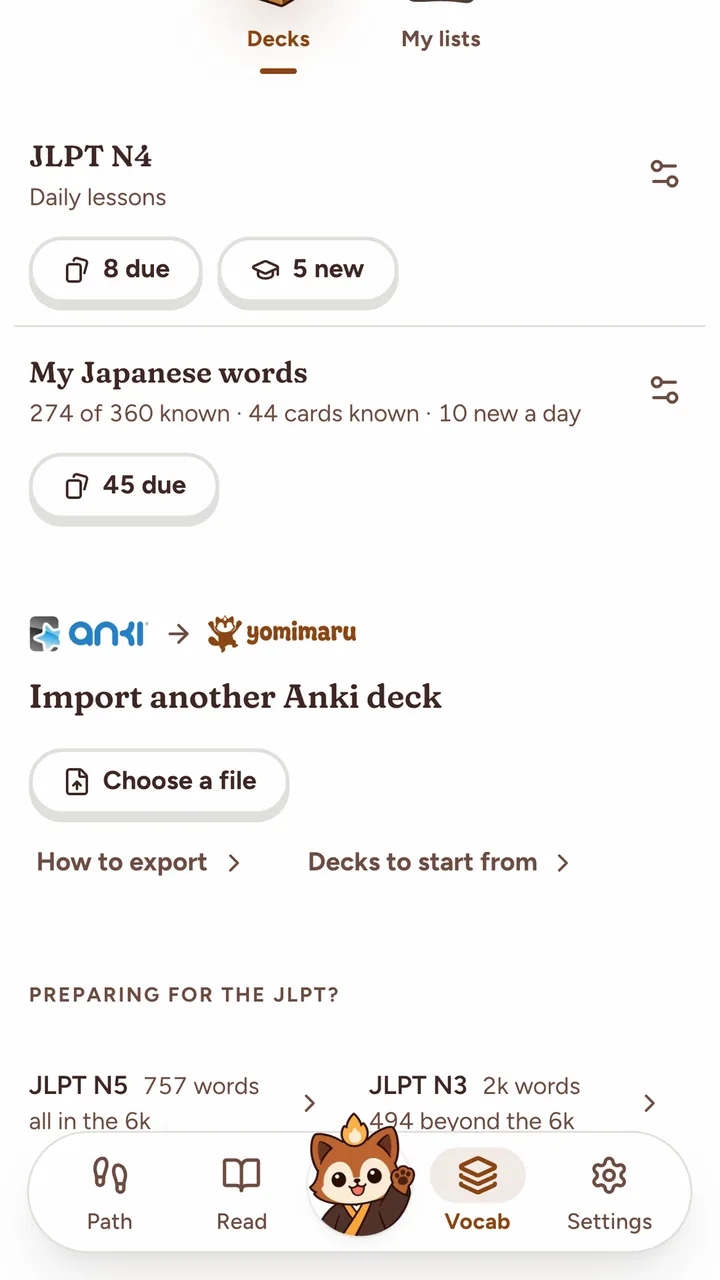
Yomimaru teaches new words from the decks you hold: the Yomimaru 6k, which every learner holds, and any JLPT decks, Anki decks or starred words you add beside it.
- The Yomimaru 6k: 6,000 words in 24 levels of 250, ranked with frequency lists, the most common first (what the 6k is).
- A JLPT deck for each level from N5 to N1 (the table below).
- Your Anki decks, with their review history (how to import Anki decks).
- The words you star in the reader, and your study lists (study lists need a paid plan).
- Your first words from Yomikana, Yomimaru's kana course, which stay in your reviews.
| Deck | Words | Not in the 6k |
|---|---|---|
| JLPT N5 | Words: 757 | Not in the 6k: 0 |
| JLPT N4 | Words: 772 | Not in the 6k: 0 |
| JLPT N3 | Words: 2,000 | Not in the 6k: 494 |
| JLPT N2 | Words: 2,000 | Not in the 6k: 202 |
| JLPT N1 | Words: 2,500 | Not in the 6k: 1,867 |
Looking a word up while reading doesn't add it to your reviews; starring it does, through your lessons. A 6k word you look up does move forward in your lessons, so the words you meet in your reading come sooner (which words get reviewed).
What are Yomimaru's Lantern tiers?
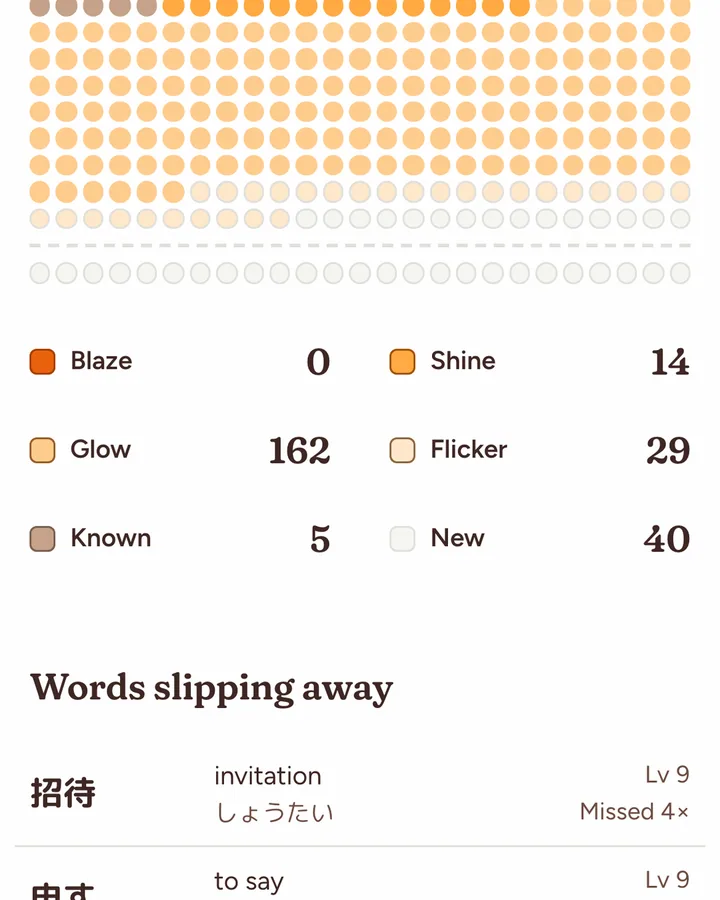
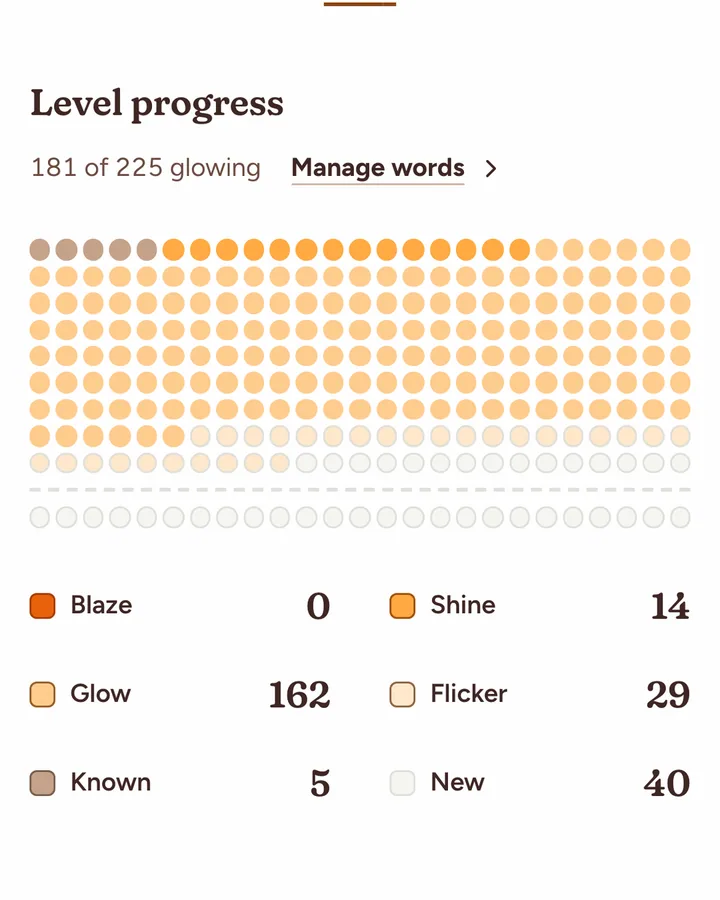
Six Lantern tiers show how long you remember a word in Yomimaru: New, Flicker, Glow, Shine, Blaze and Known. A word counts as learned once it holds for a week (Glow).
| Tier | What it means | Learned |
|---|---|---|
| New | What it means: Not studied yet. | Learned: No |
| Flicker 火 | What it means: In review. Your memory of it holds under a week. | Learned: No |
| Glow 灯 | What it means: Your memory of it holds a week or more. | Learned: Yes |
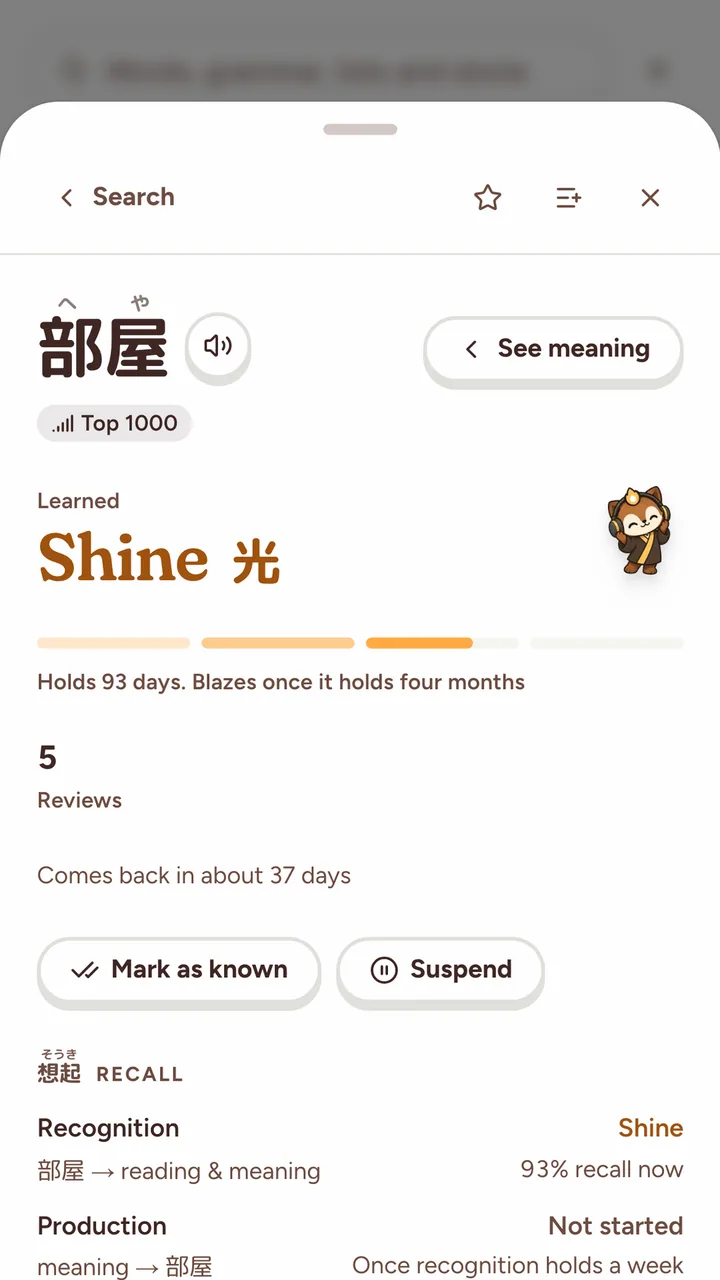
| Shine 光 | What it means: Your memory of it holds a month or more. | Learned: Yes |
| Blaze 炎 | What it means: Your memory of it holds four months or more. | Learned: Yes |
| Known | What it means: You marked it known. It leaves your reviews. | Learned: Yes |
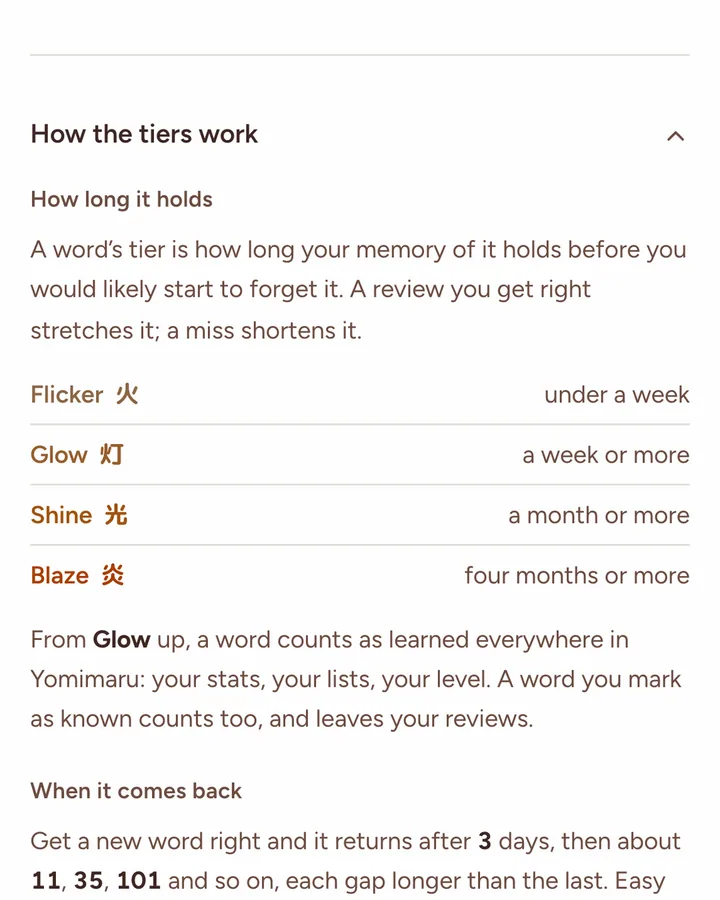
The app's explainer, "How the tiers work", puts it this way: "A word's tier is how long your memory of it holds before you would likely start to forget it. A review you get right stretches it; a miss shortens it." Yomimaru estimates that time for each word from your answers (how Yomimaru schedules reviews).
- Flicker 火Under 7 daysStill learning
- Glow 灯7 to 30 daysLearned
- Shine 光30 to 120 daysLearned
- Blaze 炎120 days or moreLearned
Glow is the line that counts. "From Glow up, a word counts as learned everywhere in Yomimaru: your stats, your lists, your level." With adaptive furigana, the reader's default, a word's reading disappears from what you read once it reaches Glow.
How does a new word become learned?
In Yomimaru, a new word is taught in a lesson and comes back for its first review the next day. Answer Good at each review after that and the word reaches Glow, and counts as learned, at its second review.
Each Good answer stretches the next gap. After a lesson the gaps run about 1, 3, 9, 25 and 64 days, and no gap goes past 365 days. A word that starts without a lesson follows a different ladder of gaps.
- Today
- Day 11 day later
- Day 43 days later
- Day 139 days later
- Day 3825 days later
- Day 10264 days later
Shine comes once a word holds for a month, and Blaze at four months. From Glow, Yomimaru can also ask a word the other way round, from its meaning to the Japanese. On a deck that practises both ways, a word climbs past Glow only as both directions hold (two cards per word).
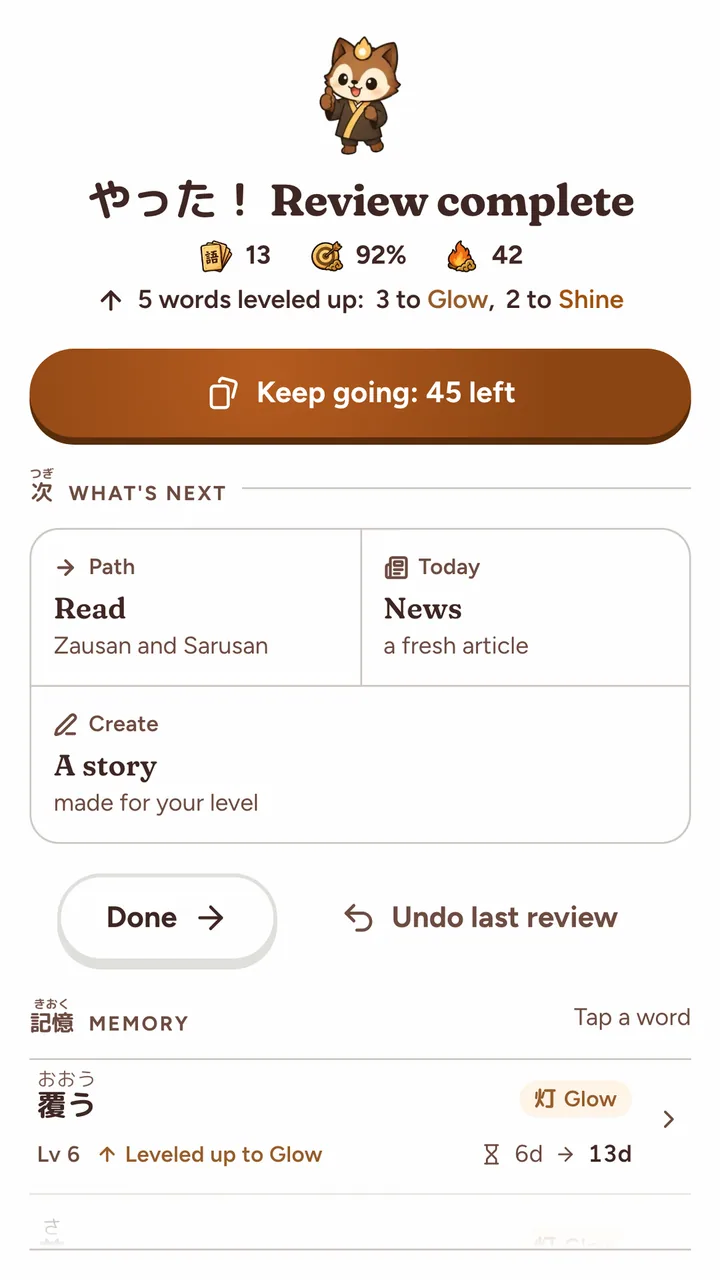
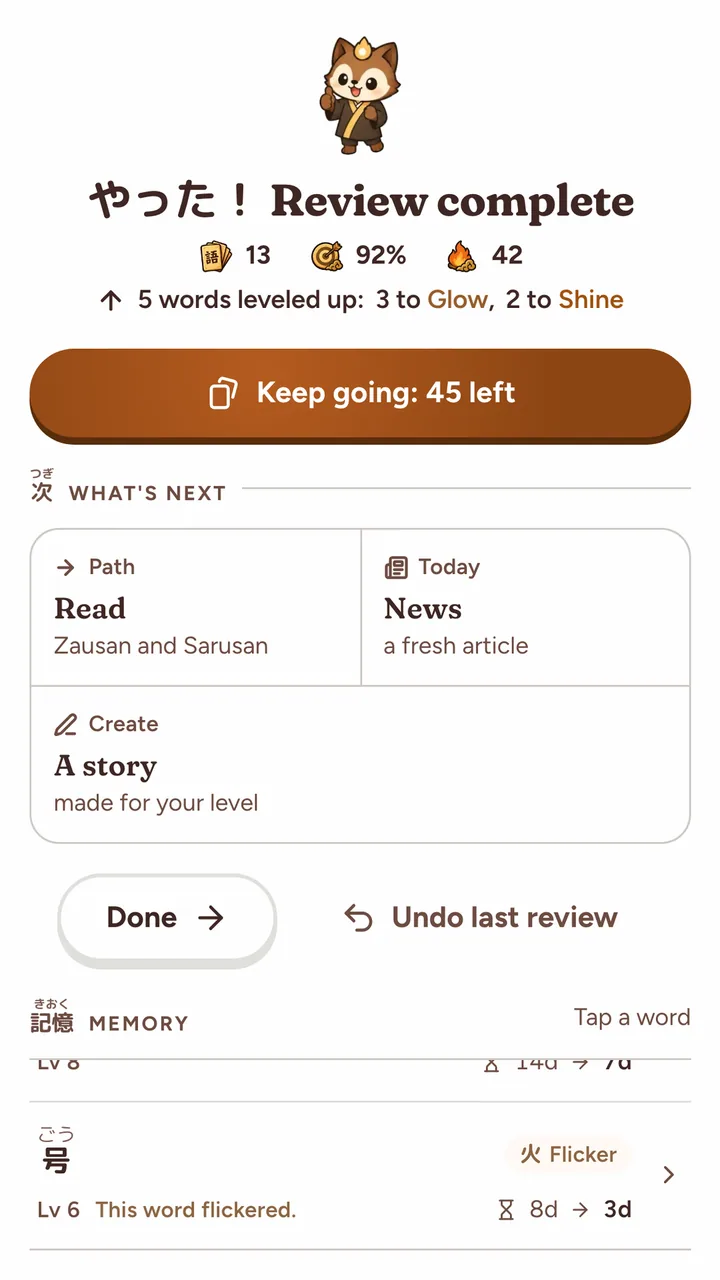
A miss brings the word back in the same sitting and the next day, and shortens how long Yomimaru expects you to remember it. A Glow word can drop back to Flicker, and the recap says "This word flickered."
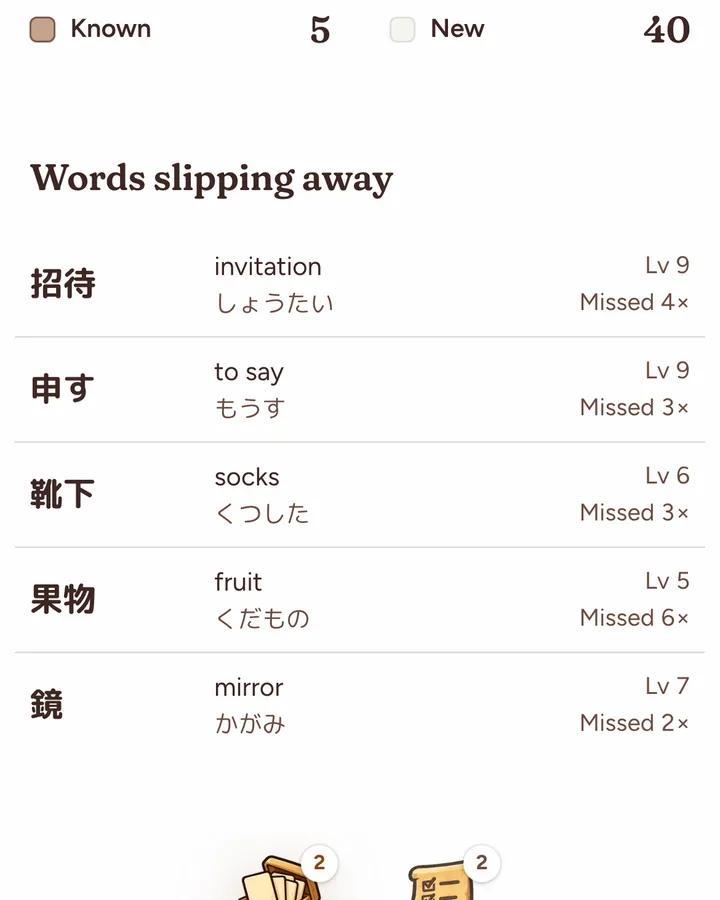
A word you keep missing shows up in two places:
- "Words slipping away", on your vocabulary page, lists the words you missed in the last 30 days that are still Flicker, or that you get right less than 75% of the time over at least 3 reviews. Only a card's first answer of the day counts, not a retry in the same sitting or a lesson's quiz.
- After 8 misses in one direction, the word's review card shows "Keeps slipping" and offers to suspend it. Nothing is suspended unless you choose to. Anki calls such a word a leech, with the same default threshold (leeches in the Anki manual).
Known and Suspend both take a word out of your reviews. A known word counts as learned. A suspended word keeps the tier it had, so a suspended Glow word still counts as learned and a suspended Flicker word does not.
How do lessons bring in new words?
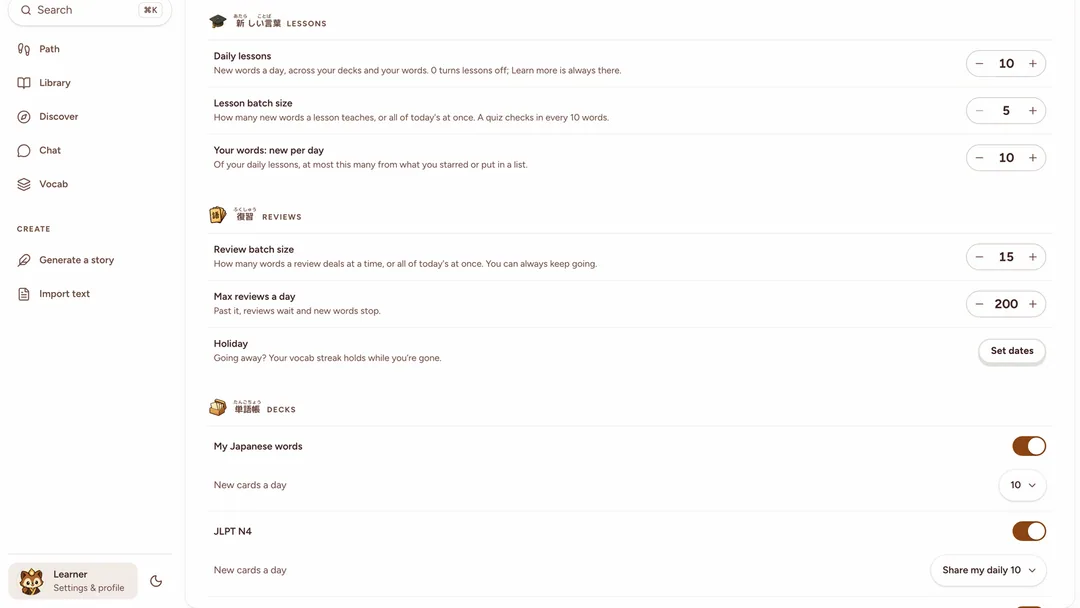
Yomimaru teaches 15 new words a day by default, in lessons of 5 words: a teach card for each word, then a short quiz. Under Settings › Vocab, "Daily lessons" goes from 0 to 100, and "Lesson batch size" can be 5, 10, 15, 20 or all. A 6k word you looked up while reading comes first, up to half of the day's new 6k words.
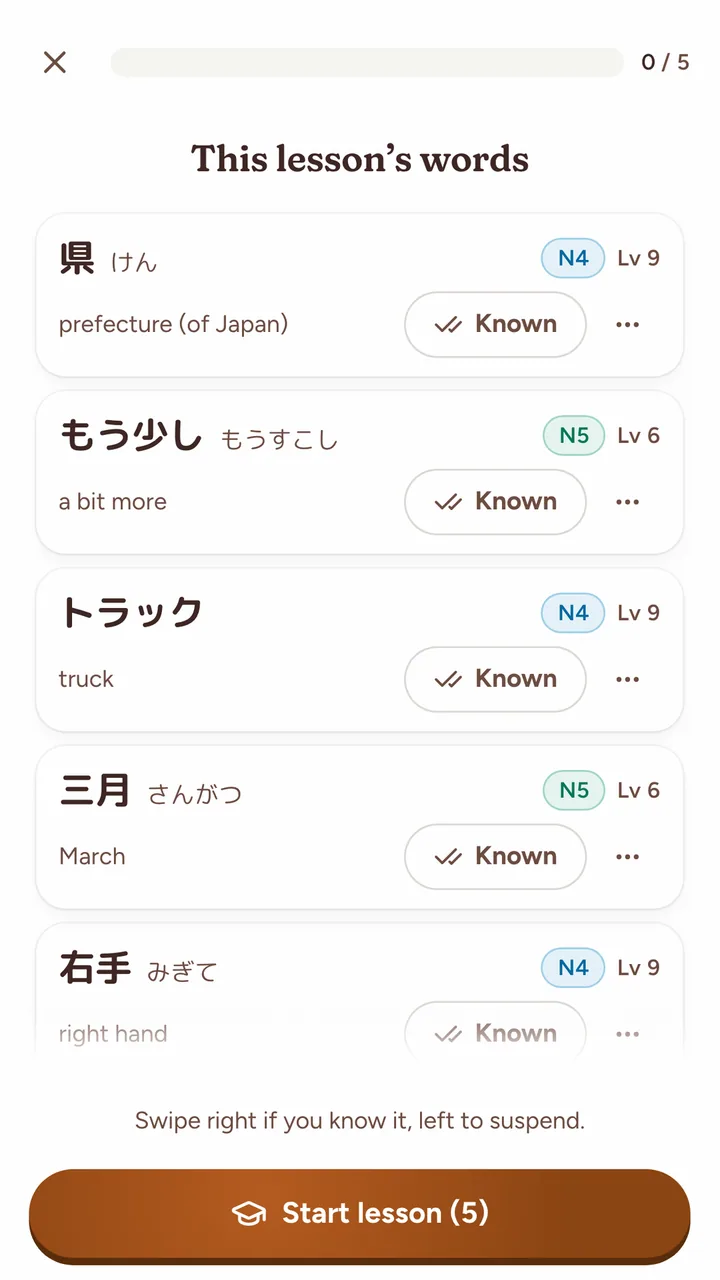
Every lesson opens on a lineup of its words. "Know one already? Mark it and a new word takes its place." On a phone, swipe a word right to mark it known, or left to suspend it.
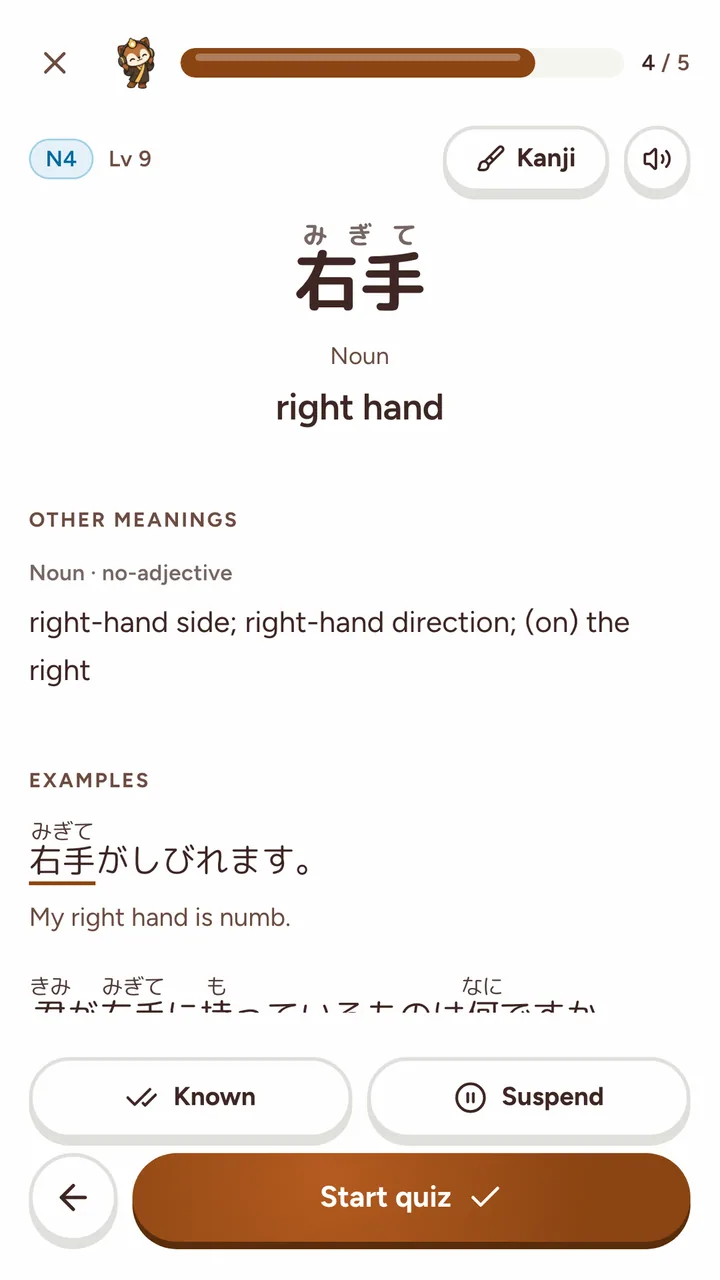
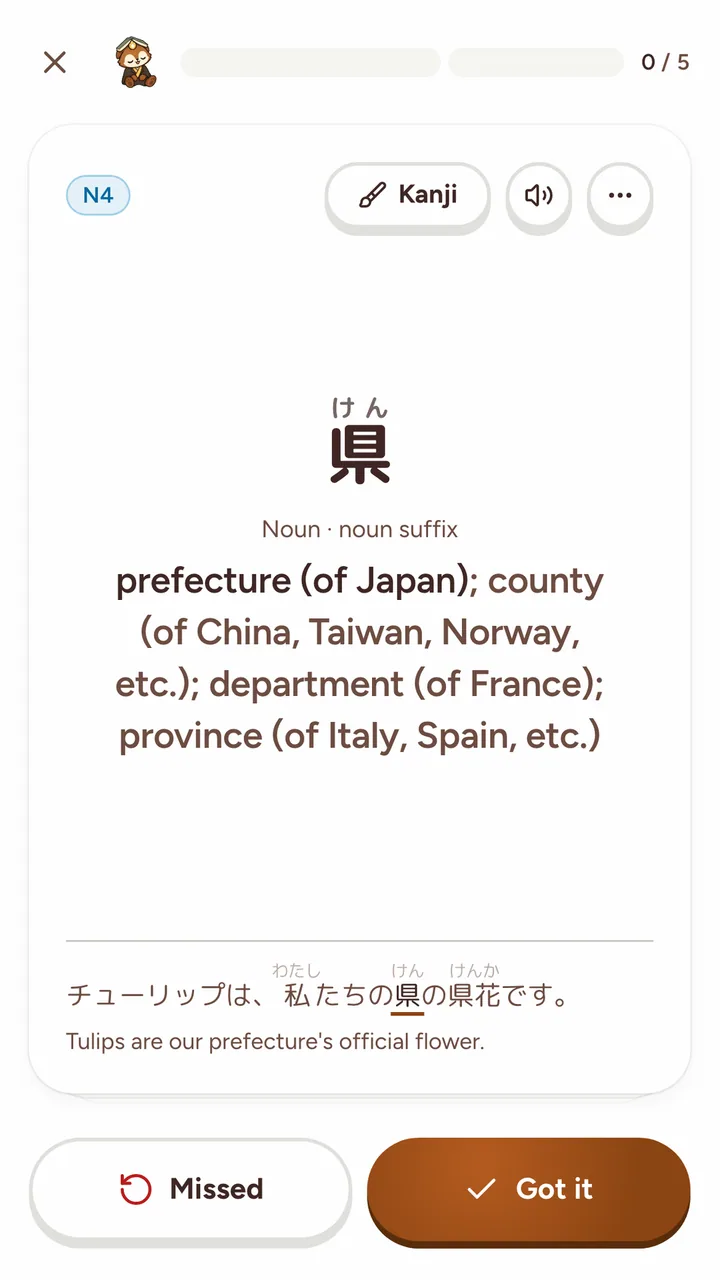
Each teach card shows the word's main meaning, then "Other meanings" and "Examples", sentences where you can tap any word as in the reader. The quiz then asks each word's meaning, and you answer "Got it" or "Missed". A missed word comes back in the quiz until you get it, and either answer brings the word back for its first review the next day. In a longer lesson, "A quiz checks in every 10 words."
When today's lessons are done, "Learn N more" teaches extra words. New words share "Max reviews a day" with your reviews: "Past it, reviews wait and new words stop." Your vocabulary page then says how many new words wait, and "Learn anyway" goes ahead.
When several decks teach, they take turns, each up to the "New cards a day" in its own settings. An imported Anki deck teaches new words only with "Teach new words first" turned on.
What is the Yomimaru 6k?
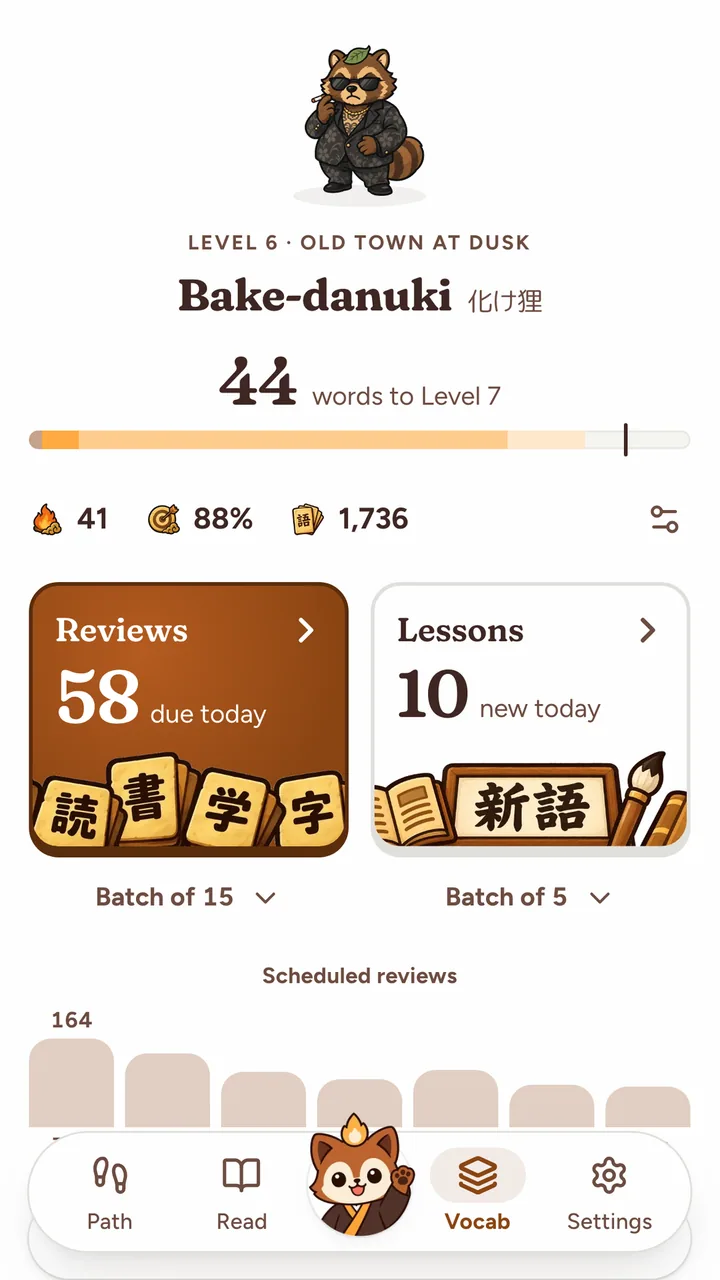
The Yomimaru 6k is 6,000 Japanese words in 24 levels of 250, ranked by how often Japanese uses them, with your starting level set by your JLPT level. It is Yomimaru's own list, not the Core 6k deck.
Yomimaru ranks the words with frequency lists, and lessons teach the 6k in that order, the most common first. The rank blends four sources: Jiten's frequency list of anime, drama, novels and visual novels (40%), wordfreq's list of subtitles, web pages and Wikipedia (30%), the Tatoeba sentences that use the word (20%), and Yomimaru's own stories and news pages (10%). Levels 1 to 4 hold the first 1,000 words, the ones you will meet most.
Each level has its own yokai, a creature from Japanese folklore, and the levels sit in 6 realms along one road:
| Realm | Levels | Words |
|---|---|---|
| Shrine in spring | Levels: 1 to 4 | Words: 1 to 1,000 |
| Old town at dusk | Levels: 5 to 8 | Words: 1,001 to 2,000 |
| Rice terraces in the rain | Levels: 9 to 11 | Words: 2,001 to 2,750 |
| Peaks above the clouds | Levels: 12 to 14 | Words: 2,751 to 3,500 |
| Autumn forest | Levels: 15 to 19 | Words: 3,501 to 4,750 |
| Winter night | Levels: 20 to 24 | Words: 4,751 to 6,000 |
A level passes once 225 of its 250 words are learned (90%), and it stays passed. Known words count, and so do words you learned in Anki or through a sync. Your level is the first one you haven't passed: lessons teach new 6k words up to its end, then offer "Learn ahead" for the next level's words.
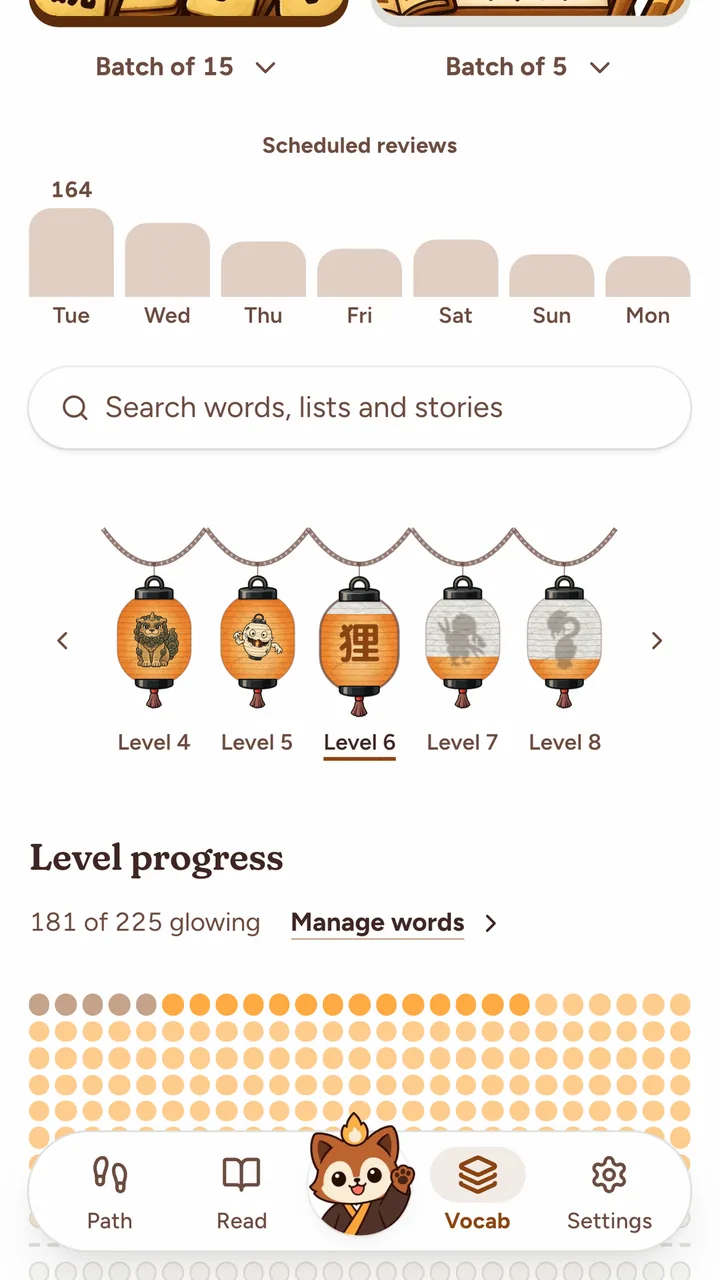
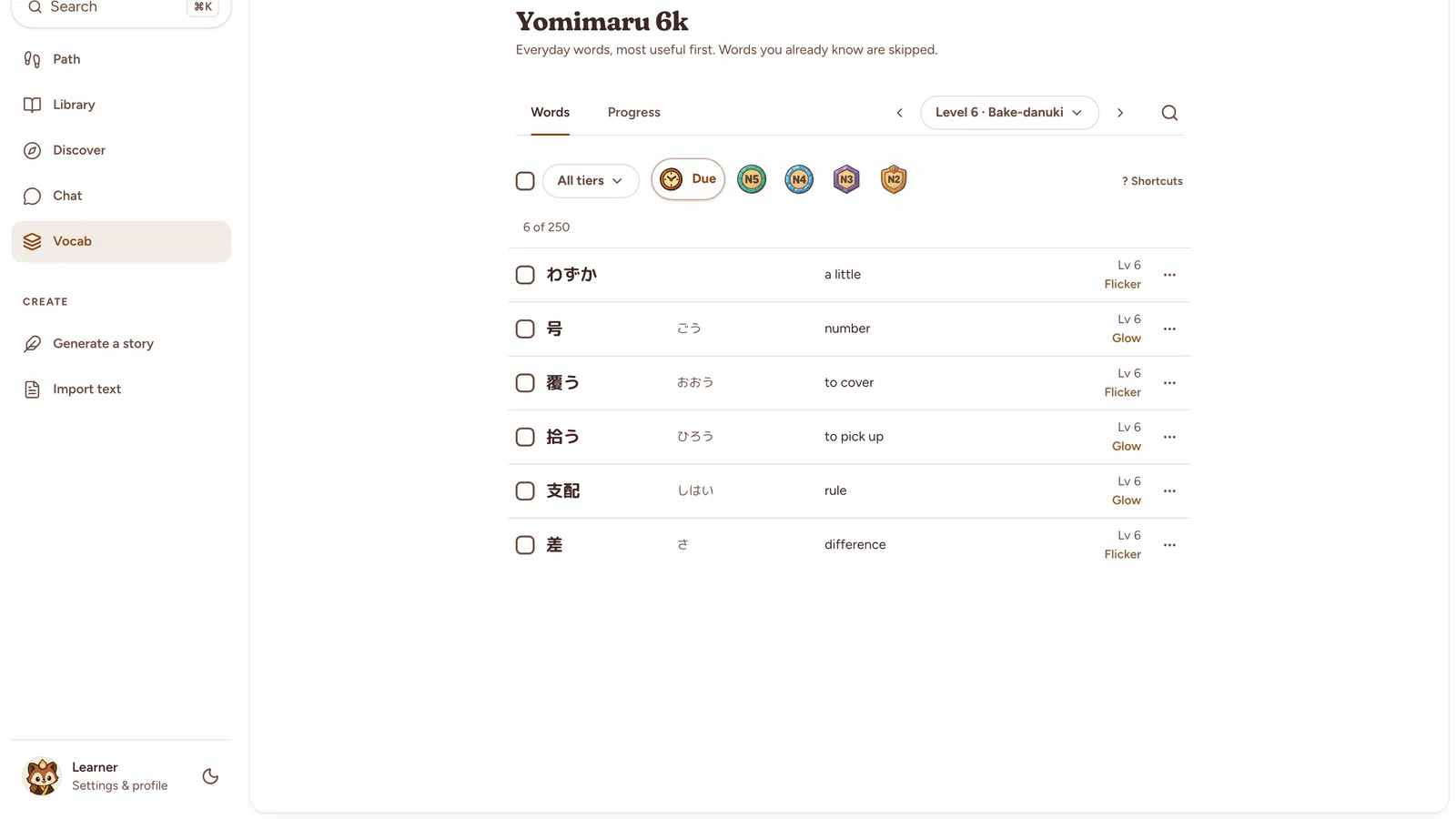
Every level's yokai has its own page: meet the yokai of the 6k.
The 250 words of level 1 are on the page of level 1's yokai.
Where do you start on the 6k?
Yomimaru starts you on the 6k at your JLPT level, not at level 1. Above beginner, every 6k word of the JLPT levels below yours counts as known from the start, and so do the most common 10% of your own level's 6k words.
| Your JLPT level | You start at |
|---|---|
| N5 | You start at: Level 1 |
| N4 | You start at: Level 2 |
| N3 | You start at: Level 4 |
| N2 | You start at: Level 8 |
| N1 | You start at: Level 11 |
Your level comes from sign-up, where you start as a beginner, pick your JLPT level, or take the level check. Change it later in Settings and Yomimaru places your words again. The levels those words fill count as passed, and their yokai show on the road as already met.
Your own learned words can fill in more. When Yomimaru places you, a level where you have studied at least 100 words, with at least 95% of them learned, also counts its other words as known when they are written in kana only or with kanji you already know.
A placed word is a guess, so Yomimaru takes it back as soon as you show you don't know it. Look it up while reading, mark it "Not known", or reset it, and it becomes New, ready for a lesson.
The JLPT index pages list each level's words and kanji: the N5 vocabulary and kanji, the N4 vocabulary and kanji, the N3 vocabulary and kanji, the N2 vocabulary and kanji and the N1 vocabulary and kanji.
Can you skip words you already know?
Yomimaru lets you skip the words you already know, so your lessons go to the words you want to learn. Mark any word as known, and words you have learned in Anki, WaniKani, MaruMori or Renshuu count as learned here too, so your lessons skip them and they fill your 6k levels.
- Mark it known: on a phone it takes one swipe. Swipe a word right in a lesson's lineup or on a deck's page. You can also use the word's card ("Mark as known"), the K key in a review, or select several at once on a deck's page.
- Import from Anki: Yomimaru imports Anki decks with their review history (.apkg or .colpkg). Vocabulary and almost every other card come over, nothing changes in Anki, and you can undo the import for 30 days. Words you've learned in Anki count as learned, because each word keeps the tier its history gives it (how to import your Anki decks).
- Connect a sync: the WaniKani, MaruMori and Renshuu syncs show words learned there as learned, and never schedule reviews here.
Bring your Anki progress, not its reviews
Your Anki progress counts in Yomimaru even if you don't want to study that deck here. Import it, and every word you learned in Anki counts as learned from the start: it loses its furigana in what you read, counts toward its JLPT level and fills your 6k levels.
To keep the progress and drop the reviews, open the deck's page, filter it to "Learned", select all and choose Suspend. A suspended word keeps its tier, so it still counts as learned, and it stops coming back for reviews. "A word's state is the same in every deck", so the 6k won't bring it back either until you unsuspend it.
If you use WaniKani
Yomimaru reads each WaniKani stage as the interval WaniKani gives it. Guru I and Guru II (a week and two weeks) show as Glow, Master (a month) as Shine, and Enlightened and Burned as Blaze, so a word at Guru or above counts as learned in Yomimaru. MaruMori works the same way.
What carries over: your WaniKani vocabulary and kanji, which fill your 6k levels and your stats. Their furigana disappear once they pass a WaniKani stage you choose in Yomimaru's WaniKani settings. What differs: your WaniKani reviews stay in WaniKani, because the sync never schedules a review in Yomimaru, and a word you study in Yomimaru follows Yomimaru's own schedule.
If you use Renshuu
Yomimaru's Renshuu sync reads the mastery Renshuu shows for each word and kanji you study there. At 50% mastery or more, a word counts as learned in Yomimaru, and fills your 6k levels and your stats. The sync also brings your Renshuu grammar progress, which places your grammar level. It runs on its own every 3 days, and "Sync now" in Yomimaru's Renshuu settings runs it at once.
Furigana disappear once a word reaches a Renshuu stage you choose in the same settings. With "Add words I star to Renshuu" on, a word you star in Yomimaru goes to your Renshuu list too, and nothing is ever removed there. Your Renshuu reviews stay in Renshuu: like WaniKani's, the sync never schedules a review in Yomimaru.
Questions
When does a word count as learned in Yomimaru?
A word counts as learned once it holds for a week, which Yomimaru calls Glow, or as soon as you mark it known. Shine and Blaze, the tiers above Glow, count too. A new word answered Good at each review reaches Glow at its second review after its lesson. See the six Lantern tiers.
How many new words should I learn a day?
Yomimaru starts you at 15 new words a day, and you can set it from 0 to 100 under Settings › Vocab. Each new word comes back for reviews over the following weeks, so more new words today means more reviews later. Once your reviews reach "Max reviews a day" (100 by default), new words wait until you catch up. Keep the number where your daily reviews fit the time you have.
Can I skip words I already know?
Yes. Mark a word as known in a lesson's lineup, with one swipe on a phone, and a new word takes its place. You can also mark words known on a word's card, in a review or on a deck's page. Words you have learned in Anki, WaniKani, MaruMori or Renshuu count as learned once you import or connect them, and the Yomimaru 6k skips them. See words you already know.
What happens to a word I keep missing?
Each miss brings the word back the next day and shortens how long Yomimaru expects you to remember it, so it can drop back to Flicker. A word you missed in the last 30 days and still hold weakly appears under "Words slipping away". After 8 misses in one direction, its review card shows "Keeps slipping" and offers to suspend it.