
- Japanese
- 鬼 (おに)
- Means
- ogre, demon; perhaps from on, "hidden"
- Also called
- aka-oni (赤鬼, red oni), ao-oni (青鬼, blue oni), kijin (鬼神)
- Found in
- Deep mountains, distant islands, hell, and the crossroads, bridges and gates of the night
- First recorded
- Peaches ward off oni in the Nihon Shoki (720), and a one-eyed oni eats a farmer in the Izumo no Kuni Fudoki, an early record of the province of Izumo [2]
What does an oni look like?
An oni is a giant, over eight shaku (about 2.4 metres) tall, with red, blue, black or yellow skin [2]. It is hairy and heavily muscled, with curly hair, two horns, one or two eyes and a wide mouth full of fangs [2]. Round its waist it wears a loincloth of tiger skin, and it carries a heavy iron club [2].
That picture took time to settle. The Nihon Kokugo Daijiten dates the familiar type, with the tiger-skin loincloth, the muscular body and the horns, to the Muromachi period, when illustrated tales called otogi-zōshi spread it [2]. Older oni were often invisible spirits with no fixed shape [2].
Why do oni have horns and a tiger-skin loincloth?
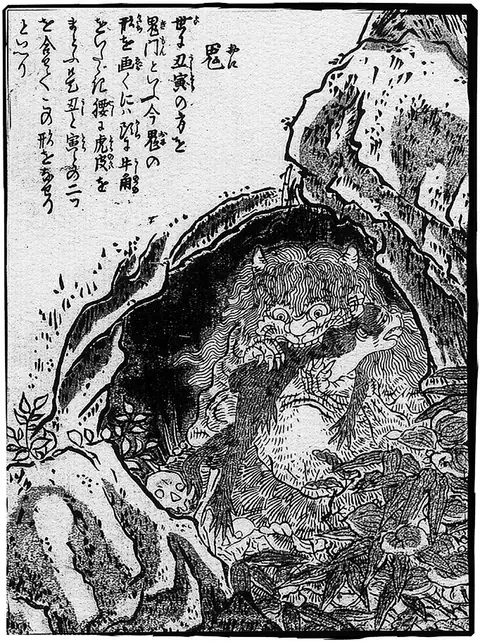
Oni have ox horns and a tiger skin because of the kimon (鬼門), the "demon gate". In the old Chinese way of naming directions after the twelve zodiac animals, the northeast lies between the ox (丑) and the tiger (寅), and it was the unlucky direction through which evil spirits passed [2][7][8].
Toriyama Sekien wrote it down in 1779. His caption reads: "People call the direction of the ox and the tiger the demon gate. When we paint an oni today we give it ox horns on its head and a tiger skin round its waist, joining the ox and the tiger to make its shape, they say" [1]. Modern reference works still give this as one explanation, not the only one [2][7]. The Buddhist scholar Sadakata Akira also points to pictures of hell, where the ox-headed jailer Gozu has two horns [2].
The northeast was guarded in real places too. The temple Enryaku-ji on Mount Hiei stands northeast of Kyoto and is said to protect the capital from that direction [8]. That story seems to have come later: the temple was founded in 788, before Kyoto became the capital [7][8].
What does an oni do?
An oni attacks people and eats them; that is its basic trait [2]. Komatsu Kazuhiko sets the oni against the kami: where a god brings people good fortune, an oni brings the opposite [2].
It lives away from people, deep in the mountains or on far-off islands, sometimes in a fortress called an oni-ga-jō [2]. It appears at the edges of the human world, at crossroads, bridges and gates, between dusk and dawn [2]. Buddhist teaching also made oni the jailers of hell, and the thunder god came to be seen as one [2].
How do you keep an oni away at Setsubun?
At Setsubun, the eve of the first day of spring in early February, people throw roasted soybeans and shout 「鬼は外、福は内」, "Oni out, luck in" [3]. The rite began at court as tsuina, a ceremony for chasing out evil held on New Year's Eve, and moved to Setsubun from the Muromachi period on [3].
Driving the oni out is half of it. The other half keeps it from coming back: a grilled sardine head stuck on a sprig of holly and set at the door, a charm still seen around Tokyo [3]. The thorny holly leaves stab the oni's eyes, and it hates the smell of the grilled fish [3].
Lafcadio Hearn described both in 1894. A caster-out of devils went from house to house crying "Oni wa soto! fuku wa uchi!", dried peas were thrown in four directions, and then a charm went up over the doors: "a little stick about the length and thickness of a skewer, a single holly-leaf, and the head of a dried iwashi" [4]. Why oni fear the holly and the fish's head, Hearn wrote, "nobody seems to know" [4].
Are oni good or evil?
Oni are mostly evil in the tales, but not always. Watanabe Shōgo notes that many oni bring good fortune, and that yama-uba and tengu have the same two sides [2]. The Namahage of Akita and the Suneka of Iwate are oni who visit homes at the New Year: children fear them, but they stand for the spirits of the coming year's harvest [2]. Komatsu Kazuhiko adds that oni sometimes bring people wealth, and that an oni could carry a village's troubles away with it when it was driven out [2].
The word was also used for real people. Outlaws and people living deep in the mountains were called oni, and in the Ōmine mountains some families were said to descend from Zenki and Gōki, the two oni servants of the mountain ascetic En no Gyōja [2].
What are the famous oni tales?
The most famous oni is Shuten-dōji, the chief of a band of oni on Mount Ōe in Tanba, who raided the capital for women and treasure [5]. In the tale, the warrior Minamoto no Yorimitsu and his four retainers disguise themselves as mountain ascetics and kill him on the emperor's orders [5]. The Nihon Kokugo Daijiten reads him as a bandit who passed himself off as an oni [5]. The oldest picture scroll of the story, the Ōeyama Ekotoba, dates from the 14th century [5].
Children meet oni first in Momotarō, the boy born from a peach who sets out for the island of oni with a dog, a monkey and a pheasant, and brings their treasure home [9]. Tales like it and Issun-bōshi fixed the oni's image in Japanese minds [2]. In 1891 the novelist Ozaki Kōyō turned Momotarō round in Oni Momotarō. An oni born from a bitter peach on the oni's island, given a loincloth of white tiger skin, sets out to take revenge on Japan and falls into the sea [6].
Where do oni come from?
The oni began as something unseen. The dictionary Wamyōshō (about 934) records the theory that the word oni comes from on (隠), "hidden", because oni hide and do not show their form [2]. Komatsu calls this and the other proposed origins guesses [2]. Until late in the Heian period the character 鬼 was often read kami, mono or shiko instead, for evil spirits and things that possess people [2].
One of the oldest oni in Japanese writing is already a man-eater. In the Izumo no Kuni Fudoki, a one-eyed oni eats a farmer working in his field [2]. Chinese ideas of the dead, the demons of Buddhism and the directions of yin-yang lore then gave it its body, its horns and its tiger skin, bit by bit [2]. The Nihon Shoki (720) already has peaches warding off oni, long before Momotarō [2].
Stories about the oni
- 鬼桃太郎Oni MomotarōMomotarō from the oni's side: an oni couple pray for a son to avenge their island, and a bitter peach brings them one, who sets off for Japan with a dragon, a baboon and a wolf.
 Ozaki Kōyō, 189126 minRead it in the Yomimaru library
- 大江山Mount ŌeMinamoto no Raikō and his four retainers climb Mount Ōe dressed as mountain monks, make Shuten-dōji drunk on sake three old men gave them, and cut off his head.Kusuyama MasaoRead it on Aozora Bunko


The oni in Japanese
The word oni is written 鬼, a kanji that first meant the spirit of a dead person in Chinese [2]. Japanese uses it for many things. 鬼ごっこ is the game of tag, where "it" is the oni, a game said to copy the old rite of chasing oni out [2], and 仕事の鬼, "an oni for work", is someone who lives for their job [2]. In Yomimaru, an app for learning Japanese, you collect the oni by completing level 15 of the Yomimaru 6k vocabulary deck, and its picture opens the deck's autumn forest.
Six words from its tales, and the levels where you learn them:
- 鬼おにogreLevel 9 · Inugami
- 虎とらtiger (Panthera tigris)Level 9 · Inugami
- 牛うしcattle (Bos taurus)Level 5 · Chōchin-obake
- 豆まめlegume (esp. edible legumes or their seeds, e.g. beans, peas, pulses)Level 16 · Jorōgumo
- 門もんgateLevel 3 · Tōfu-kozō
- 桃ももpeach (Prunus persica)Level 14 · Yama-uba
Yomimaru 6k vocabulary deck words 3,501 to 3,750
These are the 250 Japanese words of level 15. Complete the level in Yomimaru to unlock the Oni. By JLPT level: 63 N3, 121 N2, 41 N1 and 25 outside the JLPT lists. The easiest come first.
| Rank | Word | Reading | Meaning | JLPT |
|---|---|---|---|---|
| 3,501 | 左側 | ひだりがわ | left side | N3 |
| 3,509 | 切れ | きれ | piece | N3 |
| 3,511 | 最低 | さいてい | least | N3 |
| 3,519 | 通り過ぎる | とおりすぎる | to go past | N3 |
| 3,524 | ひく | to run over (with a vehicle) | N3 | |
| 3,526 | 著者 | ちょしゃ | author (usu. of a particular book) | N3 |
| 3,528 | 見当たる | みあたる | to be found | N3 |
| 3,533 | スタート | start | N3 | |
| 3,534 | タイ | Thailand | N3 | |
| 3,537 | 片手 | かたて | one hand | N3 |
| 3,540 | 順番 | じゅんばん | order | N3 |
| 3,541 | 気候 | きこう | climate | N3 |
| 3,548 | トンネル | tunnel | N3 | |
| 3,565 | 振り向く | ふりむく | to turn one's face | N3 |
| 3,573 | ニコニコ | with a friendly grin | N3 | |
| 3,581 | 事務 | じむ | office work | N3 |
| 3,582 | 哀れ | あわれ | pity | N3 |
| 3,585 | 農家 | のうか | farmer | N3 |
| 3,586 | 手間 | てま | time | N3 |
| 3,588 | 分かれる | わかれる | to branch | N3 |
| 3,594 | 経由 | けいゆ | going through | N3 |
| 3,603 | 代理 | だいり | representation | N3 |
| 3,609 | 工事 | こうじ | construction work | N3 |
| 3,616 | 等しい | ひとしい | equal | N3 |
| 3,625 | ぐるぐる | (turning) round and round | N3 | |
| 3,634 | 立ち去る | たちさる | to leave | N3 |
| 3,643 | 配達 | はいたつ | delivery | N3 |
| 3,645 | 心から | こころから | from the bottom of one's heart | N3 |
| 3,646 | 陽気 | ようき | cheerful | N3 |
| 3,647 | あら | oh! | N3 | |
| 3,649 | ファイル | file (for holding papers) | N3 | |
| 3,652 | ちっとも | (not) at all | N3 | |
| 3,655 | 券 | けん | ticket | N3 |
| 3,657 | プログラム | program (of events, music, etc.) | N3 | |
| 3,661 | 握手 | あくしゅ | handshake | N3 |
| 3,662 | ロープ | rope | N3 | |
| 3,663 | ファン | fan | N3 | |
| 3,665 | 盛ん | さかん | prosperous | N3 |
| 3,668 | 寝室 | しんしつ | bedroom | N3 |
| 3,669 | 竜 | りゅう | dragon (esp. a Chinese dragon) | N3 |
| 3,672 | 滅多に | めったに | rarely | N3 |
| 3,675 | スイッチ | switch | N3 | |
| 3,679 | 許し | ゆるし | pardon | N3 |
| 3,680 | 誤り | あやまり | error | N3 |
| 3,683 | 痛める | いためる | to hurt | N3 |
| 3,686 | 学習 | がくしゅう | learning | N3 |
| 3,689 | サイト | site | N3 | |
| 3,690 | かえる | frog | N3 | |
| 3,697 | 郵便 | ゆうびん | mail service | N3 |
| 3,700 | いらいら | to get irritated | N3 | |
| 3,702 | 見物 | けんぶつ | sightseeing | N3 |
| 3,707 | 莫大 | ばくだい | vast | N3 |
| 3,715 | 大騒ぎ | おおさわぎ | clamour | N3 |
| 3,717 | アルコール | alcohol | N3 | |
| 3,719 | 嗅ぐ | かぐ | to sniff | N3 |
| 3,723 | 翻訳 | ほんやく | translation | N3 |
| 3,725 | 欠く | かく | to chip | N3 |
| 3,732 | 愉快 | ゆかい | pleasant | N3 |
| 3,733 | にっこり | sweetly (smiling) | N3 | |
| 3,741 | 親子 | おやこ | parent and child | N3 |
| 3,745 | 機嫌 | きげん | humour | N3 |
| 3,746 | 女王 | じょおう | queen | N3 |
| 3,747 | メーカー | manufacturer (esp. a major company) | N3 | |
| 3,502 | 経過 | けいか | passage (of time) | N2 |
| 3,505 | 活用 | かつよう | practical use | N2 |
| 3,506 | 肝心 | かんじん | essential | N2 |
| 3,507 | 作者 | さくしゃ | creator (of a work) | N2 |
| 3,508 | 時点 | じてん | point in time | N2 |
| 3,510 | 展示 | てんじ | exhibition | N2 |
| 3,513 | 説教 | せっきょう | sermon | N2 |
| 3,514 | 愚痴 | ぐち | idle complaint | N2 |
| 3,515 | 低下 | ていか | fall | N2 |
| 3,516 | 単位 | たんい | unit | N2 |
| 3,517 | 広場 | ひろば | public square | N2 |
| 3,518 | 持ち込む | もちこむ | to bring in | N2 |
| 3,521 | 反省 | はんせい | reflection | N2 |
| 3,522 | 枠 | わく | frame | N2 |
| 3,523 | 延長 | えんちょう | extension | N2 |
| 3,527 | 正常 | せいじょう | normal | N2 |
| 3,529 | 発射 | はっしゃ | firing (esp. a rocket or missile) | N2 |
| 3,530 | 抱きしめる | だきしめる | to hug (someone) tight | N2 |
| 3,531 | 秘書 | ひしょ | (private) secretary | N2 |
| 3,532 | 栄養 | えいよう | nutrition | N2 |
| 3,535 | 気配 | けはい | indication | N2 |
| 3,538 | 廃止 | はいし | abolition | N2 |
| 3,542 | 形成 | けいせい | formation | N2 |
| 3,543 | 前方 | ぜんぽう | ahead | N2 |
| 3,547 | 首相 | しゅしょう | prime minister | N2 |
| 3,550 | 怪物 | かいぶつ | monster | N2 |
| 3,551 | 空中 | くうちゅう | sky | N2 |
| 3,553 | 滝 | たき | waterfall | N2 |
| 3,555 | 不快 | ふかい | displeasure | N2 |
| 3,557 | 追求 | ついきゅう | pursuit (of a goal, ideal, etc.) | N2 |
| 3,558 | 探る | さぐる | to feel around for | N2 |
| 3,559 | 立ち止まる | たちどまる | to stop (in one's tracks) | N2 |
| 3,560 | 曲げる | まげる | to bend | N2 |
| 3,561 | 商人 | しょうにん | merchant | N2 |
| 3,563 | 仕様 | しよう | way | N2 |
| 3,567 | 長期 | ちょうき | long-term | N2 |
| 3,568 | 勘弁 | かんべん | pardon | N2 |
| 3,569 | 無限 | むげん | infinity | N2 |
| 3,571 | 勝る | まさる | to excel | N2 |
| 3,572 | からかう | to tease | N2 | |
| 3,574 | 額 | がく | (picture) frame | N2 |
| 3,575 | 塞ぐ | ふさぐ | to stop up | N2 |
| 3,577 | 宿泊 | しゅくはく | accommodation | N2 |
| 3,578 | 往復 | おうふく | making a round trip; round-trip ticket | N2 |
| 3,579 | ささやく | to whisper | N2 | |
| 3,580 | 蝶 | ちょう | butterfly | N2 |
| 3,583 | 出来上がる | できあがる | to be completed | N2 |
| 3,590 | 済ます | すます | to finish | N2 |
| 3,592 | 忠告 | ちゅうこく | advice | N2 |
| 3,593 | 要する | ようする | to need | N2 |
| 3,595 | 口調 | くちょう | tone (of voice) | N2 |
| 3,597 | なおさら | still more | N2 | |
| 3,600 | 議員 | ぎいん | member of an assembly | N2 |
| 3,601 | 強化 | きょうか | strengthening | N2 |
| 3,602 | 拒む | こばむ | to refuse | N2 |
| 3,604 | 直前 | ちょくぜん | just before | N2 |
| 3,606 | 当初 | とうしょ | beginning | N2 |
| 3,607 | 怒鳴る | どなる | to shout (in anger) | N2 |
| 3,608 | 果て | はて | end | N2 |
| 3,610 | 処置 | しょち | measure | N2 |
| 3,611 | 霊 | れい | soul | N2 |
| 3,612 | 金銭 | きんせん | money | N2 |
| 3,614 | 探偵 | たんてい | detective | N2 |
| 3,615 | 信念 | しんねん | belief | N2 |
| 3,618 | 知人 | ちじん | friend | N2 |
| 3,620 | 浮かべる | うかべる | to float | N2 |
| 3,627 | 嫁 | よめ | bride | N2 |
| 3,628 | 診察 | しんさつ | medical examination | N2 |
| 3,631 | 群れ | むれ | group | N2 |
| 3,632 | 双方 | そうほう | both parties | N2 |
| 3,633 | 強盗 | ごうとう | robber | N2 |
| 3,637 | 系 | けい | system | N2 |
| 3,638 | 見出す | みいだす | to find out | N2 |
| 3,639 | すっきり | refreshingly | N2 | |
| 3,640 | 発売 | はつばい | sale | N2 |
| 3,641 | 言うまでもない | いうまでもない | goes without saying | N2 |
| 3,642 | 投資 | とうし | investment | N2 |
| 3,644 | やや | a little | N2 | |
| 3,648 | 余る | あまる | to remain | N2 |
| 3,650 | 這う | はう | to crawl | N2 |
| 3,653 | 帝国 | ていこく | empire | N2 |
| 3,659 | 外見 | がいけん | outward appearance | N2 |
| 3,660 | しつこい | insistent | N2 | |
| 3,671 | 重ねる | かさねる | to pile up | N2 |
| 3,674 | 天国 | てんごく | paradise | N2 |
| 3,676 | 権 | けん | right (to do something) | N2 |
| 3,677 | 付近 | ふきん | neighborhood | N2 |
| 3,678 | 部隊 | ぶたい | force | N2 |
| 3,681 | こする | to rub | N2 | |
| 3,682 | 不良 | ふりょう | bad | N2 |
| 3,684 | 角度 | かくど | angle | N2 |
| 3,692 | 散る | ちる | to fall (e.g. blossoms, leaves) | N2 |
| 3,694 | 縫う | ぬう | to sew | N2 |
| 3,695 | 発する | はっする | to let out | N2 |
| 3,696 | 野郎 | やろう | guy | N2 |
| 3,698 | あてはまる | to apply (of a rule) | N2 | |
| 3,699 | くだらない | trivial | N2 | |
| 3,701 | ためらう | to hesitate | N2 | |
| 3,705 | 郊外 | こうがい | suburb | N2 |
| 3,708 | リスク | risk | N2 | |
| 3,709 | 跳ねる | はねる | to jump | N2 |
| 3,710 | 恨み | うらみ | resentment | N2 |
| 3,711 | 追加 | ついか | addition | N2 |
| 3,713 | 資産 | しさん | property | N2 |
| 3,716 | 響き | ひびき | echo | N2 |
| 3,718 | 輸送 | ゆそう | transport | N2 |
| 3,720 | 高める | たかめる | to raise | N2 |
| 3,721 | 揃える | そろえる | to collect | N2 |
| 3,722 | 蘇る | よみがえる | to be resurrected | N2 |
| 3,727 | 灰色 | はいいろ | grey | N2 |
| 3,728 | 投稿 | とうこう | contribution (to a newspaper, magazine, etc.) | N2 |
| 3,730 | めす | female (animal, plant) | N2 | |
| 3,731 | 党 | とう | party (political) | N2 |
| 3,738 | さかのぼる | to go upstream | N2 | |
| 3,739 | 思い込む | おもいこむ | to be convinced (that) | N2 |
| 3,740 | 襲撃 | しゅうげき | (surprise) attack | N2 |
| 3,742 | カラス | crow (Corvus spp.) | N2 | |
| 3,743 | 複数 | ふくすう | plural | N2 |
| 3,748 | 突破 | とっぱ | breaking through | N2 |
| 3,749 | はじく | to flip | N2 | |
| 3,750 | 紺 | こん | navy blue | N2 |
| 3,503 | 直面 | ちょくめん | confrontation | N1 |
| 3,504 | 合意 | ごうい | (coming to an) agreement | N1 |
| 3,520 | 燃料 | ねんりょう | fuel | N1 |
| 3,525 | ごまかす | to deceive | N1 | |
| 3,536 | 行い | おこない | deed | N1 |
| 3,539 | 取り除く | とりのぞく | to remove | N1 |
| 3,544 | 排除 | はいじょ | exclusion | N1 |
| 3,545 | 試みる | こころみる | to try | N1 |
| 3,546 | 見逃す | みのがす | to miss | N1 |
| 3,549 | 試み | こころみ | attempt | N1 |
| 3,552 | 垂れる | たれる | to hang | N1 |
| 3,554 | 励ます | はげます | to encourage | N1 |
| 3,564 | 要因 | よういん | main cause | N1 |
| 3,566 | 祈り | いのり | prayer | N1 |
| 3,570 | 出世 | しゅっせ | success in life | N1 |
| 3,591 | 青春 | せいしゅん | youth | N1 |
| 3,598 | まくる | to turn up | N1 | |
| 3,605 | 放棄 | ほうき | abandonment | N1 |
| 3,622 | 名付ける | なづける | to name | N1 |
| 3,623 | うんざり | tedious | N1 | |
| 3,624 | 定める | さだめる | to decide | N1 |
| 3,629 | 概念 | がいねん | general idea | N1 |
| 3,635 | 依存 | いぞん | dependence | N1 |
| 3,636 | いざ | now | N1 | |
| 3,651 | 懸念 | けねん | worry | N1 |
| 3,656 | 始末 | しまつ | management | N1 |
| 3,664 | 憂鬱 | ゆううつ | depression | N1 |
| 3,667 | 値する | あたいする | to be worth | N1 |
| 3,670 | 休める | やすめる | to rest | N1 |
| 3,685 | 尊い | とうとい | precious | N1 |
| 3,688 | 徒歩 | とほ | walking | N1 |
| 3,691 | 追跡 | ついせき | chase | N1 |
| 3,703 | 勤務 | きんむ | service | N1 |
| 3,706 | 野生 | やせい | wild | N1 |
| 3,712 | 損失 | そんしつ | loss (of assets, profit, etc.) | N1 |
| 3,724 | 疑惑 | ぎわく | doubt | N1 |
| 3,726 | 防衛 | ぼうえい | defense | N1 |
| 3,729 | そこら | around there | N1 | |
| 3,734 | 躊躇 | ちゅうちょ | hesitation | N1 |
| 3,735 | 操縦 | そうじゅう | steering | N1 |
| 3,736 | 密か | ひそか | secret | N1 |
| 3,512 | それなら | if that's the case ... | ||
| 3,556 | 会長 | かいちょう | president (of a society) | |
| 3,562 | 研究所 | けんきゅうじょ | research institute | |
| 3,576 | 芸 | げい | art | |
| 3,584 | 戦略 | せんりゃく | strategy | |
| 3,587 | そうですね | that's so, isn't it | ||
| 3,589 | ようこそ | welcome | ||
| 3,596 | 拳 | こぶし | fist | |
| 3,599 | 数時間 | すうじかん | a few hours | |
| 3,613 | 君たち | きみたち | you (plural) | |
| 3,617 | 長時間 | ちょうじかん | long time | |
| 3,619 | あり | ant | ||
| 3,621 | ニューヨーク | New York | ||
| 3,626 | 四人 | よにん | four people | |
| 3,630 | 表明 | ひょうめい | declaration | |
| 3,654 | 気持ちいい | きもちいい | feeling good | |
| 3,658 | 興味深い | きょうみぶかい | very interesting | |
| 3,666 | 市長 | しちょう | mayor | |
| 3,673 | 次回 | じかい | next time (occasion) | |
| 3,687 | 見知らぬ | みしらぬ | strange | |
| 3,693 | 僕たち | ぼくたち | we | |
| 3,704 | 利 | り | advantage | |
| 3,714 | 想定 | そうてい | hypothesis | |
| 3,737 | あっという間に | あっというまに | in an instant | |
| 3,744 | 路線 | ろせん | route (bus, train, air, etc.) |
Sources
- Edo picture bookToriyama Sekien, Konjaku Gazu Zoku Hyakki (1779), "Oni", Ryukoku University Library copy
- EncyclopediaKotobank, "鬼", with Komatsu Kazuhiko's and Sadakata Akira's entries in Heibonsha's Sekai Daihyakka Jiten, Watanabe Shōgo's in Shogakukan's Nihon Daihyakka Zensho and the Nihon Kokugo Daijiten
- EncyclopediaKotobank, "節分", Inokuchi Shōji's entry in Shogakukan's Nihon Daihyakka Zensho
- Classic textLafcadio Hearn, "Two Strange Festivals", in Glimpses of Unfamiliar Japan, Second Series (1894), Project Gutenberg
- EncyclopediaKotobank, "酒呑童子", with the Nihon Kokugo Daijiten, Daijisen and Watanabe Shōgo's entry in Shogakukan's Nihon Daihyakka Zensho
- Classic textOzaki Kōyō, Oni Momotarō (鬼桃太郎), Hakubunkan (1891), Aozora Bunko text
- EncyclopediaEnglish Wikipedia, "Oni"
- EncyclopediaKotobank, "鬼門", with the entries in Shogakukan's Nihon Daihyakka Zensho and Heibonsha's Sekai Daihyakka Jiten
- EncyclopediaKotobank, "桃太郎", with the Daijisen and the Nihon Kokugo Daijiten
The art on this page was drawn for Yomimaru.
Questions
What is an oni?
An oni is the ogre of Japanese folklore: a huge, horned, man-eating figure with red, blue or black skin, a tiger-skin loincloth and an iron club. It lives far from people, in the mountains or on islands, and comes out at night. See what an oni looks like.
Why do oni have horns and a tiger-skin loincloth?
Because of the northeast, the unlucky "demon gate". In the old way of naming directions the northeast lies between the ox and the tiger, so the oni was given an ox's horns and a tiger's skin. Toriyama Sekien wrote this down in 1779. See why oni have horns.
Why do people throw beans at oni at Setsubun?
Throwing roasted soybeans while shouting "Oni wa soto, fuku wa uchi" ("Oni out, luck in") comes from an old court rite for driving out evil at the turn of the year. A grilled sardine head on a sprig of holly at the door keeps the oni from coming back. See Setsubun.
Are oni evil?
Most oni in the tales eat people and must be driven out or killed. Yet some bring luck or wealth, and some regional figures in oni masks visit homes to bless them. See whether oni are good or evil.