
- Japanese
- 絡新婦 (じょろうぐも)
- Means
- woman spider
- Also called
- jorō-gumo (女郎蜘蛛)
- Found in
- Waterfalls and deep pools, old houses, and the attics and eaves where spiders spin
What does a jorōgumo look like?
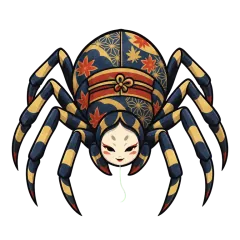
A jorōgumo is a spider that can take the shape of a woman [3][6]. In the two Edo tales below it appears in that shape, and only at the end is a spider found [3].
Toriyama Sekien drew it in 1776 as a spider woman: a long-haired woman whose robes turn into threads, holding a swarm of small spiders on her lines, beside a flowering plum [1][6]. The small spiders breathe fire [3]. Daijisen Plus lists both forms of its lore: a spider that can turn into a woman, and a spider woman who controls small spiders [2].
The Edo story collection Tonoigusa gives a size for its real shape. When the yokai in its tale is killed, the body found in the attic is a jorōgumo one or two shaku long, about 30 to 60 centimetres [3].
What does a jorōgumo do?
A jorōgumo deceives people in human shape and kills them, or drags them into water with its thread [3]. The shape-shifting tales are found in Edo story books, the thread ones in legends told at waterfalls and pools [3].
In Tonoigusa, a woman of nineteen or twenty appears before a young samurai holding a child and tells it, "That is your father. Go and let him hold you." The samurai sees that she is a yokai and cuts at her, and she flees into the ceiling. The next day a dead jorōgumo with a sword wound is found in the attic, among the bodies of the many people it had eaten [3].
In Taihei Hyakumonogatari, a man called Magoroku dozes on his veranda in Takada, in Mimasaka (now Okayama). A woman in her fifties invites him to her house, where her daughter asks him to marry her. He refuses, since he has a wife, and the house vanishes. He wakes on his own veranda to find a small spider and his eaves thick with webs, and he remembers chasing a spider away two days before [3].
At Jōren Falls in Izu, a man resting by the pool feels threads winding round his leg. He ties them to a tree stump, and the stump is torn out and dragged into the falls [3]. A woodcutter who later drops his axe in the pool is given it back by a woman, on condition that he tells no one. Later he tells the story at a drinking party, falls asleep and never wakes [3].
What is the jorōgumo's pool in Sendai?
The jorōgumo's pool is Kashiko-ga-fuchi (賢淵), a deep pool on the Hirose River in Sendai, where people pray to the spider to keep them from drowning [4][5].
The story is the thread legend again. A man fishing at the pool finds a spider's thread hooked on his foot. He moves it to the roots of a big willow, and the whole tree is dragged into the water. Then a voice comes from the pool: 「賢い、賢い」, "Clever, clever" [4][5]. That is said to be how the pool got its name [3]. The Sendai City record gives a willow, while Japanese Wikipedia's version of the tale, like the Izu one, has a tree stump [3][4].
After that, the people of the area worshipped the great spider as a god that protects against drowning, and also as a god of trade [4][5]. A stone carved 「妙法蜘蛛之霊」, "the spirit of the spider of the Wonderful Law", stands there with a small torii gate [4][5].
Is the jorōgumo good or evil?
The jorōgumo is dangerous in almost every tale: it eats people, deceives them and drags them under the water [3]. Even the woman at Jōren Falls who returns the axe kills the man who breaks his promise [3].
Kashiko-ga-fuchi is the exception. There the spider that once tried to drown a man became the pool's protector, prayed to by the people it threatened [4][5]. Sendai has another tale of the same pool, in which an eel takes the shape of a woman and asks a man called Genbei to help it fight the jorōgumo. He promises, stays home out of fear, and the eel loses [3].
Where does the jorōgumo come from?
The jorōgumo takes its name from a real spider. The Nihon Kokugo Daijiten's earliest record of the spider's name 女郎蜘蛛 is the illustrated dictionary Kinmō Zui (1666) [2]. The spider Japanese entomologists now call jorōgumo is Trichonephila clavata, known in English as the jorō spider [6].
As a yokai, it appears in Edo story collections such as Tonoigusa and Taihei Hyakumonogatari, and in Toriyama Sekien's first yokai picture book, Gazu Hyakki Yagyō (1776) [1][3]. The legends of a thread that drags a stump or a tree into a pool are told in many places, and Sendai's is the most widely known [3].
The jorōgumo in Japanese
The name has two spellings. 女郎蜘蛛 spells out the sound: 女郎, a woman, and 蜘蛛, a spider, read gumo in the name [2][3]. 絡新婦 is a Chinese name for a spider, made of 絡, to entangle, and 新婦, a bride. It is borrowed for its meaning and read jorōgumo, the kind of reading called jukujikun [3][6]. Sekien used 絡新婦 and wrote its reading beside it [1], and Daijisen notes that the spider can be written either way [2].
In Yomimaru, an app for learning Japanese, you collect the jorōgumo by completing level 16 of the Yomimaru 6k vocabulary deck. The deck prints the spider in kana, くも.
Six words from its tales, and the levels where you learn them:
- くもspiderLevel 16 · Jorōgumo
- 糸いとthreadLevel 9 · Inugami
- 滝たきwaterfallLevel 15 · Oni
- 足あしfootLevel 1 · Kitsune
- 賢いかしこいwiseLevel 8 · Rokurokubi
- 水みずwater (esp. cool or cold)Level 1 · Kitsune
Yomimaru 6k vocabulary deck words 3,751 to 4,000
These are the 250 Japanese words of level 16. Complete the level in Yomimaru to unlock the Jorōgumo. By JLPT level: 62 N3, 105 N2, 65 N1 and 18 outside the JLPT lists. The easiest come first.
| Rank | Word | Reading | Meaning | JLPT |
|---|---|---|---|---|
| 3,751 | 農業 | のうぎょう | agriculture | N3 |
| 3,752 | 大雨 | おおあめ | heavy rain | N3 |
| 3,756 | 学問 | がくもん | study | N3 |
| 3,760 | 早朝 | そうちょう | early morning | N3 |
| 3,768 | 縦 | たて | the vertical | N3 |
| 3,769 | サイン | autograph | N3 | |
| 3,779 | 会員 | かいいん | member | N3 |
| 3,782 | 顔色 | かおいろ | complexion | N3 |
| 3,785 | ポイント | key point; point (in a loyalty program) | N3 | |
| 3,790 | 付き合い | つきあい | association | N3 |
| 3,796 | 診る | みる | to examine (medically) | N3 |
| 3,801 | 手前 | てまえ | before oneself | N3 |
| 3,815 | メンバー | member | N3 | |
| 3,821 | 湧く | わく | to well (up) | N3 |
| 3,822 | ガソリン | gasoline | N3 | |
| 3,824 | 青空 | あおぞら | blue sky | N3 |
| 3,830 | 画家 | がか | painter | N3 |
| 3,833 | 輸入 | ゆにゅう | import | N3 |
| 3,838 | 飯 | めし | cooked rice | N3 |
| 3,840 | 市内 | しない | in the city | N3 |
| 3,842 | 竹 | たけ | bamboo (any grass of subfamily Bambusoideae) | N3 |
| 3,843 | ハンドル | handle | N3 | |
| 3,844 | 乗り | のり | riding | N3 |
| 3,846 | プロ | professional | N3 | |
| 3,847 | 正午 | しょうご | noon | N3 |
| 3,849 | コスト | cost | N3 | |
| 3,853 | スケジュール | schedule | N3 | |
| 3,855 | 押さえる | おさえる | to pin down | N3 |
| 3,872 | 後者 | こうしゃ | the latter | N3 |
| 3,873 | 豆 | まめ | legume (esp. edible legumes or their seeds, e.g. beans, peas, pulses) | N3 |
| 3,875 | ブレーキ | brake | N3 | |
| 3,879 | サイズ | size | N3 | |
| 3,881 | 頷く | うなずく | to nod | N3 |
| 3,884 | 真夜中 | まよなか | dead of night | N3 |
| 3,887 | 上品 | じょうひん | elegant | N3 |
| 3,891 | 無料 | むりょう | free (of charge) | N3 |
| 3,900 | ぐっすり | soundly (sleeping) | N3 | |
| 3,901 | 翌朝 | よくあさ | next morning | N3 |
| 3,902 | すまない | inexcusable | N3 | |
| 3,903 | 混雑 | こんざつ | congestion | N3 |
| 3,904 | 放す | はなす | to release | N3 |
| 3,908 | 礼儀 | れいぎ | manners | N3 |
| 3,916 | 良心 | りょうしん | conscience | N3 |
| 3,920 | ネット | network | N3 | |
| 3,926 | 感想 | かんそう | impressions | N3 |
| 3,927 | 徹夜 | てつや | staying up all night | N3 |
| 3,929 | コーナー | corner | N3 | |
| 3,935 | 締める | しめる | to tie | N3 |
| 3,939 | くも | spider | N3 | |
| 3,960 | 室内 | しつない | indoor | N3 |
| 3,964 | 持ち出す | もちだす | to take out | N3 |
| 3,968 | ついていく | to accompany | N3 | |
| 3,970 | 見学 | けんがく | inspection | N3 |
| 3,972 | 用心 | ようじん | care | N3 |
| 3,976 | ミス | mistake | N3 | |
| 3,982 | パイプ | pipe | N3 | |
| 3,990 | 組合 | くみあい | association | N3 |
| 3,992 | 天然 | てんねん | nature | N3 |
| 3,993 | こらえる | to bear | N3 | |
| 3,996 | 人種 | じんしゅ | race (of people) | N3 |
| 3,999 | 老ける | ふける | to age | N3 |
| 4,000 | 輸出 | ゆしゅつ | export | N3 |
| 3,753 | 延期 | えんき | postponement | N2 |
| 3,754 | まし | better | N2 | |
| 3,755 | 日光 | にっこう | sunlight | N2 |
| 3,759 | 方面 | ほうめん | direction | N2 |
| 3,761 | 近寄る | ちかよる | to approach | N2 |
| 3,765 | 無数 | むすう | innumerable | N2 |
| 3,766 | 動揺 | どうよう | shaking | N2 |
| 3,767 | 引き受ける | ひきうける | to take on | N2 |
| 3,770 | 西洋 | せいよう | the West | N2 |
| 3,774 | 手配 | てはい | arrangement | N2 |
| 3,775 | 打ち明ける | うちあける | to confide | N2 |
| 3,776 | 塀 | へい | wall | N2 |
| 3,777 | 疲労 | ひろう | fatigue | N2 |
| 3,780 | きっかけ | chance | N2 | |
| 3,781 | 浮気 | うわき | extramarital sex | N2 |
| 3,783 | 先頭 | せんとう | head (of a line, group, etc.) | N2 |
| 3,784 | 文明 | ぶんめい | civilization | N2 |
| 3,786 | 振る舞い | ふるまい | behavior | N2 |
| 3,787 | 打ち込む | うちこむ | to drive in (a nail, stake, etc.) | N2 |
| 3,788 | 冷やす | ひやす | to cool (from room temperature) | N2 |
| 3,792 | 快適 | かいてき | pleasant | N2 |
| 3,794 | メディア | media | N2 | |
| 3,795 | 整う | ととのう | to be ready | N2 |
| 3,797 | 例外 | れいがい | exception | N2 |
| 3,798 | 過程 | かてい | process | N2 |
| 3,800 | 詐欺 | さぎ | fraud | N2 |
| 3,802 | 自覚 | じかく | self-consciousness | N2 |
| 3,803 | 寄付 | きふ | contribution | N2 |
| 3,806 | あいにく | unfortunately | N2 | |
| 3,807 | 生存 | せいぞん | existence | N2 |
| 3,808 | 例える | たとえる | to compare (something) to | N2 |
| 3,810 | 階級 | かいきゅう | (social) class | N2 |
| 3,812 | 懸命 | けんめい | eager | N2 |
| 3,813 | 公表 | こうひょう | official announcement | N2 |
| 3,814 | 兵 | へい | (common) soldier | N2 |
| 3,817 | ケチ | stinginess | N2 | |
| 3,818 | 防止 | ぼうし | prevention | N2 |
| 3,819 | 接する | せっする | to touch | N2 |
| 3,823 | 効率 | こうりつ | efficiency | N2 |
| 3,825 | 頂上 | ちょうじょう | top | N2 |
| 3,826 | 吹き出す | ふきだす | to spout out | N2 |
| 3,829 | 法則 | ほうそく | law | N2 |
| 3,834 | 弓 | ゆみ | bow (weapon) | N2 |
| 3,836 | 崩れる | くずれる | to collapse | N2 |
| 3,839 | 騒音 | そうおん | noise | N2 |
| 3,845 | 成人 | せいじん | adult | N2 |
| 3,848 | 通用 | つうよう | (common) use (of a language, currency, etc.) | N2 |
| 3,850 | 瞳 | ひとみ | pupil (of the eye) | N2 |
| 3,854 | 映像 | えいぞう | image (on a screen) | N2 |
| 3,857 | 俳優 | はいゆう | actor | N2 |
| 3,861 | 潮 | しお | tide | N2 |
| 3,864 | 反映 | はんえい | reflection (of light) | N2 |
| 3,876 | 再生 | さいせい | restoration to life | N2 |
| 3,877 | 上等 | じょうとう | superior | N2 |
| 3,880 | 症状 | しょうじょう | symptoms | N2 |
| 3,882 | 普及 | ふきゅう | diffusion | N2 |
| 3,885 | 事項 | じこう | matter | N2 |
| 3,886 | とっくに | long ago | N2 | |
| 3,888 | 外部 | がいぶ | outside (e.g. of a building) | N2 |
| 3,889 | 予備 | よび | reserve | N2 |
| 3,890 | 特殊 | とくしゅ | special | N2 |
| 3,893 | 群 | ぐん | group | N2 |
| 3,895 | 会見 | かいけん | interview | N2 |
| 3,897 | 不気味 | ぶきみ | weird | N2 |
| 3,898 | 連想 | れんそう | association (of ideas) | N2 |
| 3,905 | 獲物 | えもの | prey | N2 |
| 3,906 | 不愉快 | ふゆかい | unpleasant | N2 |
| 3,907 | 潜る | もぐる | to dive (into or under water) | N2 |
| 3,912 | 消化 | しょうか | digestion (of food) | N2 |
| 3,913 | 砂漠 | さばく | desert | N2 |
| 3,914 | 収まる | おさまる | to fit into (a box, frame, category, etc.) | N2 |
| 3,918 | 正面 | しょうめん | front | N2 |
| 3,921 | 対抗 | たいこう | opposition | N2 |
| 3,922 | 軌道 | きどう | orbit | N2 |
| 3,923 | 解除 | かいじょ | termination (of a contract) | N2 |
| 3,930 | 版 | はん | edition | N2 |
| 3,932 | 待機 | たいき | standing by | N2 |
| 3,933 | 共同 | きょうどう | cooperation | N2 |
| 3,934 | 善 | ぜん | good | N2 |
| 3,937 | 近づける | ちかづける | to bring near | N2 |
| 3,942 | 沈黙 | ちんもく | silence | N2 |
| 3,943 | 鐘 | かね | bell (often a large hanging bell) | N2 |
| 3,947 | 観点 | かんてん | point of view | N2 |
| 3,948 | 需要 | じゅよう | demand | N2 |
| 3,949 | 観客 | かんきゃく | spectator | N2 |
| 3,950 | 姓 | せい | surname | N2 |
| 3,951 | ゆり | lily (Lilium spp.) | N2 | |
| 3,952 | 爽やか | さわやか | fresh | N2 |
| 3,953 | 儀式 | ぎしき | ceremony | N2 |
| 3,955 | 入場 | にゅうじょう | entrance | N2 |
| 3,956 | とうてい | (cannot) possibly | N2 | |
| 3,958 | 軍隊 | ぐんたい | armed forces | N2 |
| 3,962 | 陸 | りく | land | N2 |
| 3,963 | 助言 | じょげん | advice | N2 |
| 3,967 | 重視 | じゅうし | regarding as important | N2 |
| 3,969 | 縁 | えん | fate | N2 |
| 3,971 | 貴族 | きぞく | nobility | N2 |
| 3,975 | つくづく | deeply | N2 | |
| 3,979 | 肺 | はい | lung | N2 |
| 3,980 | 観念 | かんねん | idea | N2 |
| 3,984 | 襟 | えり | collar | N2 |
| 3,986 | 規定 | きてい | stipulation | N2 |
| 3,989 | ぞっと | shuddering | N2 | |
| 3,994 | 航空 | こうくう | aviation | N2 |
| 3,998 | 節約 | せつやく | economising | N2 |
| 3,757 | 欲望 | よくぼう | desire | N1 |
| 3,758 | 飲み込む | のみこむ | to swallow | N1 |
| 3,762 | 物体 | ぶったい | object | N1 |
| 3,764 | 尽きる | つきる | to be used up | N1 |
| 3,771 | 反する | はんする | to be contrary (to) | N1 |
| 3,773 | 見通し | みとおし | unobstructed view | N1 |
| 3,778 | 着 | ちゃく | arrival | N1 |
| 3,789 | 引き取る | ひきとる | to take into one's possession | N1 |
| 3,791 | つぶやく | to mutter | N1 | |
| 3,793 | 悩ます | なやます | to afflict | N1 |
| 3,799 | 職務 | しょくむ | professional duties | N1 |
| 3,805 | 明白 | めいはく | obvious | N1 |
| 3,809 | 整える | ととのえる | to put in order | N1 |
| 3,811 | 貫く | つらぬく | to go through | N1 |
| 3,816 | 判決 | はんけつ | judicial decision | N1 |
| 3,827 | めくる | to turn over | N1 | |
| 3,832 | 本能 | ほんのう | instinct | N1 |
| 3,835 | 大げさ | おおげさ | exaggerated | N1 |
| 3,841 | 手順 | てじゅん | process | N1 |
| 3,851 | ゆえ | reason | N1 | |
| 3,852 | 賢明 | けんめい | wise | N1 |
| 3,856 | 鮮やか | あざやか | vivid | N1 |
| 3,858 | 配慮 | はいりょ | consideration | N1 |
| 3,859 | 無意味 | むいみ | nonsense | N1 |
| 3,860 | 屋敷 | やしき | residence | N1 |
| 3,862 | 見解 | けんかい | opinion | N1 |
| 3,863 | 洪水 | こうずい | flood | N1 |
| 3,866 | 活発 | かっぱつ | lively | N1 |
| 3,867 | 弱る | よわる | to weaken | N1 |
| 3,868 | 側面 | そくめん | side | N1 |
| 3,869 | 引きずる | ひきずる | to drag | N1 |
| 3,870 | こもる | to shut oneself in (e.g. one's room) | N1 | |
| 3,871 | 結びつける | むすびつける | to tie (to) | N1 |
| 3,874 | 脱出 | だっしゅつ | escape | N1 |
| 3,878 | 事前 | じぜん | prior | N1 |
| 3,883 | 煽る | あおる | to fan (oneself, flames, etc.) | N1 |
| 3,892 | 麻痺 | まひ | paralysis | N1 |
| 3,899 | 荒らす | あらす | to lay waste | N1 |
| 3,909 | 圧力 | あつりょく | pressure | N1 |
| 3,910 | 体制 | たいせい | order | N1 |
| 3,911 | 理屈 | りくつ | theory | N1 |
| 3,915 | 手がかり | てがかり | clue | N1 |
| 3,917 | 杖 | つえ | cane | N1 |
| 3,919 | 挑む | いどむ | to challenge to (a fight, game, etc.) | N1 |
| 3,924 | 源 | みなもと | source (of a river) | N1 |
| 3,925 | 領域 | りょういき | territory | N1 |
| 3,938 | 遮る | さえぎる | to interrupt | N1 |
| 3,940 | 手当 | てあて | salary | N1 |
| 3,941 | 追い出す | おいだす | to expel | N1 |
| 3,946 | 措置 | そち | measure | N1 |
| 3,954 | 入浴 | にゅうよく | bathing | N1 |
| 3,957 | 達成 | たっせい | achievement | N1 |
| 3,959 | 帯びる | おびる | to wear (a sword, decoration, etc.) | N1 |
| 3,961 | 敗北 | はいぼく | defeat | N1 |
| 3,965 | 妥協 | だきょう | compromise | N1 |
| 3,966 | 軽蔑 | けいべつ | contempt | N1 |
| 3,973 | 脅かす | おびやかす | to intimidate | N1 |
| 3,977 | 傾ける | かたむける | to incline | N1 |
| 3,978 | 時折 | ときおり | sometimes | N1 |
| 3,981 | 打撃 | だげき | blow | N1 |
| 3,983 | 従来 | じゅうらい | up to now | N1 |
| 3,985 | 嘘つき | うそつき | liar | N1 |
| 3,987 | 滅ぼす | ほろぼす | to destroy | N1 |
| 3,995 | 迅速 | じんそく | quick | N1 |
| 3,997 | 盛り上がる | もりあがる | to swell | N1 |
| 3,763 | 遠慮なく | えんりょなく | without reservation | |
| 3,772 | 放課後 | ほうかご | after school (at the end of the day) | |
| 3,804 | 叔母 | おば | aunt | |
| 3,820 | 手放す | てばなす | to let go of | |
| 3,828 | くつろぐ | to relax | ||
| 3,831 | 言及 | げんきゅう | reference | |
| 3,837 | 違法 | いほう | illegal | |
| 3,865 | 戦場 | せんじょう | battlefield | |
| 3,894 | 過激 | かげき | extreme (measure, idea, etc.) | |
| 3,896 | 賞賛 | しょうさん | praise | |
| 3,928 | ついてくる | to follow | ||
| 3,931 | 早起き | はやおき | early rising | |
| 3,936 | 数回 | すうかい | several times | |
| 3,944 | 大嫌い | だいきらい | hating | |
| 3,945 | 成し遂げる | なしとげる | to accomplish | |
| 3,974 | 何度 | なんど | how many times | |
| 3,988 | 戦後 | せんご | postwar period | |
| 3,991 | 装う | よそおう | to dress (oneself in) |
Sources
- Edo picture bookToriyama Sekien, Gazu Hyakki Yagyō (1776), "Jorōgumo", Ryukoku University Library copy
- EncyclopediaKotobank, "女郎蜘蛛", with Shogakukan's Daijisen, Daijisen Plus and Nihon Kokugo Daijiten
- EncyclopediaJapanese Wikipedia, "絡新婦", citing Murakami Kenji, Yōkai Jiten (2000)
- Archive recordSendai City, Sendai Cultural Property Supporters, record of the second meeting of the preservation group (18 July 2025), with a photograph of the Kashiko-ga-fuchi signboard
- Archive recordJR East, Eki-net travel guide, "賢淵" (Kashiko-ga-fuchi), archived 19 June 2010
- EncyclopediaEnglish Wikipedia, "Jorōgumo"
The art on this page was drawn for Yomimaru.
Questions
What is a jorōgumo?
A jorōgumo is a spider yokai that can take the shape of a woman. In the old tales it deceives people in that shape, and at waterfalls and pools it ties its thread round a person's leg to drag them into the water. See what a jorōgumo does.
Why is jorōgumo written 絡新婦?
絡新婦 is a Chinese name for a spider, borrowed for its meaning and read as jorōgumo. The spelling that matches the sound is 女郎蜘蛛, "woman spider". Both are still used. See the jorōgumo in Japanese.
Is the jorōgumo evil?
In most tales it is dangerous: it kills people and tries to drown them. But at Kashiko-ga-fuchi, a pool in Sendai, people worship it as a god that protects them from drowning. See whether it is good or evil.
Is the jorōgumo a real spider?
The yokai takes its name from a real spider. In Japanese, jorōgumo is also the name of Trichonephila clavata, the orb-weaver known in English as the jorō spider. See where the jorōgumo comes from.