
- Japanese
- 豆腐小僧 (とうふこぞう)
- Means
- tofu boy
- Also called
- ōatama kozō (大頭小僧, "big-headed boy")
- Found in
- The streets of Edo on rainy nights, in picture books and toy prints
What does a tōfu-kozō look like?
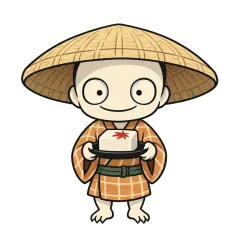
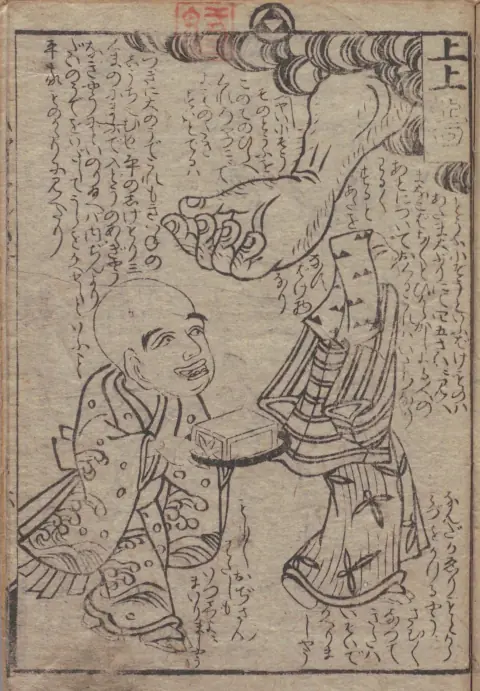
A tōfu-kozō is a small boy in a wide straw hat, carrying a block of tofu on a tray [2][3]. The tofu is usually kōyō-dōfu, tofu with the shape of a maple leaf pressed into it, which was really sold in late Edo [2][3]. Some pictures give him an ordinary child's face, and from late Edo he is often drawn with a single eye [2][3].
An early picture book to name him, from 1779, makes his head his mark: "the monster called tōfu-kozō has a big head", it says [1][2][3]. Another picture book of 1788 calls a boy with all his features ōatama kozō, "big-headed boy", and gives him the giant mikoshi-nyūdō for a father and a rokurokubi for a mother [2].
What does a tōfu-kozō do?
In the Edo picture books a tōfu-kozō runs errands: he carries tofu and sake about town for the other monsters [2][3]. A comic senryū verse of the time puts it in one line, 豆腐小僧ハ化ものゝ小間使ひ: the tōfu-kozō is the monsters' errand boy [3]. He follows people on rainy nights, but he does nothing worse [2].
The stories make him a figure of fun. He is good-natured, timid and comic, people ignore him, and the other monsters sometimes bully him [2]. In Harumachi's book of 1779 he is not even a real yokai, but a weasel in disguise [2].
Is the tōfu-kozō dangerous?
The tōfu-kozō of the Edo books is harmless. He never does anything really wicked, and his whole part is to be weak and funny [2].
His dangerous side was added much later. Yokai encyclopedias from the Shōwa era on say he offers his tofu to passers-by and that whoever eats it grows mould all over [2][3]. No Edo source has anything like it: the mould is a modern invention of the yokai encyclopedias [2]. It is the version most modern books tell, so the line about mould says more about the 20th century than about Edo [2].
Where does the tōfu-kozō come from?
The tōfu-kozō was born in the picture books of Edo, and the record outside them is thin. He can be traced to the An'ei era (1772 to 1781), and Harumachi's book of 1779 is among the first to show him [1][2]. Folk tales, essays and collections of strange stories hardly mention him, so scholars treat him as an invented yokai of the city's picture books [2].
Nobody knows exactly how he was made up [2]. One idea is that tofu was a popular, nourishing food in Edo, and the books reflected it [2]. He is close kin to the one-eyed boy, the hitotsume-kozō, who is also often drawn carrying tofu, and some writers think the tōfu-kozō is just another name for him [2][3]. Others answer that many tōfu-kozō plainly have two eyes [3].
From the end of the Edo period into the Meiji era he was a favourite of toy prints, kites, board games and card games [2]. In 1999 and 2000, the scholar Adam Kabat reprinted the Edo picture books that feature him, and he has been a popular character ever since [2].
The tōfu-kozō in Japanese
The name tōfu-kozō joins 豆腐, tofu, to 小僧, a boy, once the word for a young apprentice monk or an errand boy. His maple-leaf tofu is 紅葉豆腐, with 紅葉, the red leaves of autumn. In Yomimaru, an app for learning Japanese, all of these come from the Yomimaru 6k vocabulary deck.
Six words from his tales, and the levels where you learn them:
- 豆腐とうふtofuLevel 23 · Yamata no Orochi
- 小僧こぞうyoungsterLevel 21 · Kamaitachi
- 雨あめrainLevel 2 · Kasa-obake
- 夜よるnightLevel 1 · Kitsune
- 子供こどもchildLevel 1 · Kitsune
- 紅葉こうようleaves turning red (in autumn)Level 22 · Ōmukade
Yomimaru 6k vocabulary deck words 501 to 750
These are the 250 Japanese words of level 3. Complete the level in Yomimaru to unlock the Tōfu-kozō. By JLPT level: 86 N5, 2 N4 and 162 N3. The easiest come first.
| Rank | Word | Reading | Meaning | JLPT |
|---|---|---|---|---|
| 664 | 日本人 | にほんじん | Japanese person | N5 |
| 665 | 教える | おしえる | to teach; to tell | N5 |
| 666 | 遠い | とおい | far | N5 |
| 667 | 学生 | がくせい | student (esp. a university student) | N5 |
| 668 | 暑い | あつい | hot | N5 |
| 669 | 左 | ひだり | left | N5 |
| 670 | すみません | excuse me; I'm sorry | N5 | |
| 671 | 公園 | こうえん | (public) park | N5 |
| 672 | 暇 | ひま | spare time | N5 |
| 673 | 英語 | えいご | English (language) | N5 |
| 674 | 消す | けす | to erase | N5 |
| 675 | 暖かい | あたたかい | warm | N5 |
| 676 | いくつ | how many | N5 | |
| 677 | 上手 | じょうず | skillful | N5 |
| 678 | 生徒 | せいと | pupil | N5 |
| 679 | 明るい | あかるい | light | N5 |
| 680 | 止める | とめる | to stop | N5 |
| 681 | 三日 | みっか | 3rd day of the month; three days | N5 |
| 682 | 弱い | よわい | weak | N5 |
| 683 | 建物 | たてもの | building | N5 |
| 684 | 大人 | おとな | adult | N5 |
| 685 | 黒い | くろい | black | N5 |
| 686 | 椅子 | いす | chair | N5 |
| 687 | 二人 | ふたり | two persons | N5 |
| 688 | 並ぶ | ならぶ | to line up | N5 |
| 690 | 短い | みじかい | short | N5 |
| 691 | ホテル | hotel | N5 | |
| 692 | 答える | こたえる | to answer | N5 |
| 693 | ドア | door | N5 | |
| 694 | 医者 | いしゃ | doctor | N5 |
| 695 | 鍵 | かぎ | key | N5 |
| 696 | もう一度 | もういちど | once more | N5 |
| 697 | 青い | あおい | blue | N5 |
| 698 | 両親 | りょうしん | parents | N5 |
| 699 | そば | near | N5 | |
| 700 | 姉 | あね | older sister | N5 |
| 701 | 開く | あく | to open (e.g. doors) | N5 |
| 702 | 熱い | あつい | hot (to the touch) | N5 |
| 703 | 様 | さま | Mr; Ms | N5 |
| 704 | 甘い | あまい | sweet-tasting | N5 |
| 705 | じゃあ | then | N5 | |
| 706 | 橋 | はし | bridge | N5 |
| 707 | 時計 | とけい | clock | N5 |
| 708 | 雑誌 | ざっし | magazine | N5 |
| 709 | 外国 | がいこく | foreign country | N5 |
| 710 | お父さん | おとうさん | father | N5 |
| 711 | バス | bus | N5 | |
| 712 | 電気 | でんき | electricity | N5 |
| 713 | あそこ | there | N5 | |
| 714 | 百 | ひゃく | hundred | N5 |
| 715 | お茶 | おちゃ | tea (esp. green or barley) | N5 |
| 716 | 洗う | あらう | to wash | N5 |
| 717 | 金 | きん | gold (metal) | N5 |
| 718 | 大好き | だいすき | liking very much | N5 |
| 719 | 掃除 | そうじ | cleaning | N5 |
| 720 | 休み | やすみ | rest | N5 |
| 721 | どれ | which (of three or more) | N5 | |
| 722 | ベッド | bed | N5 | |
| 723 | 吹く | ふく | to blow (of the wind) | N5 |
| 724 | 卵 | たまご | eggs | N5 |
| 725 | 散歩 | さんぽ | walk | N5 |
| 726 | 吸う | すう | to smoke | N5 |
| 727 | 荷物 | にもつ | luggage | N5 |
| 728 | 庭 | にわ | garden | N5 |
| 729 | 千 | せん | thousand | N5 |
| 730 | 冷たい | つめたい | cold (to the touch) | N5 |
| 731 | 男の子 | おとこのこ | boy | N5 |
| 732 | 天気 | てんき | weather | N5 |
| 733 | 横 | よこ | horizontal (as opposed to vertical) | N5 |
| 734 | 四 | よん | four | N5 |
| 735 | 鼻 | はな | nose | N5 |
| 736 | 去年 | きょねん | last year | N5 |
| 737 | 下がる | さがる | to come down | N5 |
| 738 | 今朝 | けさ | this morning | N5 |
| 739 | そちら | that way | N5 | |
| 740 | 練習 | れんしゅう | practice | N5 |
| 741 | 昼 | ひる | noon | N5 |
| 742 | 兄弟 | きょうだい | siblings | N5 |
| 743 | 机 | つくえ | desk | N5 |
| 744 | あっ | ah | N5 | |
| 745 | つらい | painful | N5 | |
| 746 | ビール | beer | N5 | |
| 747 | いいえ | no | N5 | |
| 748 | コーヒー | coffee | N5 | |
| 749 | 門 | もん | gate | N5 |
| 750 | テーブル | table | N5 | |
| 663 | 過ぎ | すぎ | past | N4 |
| 689 | よろしく | well | N4 | |
| 501 | 人間 | にんげん | human being | N3 |
| 502 | 以上 | いじょう | not less than ... | N3 |
| 503 | 者 | もの | person | N3 |
| 504 | 何か | なにか | something | N3 |
| 505 | どんな | what kind of | N3 | |
| 506 | ただ | ordinary | N3 | |
| 507 | すべて | everything | N3 | |
| 508 | まま | as (it is) | N3 | |
| 509 | お前 | おまえ | you | N3 |
| 510 | 全く | まったく | really | N3 |
| 511 | 考え | かんがえ | thinking | N3 |
| 512 | ずっと | continuously | N3 | |
| 513 | 結果 | けっか | result | N3 |
| 514 | 関係 | かんけい | relation | N3 |
| 515 | しまう | to finish | N3 | |
| 516 | 与える | あたえる | to give (esp. to someone of lower status) | N3 |
| 517 | ほとんど | almost | N3 | |
| 518 | 感じる | かんじる | to feel | N3 |
| 519 | 気 | き | spirit | N3 |
| 520 | 信じる | しんじる | to believe | N3 |
| 521 | 相手 | あいて | companion | N3 |
| 522 | 求める | もとめる | to want | N3 |
| 523 | 時代 | じだい | period | N3 |
| 524 | 事件 | じけん | incident; case | N3 |
| 525 | 最近 | さいきん | recently | N3 |
| 526 | かなり | considerably | N3 | |
| 527 | 以前 | いぜん | before | N3 |
| 528 | 似る | にる | to resemble | N3 |
| 529 | 名 | な | name | N3 |
| 530 | さらに | furthermore | N3 | |
| 531 | 認める | みとめる | to recognize | N3 |
| 532 | 方法 | ほうほう | method | N3 |
| 533 | 事実 | じじつ | fact | N3 |
| 534 | 気づく | きづく | to notice | N3 |
| 535 | 存在 | そんざい | existence | N3 |
| 536 | 守る | まもる | to protect | N3 |
| 537 | 間違い | まちがい | mistake | N3 |
| 538 | 以外 | いがい | excluding | N3 |
| 539 | 成功 | せいこう | success | N3 |
| 540 | 完全 | かんぜん | perfect | N3 |
| 541 | 実際 | じっさい | reality | N3 |
| 542 | 現在 | げんざい | the present | N3 |
| 543 | 数 | かず | number | N3 |
| 544 | 姿 | すがた | figure | N3 |
| 545 | 目的 | もくてき | purpose | N3 |
| 546 | ばか | idiot | N3 | |
| 547 | 情報 | じょうほう | information | N3 |
| 548 | 訳 | わけ | reason | N3 |
| 549 | 行動 | こうどう | action | N3 |
| 550 | 途中 | とちゅう | on the way | N3 |
| 551 | 失う | うしなう | to lose | N3 |
| 552 | 実は | じつは | as a matter of fact | N3 |
| 553 | 離れる | はなれる | to be separated | N3 |
| 554 | 許す | ゆるす | to permit | N3 |
| 555 | 利用 | りよう | use | N3 |
| 556 | 状態 | じょうたい | state | N3 |
| 557 | すでに | already | N3 | |
| 558 | 発見 | はっけん | discovery | N3 |
| 559 | 描く | えがく | to draw | N3 |
| 560 | 突然 | とつぜん | abrupt | N3 |
| 561 | 結局 | けっきょく | after all | N3 |
| 562 | なかなか | very | N3 | |
| 563 | 研究 | けんきゅう | research | N3 |
| 564 | 神 | かみ | god | N3 |
| 565 | 死 | し | death | N3 |
| 566 | 殺す | ころす | to kill | N3 |
| 567 | 我々 | われわれ | we | N3 |
| 568 | しっかり | tightly (holding on) | N3 | |
| 569 | 友人 | ゆうじん | friend | N3 |
| 570 | 残す | のこす | to leave (behind) | N3 |
| 571 | 敵 | てき | opponent | N3 |
| 572 | 会 | かい | meeting | N3 |
| 573 | 意見 | いけん | opinion | N3 |
| 574 | 代わり | かわり | substitute | N3 |
| 575 | 重要 | じゅうよう | important | N3 |
| 576 | しばらく | for a moment | N3 | |
| 577 | 正直 | しょうじき | honest | N3 |
| 578 | 約 | やく | approximately | N3 |
| 579 | まるで | quite | N3 | |
| 580 | ついに | finally | N3 | |
| 581 | ゆっくり | slowly | N3 | |
| 582 | 戦争 | せんそう | war | N3 |
| 583 | 元 | もと | origin | N3 |
| 584 | 影響 | えいきょう | influence | N3 |
| 585 | 何と | なんと | what | N3 |
| 586 | 責任 | せきにん | duty | N3 |
| 587 | 済む | すむ | to finish | N3 |
| 588 | 秘密 | ひみつ | secret | N3 |
| 589 | 我慢 | がまん | endurance | N3 |
| 590 | 当然 | とうぜん | natural | N3 |
| 591 | 隠す | かくす | to hide | N3 |
| 592 | 理解 | りかい | understanding | N3 |
| 593 | 胸 | むね | chest | N3 |
| 594 | つまり | that is to say | N3 | |
| 595 | 経つ | たつ | to pass (of time) | N3 |
| 596 | 少年 | しょうねん | boy | N3 |
| 597 | 合わせる | あわせる | to match (rhythm, speed, etc.) | N3 |
| 598 | 不思議 | ふしぎ | wonderful | N3 |
| 599 | やってくる | to come along | N3 | |
| 600 | 命 | いのち | life | N3 |
| 601 | 過ごす | すごす | to spend (time) | N3 |
| 602 | 激しい | はげしい | violent | N3 |
| 603 | 自然 | しぜん | nature | N3 |
| 604 | 無駄 | むだ | futility | N3 |
| 605 | 他人 | たにん | another person | N3 |
| 606 | なんとか | something | N3 | |
| 607 | 安全 | あんぜん | safety | N3 |
| 608 | 新 | しん | new | N3 |
| 609 | 明らか | あきらか | clear | N3 |
| 610 | 越える | こえる | to cross over | N3 |
| 611 | 満足 | まんぞく | satisfaction | N3 |
| 612 | 出会う | であう | to meet (by chance) | N3 |
| 613 | 黙る | だまる | to be silent | N3 |
| 614 | 当時 | とうじ | at that time | N3 |
| 615 | 想像 | そうぞう | imagination | N3 |
| 616 | 人生 | じんせい | (one's) life | N3 |
| 617 | 確認 | かくにん | check; confirmation | N3 |
| 618 | 機会 | きかい | chance | N3 |
| 619 | 辺り | あたり | (in the) neighbourhood | N3 |
| 620 | 期待 | きたい | expectation | N3 |
| 621 | 噂 | うわさ | rumour | N3 |
| 622 | 愛 | あい | love | N3 |
| 623 | 旅 | たび | travel | N3 |
| 624 | だって | after all | N3 | |
| 625 | 発表 | はっぴょう | announcement | N3 |
| 626 | どうしても | by all means | N3 | |
| 627 | 過去 | かこ | the past | N3 |
| 628 | 仲間 | なかま | companion | N3 |
| 629 | ある | a certain ... | N3 | |
| 630 | 身 | み | one's body | N3 |
| 631 | そのまま | without change | N3 | |
| 632 | ちゃんと | diligently | N3 | |
| 633 | 原因 | げんいん | cause | N3 |
| 634 | 参加 | さんか | participation | N3 |
| 635 | 解決 | かいけつ | settlement | N3 |
| 636 | 分 | ぶん | part | N3 |
| 637 | 乗せる | のせる | to place on (something) | N3 |
| 638 | 今回 | こんかい | this time | N3 |
| 639 | 部 | ぶ | department (in an organization, company, etc.) | N3 |
| 640 | 母親 | ははおや | mother | N3 |
| 641 | 少女 | しょうじょ | girl (usu. between 7 and 17) | N3 |
| 642 | それぞれ | each | N3 | |
| 643 | 避ける | さける | to avoid (physical contact with) | N3 |
| 644 | それでも | but (still) | N3 | |
| 645 | 近づく | ちかづく | to approach | N3 |
| 646 | 変化 | へんか | change | N3 |
| 647 | 楽 | らく | comfort | N3 |
| 648 | せい | consequence | N3 | |
| 649 | とにかく | anyway | N3 | |
| 650 | 希望 | きぼう | hope | N3 |
| 651 | 素敵 | すてき | lovely | N3 |
| 652 | 不安 | ふあん | anxiety | N3 |
| 653 | 努力 | どりょく | effort | N3 |
| 654 | 台 | だい | stand | N3 |
| 655 | 可能 | かのう | possible | N3 |
| 656 | 機械 | きかい | machine | N3 |
| 657 | 再び | ふたたび | again | N3 |
| 658 | その後 | そのあと | after that | N3 |
| 659 | 部分 | ぶぶん | portion | N3 |
| 660 | 願う | ねがう | to desire | N3 |
| 661 | 受け取る | うけとる | to receive | N3 |
| 662 | 奪う | うばう | to take (by force) | N3 |
Sources
- Edo picture bookKoikawa Harumachi, Bakemono Shiuchi Hyōbanki (妖怪仕内評判記, 1779), National Diet Library Digital Collections
- EncyclopediaJapanese Wikipedia, "豆腐小僧"
- EncyclopediaEnglish Wikipedia, "Tōfu-kozō"
The art on this page was drawn for Yomimaru.
Questions
What does a tōfu-kozō do?
In the Edo picture books he carries tofu and sake for other monsters and follows people on rainy nights, doing no real harm. Other yokai often bully him. See what a tōfu-kozō does.
Does eating a tōfu-kozō's tofu make you grow mould?
Only in modern books. Yokai books from the Shōwa era on say his tofu covers you in mould, but no Edo source says so: the detail was added in the 20th century. See whether the tōfu-kozō is dangerous.
Is the tōfu-kozō an old legend?
No. He first appears in Edo picture books of the 1770s, and almost no folk tales or essays mention him, so scholars see him as an invention of those books. See where the tōfu-kozō comes from.