
- Japanese
- 天狗 (てんぐ)
- Means
- heavenly dog
- Also called
- daitengu (大天狗), karasu-tengu (烏天狗, crow tengu), konoha-tengu, guhin (狗賓)
- Found in
- Deep in the mountains, above all the sacred peaks of the mountain ascetics
What does a tengu look like?
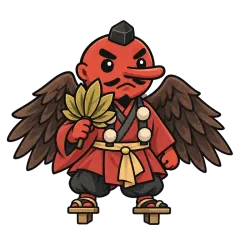
A tengu usually looks like a mountain ascetic, a yamabushi, with a red face, a tall nose and wings on its back. It holds a fan of feathers, a sword or a staff, and it can fly wherever it likes [3]. Many pictures also give it tall wooden sandals with a single tooth [4].
There are two classic kinds. The great tengu, the daitengu, has the long nose and an almost human body. The small crow tengu, the karasu-tengu, keeps a bird's beak [3][5]. Statues and folk crafts often show the two together, the long-nosed tengu as the master and the crow tengu as its follower [2].
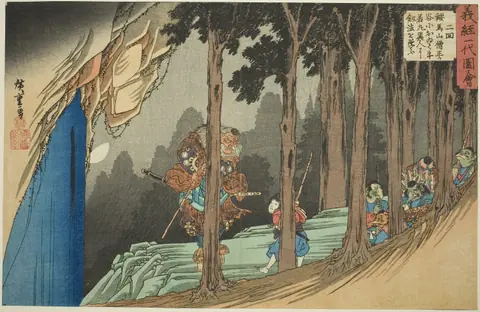
The long nose is late. In the Heian period the tengu was most often pictured as a kite, a bird of prey [4]. The National Diet Library dates the familiar long-nosed tengu to the Muromachi period and says it is often credited to the painter Kanō Motonobu, who drew the great tengu of Mount Kurama. One theory has him make it look stronger and grander than a crow tengu [2]. Japanese Wikipedia finds long noses a little earlier, in picture scrolls of the late Kamakura period [4]. The bird never quite left: in 1776 Toriyama Sekien still drew the tengu as a great bird [4][7].
Why the nose grew is still argued. The folklorist Gorai Shigeru traced it to an old gigaku dance mask with a tall nose [3]. Other scholars find no written support for that, and read the nose as a bird's beak made human: in one medieval picture scroll, a tengu in human shape turns back into a kite, and its nose stretches into the upper half of the beak [4]. The god Sarutahiko, described with a very long nose, is often mixed up with the tengu, and festival dancers playing him wear a tengu mask [2][4].
What does a tengu do?
A tengu makes the mountains strange. Folk tales blame it for sounds with no visible cause, for stones thrown from nowhere, and for people who vanish [2][4].
The earliest tengu of folk belief had no shape at all, only a sound [2]. People heard a tree being cut and crashing down, and the next day found nothing fallen: that was tengu-daoshi, the tengu's felling. Others heard lively flute music from deep in the mountains where no one lived [2]. In Gunma, laughter rang out from nowhere and grew louder each time a walker laughed back [4]. In one story recorded by the folklorist Hayakawa Kōtarō, a group of sawyers held a loud drinking party in their mountain hut. Stones and fireballs flew, the hut shook and trees crashed all night, and at dawn not one tree had fallen [4].
Tengu also carry people away. Many tales of people spirited away say a tengu took them flying through the sky and showed them other worlds [2]. Medieval stories add a darker side: the tengu of the Konjaku Monogatarishū (late Heian) work against Buddhism, and lose. One appears in a treetop as a Buddha, and once its disguise is exposed it turns out to be a bird [2].
Is the tengu good or evil?
The tengu is both, and the old dictionaries sort it into kinds. The Nihon Kokugo Daijiten names three: mountain gods who reward good and protect Buddhism, monks who fell through pride, and people who fell through a grudge or rage they carried in life [3].
The protectors have names and mountains. Sōjōbō of Mount Kurama, Tarōbō of Mount Atago and Sanjakubō of Mount Akiha are worshipped to this day [3][4]. Sōjōbō is the tengu said to have taught swordplay to the boy Ushiwakamaru, who grew up to be the warrior Minamoto no Yoshitsune [2][3]. The Noh play Kurama Tengu tells that story, and in the Edo period it made the tengu a favourite of ordinary people [2].
The demon side came from the same mountains. People feared the wild spirit of the peaks, which raised storms, made strange noises and took people, and gave that fear to the tengu [3]. Even so, many tales end gently. Children taken by a tengu were said to come home a few days later and tell of flying through the sky [3]. In a valley in Nagano, a tengu that made trouble in the village stopped once people built it a shrine and worshipped it as a god [4].
Why does a proud person "become a tengu"?
In Japanese, "tengu ni naru" (天狗になる), to become a tengu, means to get carried away and brag, to be full of yourself [1]. The tengu was seen as pride made flesh, and its tall nose as the sign of it [4].
The idea is medieval. Arrogant monks and ascetics were said to fall, after death, onto a road of their own, tengudō, the way of the tengu: their Buddhist learning kept them out of hell, and their wrong ways kept them out of paradise [4][5]. The Tengu Zōshi picture scrolls of 1296 drew the monks of seven great temples as tengu to mock their arrogance [3][4]. The dictionary records "tengu" for a conceited person by 1814 [3].
Where does the tengu come from?
The tengu began as a shooting star. In China, 天狗 was a fireball that fell with a roar, read as a dog charging down from heaven and feared as a sign of disaster [4].
The name first appears in Japan in the Nihon Shoki, under the year 637. A huge star crossed the sky over the capital with a noise like thunder, and the monk Min, just back from China, said it was no falling star but a tengu, whose barking sounds like thunder [4]. The text reads the characters as amatsukitsune, "the fox of heaven" [3][4]. After that the word vanishes from the records for centuries [4].
When it returns in the Heian period, the tengu is a creature of the mountains [4]. It took in the spirits of the peaks, the restless dead and Buddhist ideas of demons, and the mountain ascetics of Shugendō gave it their own robes [3]. The Tale of Genji already names the tengu among the things that lead people astray [3].
Stories about the tengu

The tengu in Japanese
The name tengu (天狗) means "heavenly dog": 天 is heaven and 狗 is an old character for a dog [4]. It keeps its old sense of pride in everyday Japanese. 天狗になる is to become conceited, and 天狗の鼻をへし折る, to snap a tengu's nose, means to take a boastful person down a peg [1][3].
Six words from its tales, and the levels where you learn them:
- 天てんskyLevel 8 · Rokurokubi
- 山やまmountainLevel 1 · Kitsune
- 鼻はなnoseLevel 3 · Tōfu-kozō
- 自慢じまんprideLevel 5 · Chōchin-obake
- 翼つばさwingLevel 10 · Kappa
- 鳥とりbirdLevel 2 · Kasa-obake
Yomimaru 6k vocabulary deck words 2,751 to 3,000
These are the 250 Japanese words of level 12. Complete the level in Yomimaru to unlock the Tengu. By JLPT level: 67 N4, 67 N3, 82 N2, 26 N1 and 8 outside the JLPT lists. The easiest come first.
| Rank | Word | Reading | Meaning | JLPT |
|---|---|---|---|---|
| 2,926 | サラリーマン | office worker | N4 | |
| 2,927 | にんじん | carrot (Daucus carota) | N4 | |
| 2,928 | ゴール | goal (in soccer, hockey, etc.) | N4 | |
| 2,929 | ジャケット | jacket | N4 | |
| 2,930 | ベルト | belt (worn around the waist) | N4 | |
| 2,931 | ライター | lighter | N4 | |
| 2,932 | カフェ | café | N4 | |
| 2,933 | いつでも | always | N4 | |
| 2,934 | センチ | centimeter | N4 | |
| 2,935 | タイヤ | tire | N4 | |
| 2,936 | ゴリラ | gorilla (Gorilla spp., esp. western gorilla, Gorilla gorilla) | N4 | |
| 2,937 | 味噌汁 | みそしる | miso soup | N4 |
| 2,938 | 忘れ物 | わすれもの | lost article | N4 |
| 2,939 | ステーキ | steak | N4 | |
| 2,940 | パジャマ | pajamas | N4 | |
| 2,941 | バイオリン | violin | N4 | |
| 2,942 | コンピュータ | computer | N4 | |
| 2,943 | パイロット | pilot | N4 | |
| 2,944 | 綿 | めん | cotton | N4 |
| 2,945 | エアコン | air conditioner | N4 | |
| 2,946 | チョコ | chocolate | N4 | |
| 2,947 | レモン | lemon | N4 | |
| 2,948 | クッキー | cookie | N4 | |
| 2,949 | ソース | sauce | N4 | |
| 2,950 | この頃 | このごろ | these days | N4 |
| 2,952 | ゴルフ | golf | N4 | |
| 2,953 | コイン | coin | N4 | |
| 2,954 | 乗り換える | のりかえる | to transfer (trains) | N4 |
| 2,955 | ピザ | pizza | N4 | |
| 2,956 | じゃがいも | potato (Solanum tuberosum) | N4 | |
| 2,957 | パーセント | percent | N4 | |
| 2,958 | スケート | skating (esp. ice) | N4 | |
| 2,959 | パンツ | underpants | N4 | |
| 2,960 | たまねぎ | onion (Allium cepa) | N4 | |
| 2,961 | レジ | (cash) register | N4 | |
| 2,962 | 柔道 | じゅうどう | judo | N4 |
| 2,963 | アニメ | animation | N4 | |
| 2,964 | 寝坊 | ねぼう | sleeping in late | N4 |
| 2,965 | 運転手 | うんてんしゅ | driver | N4 |
| 2,966 | 大雪 | おおゆき | heavy snow | N4 |
| 2,967 | 美術館 | びじゅつかん | art museum | N4 |
| 2,969 | キャベツ | cabbage (Brassica oleracea) | N4 | |
| 2,971 | 歯医者 | はいしゃ | dentist | N4 |
| 2,972 | チキン | chicken | N4 | |
| 2,973 | だんだん | gradually | N4 | |
| 2,974 | 飛び上がる | とびあがる | to jump up | N4 |
| 2,975 | インク | ink | N4 | |
| 2,976 | 下宿 | げしゅく | boarding | N4 |
| 2,977 | できれば | if possible | N4 | |
| 2,978 | はさみ | scissors | N4 | |
| 2,979 | 家内 | かない | (my) wife | N4 |
| 2,980 | 石鹸 | せっけん | soap | N4 |
| 2,981 | サングラス | sunglasses | N4 | |
| 2,982 | バスケットボール | basketball | N4 | |
| 2,983 | メロン | melon (esp. a muskmelon, Cucumis melo) | N4 | |
| 2,984 | 度 | たび | time (three times, each time, etc.) | N4 |
| 2,985 | 動物園 | どうぶつえん | zoo | N4 |
| 2,986 | シーツ | sheet | N4 | |
| 2,987 | 読み方 | よみかた | pronunciation | N4 |
| 2,988 | ネックレス | necklace | N4 | |
| 2,989 | ポスター | poster | N4 | |
| 2,990 | パスポート | passport | N4 | |
| 2,991 | 酸っぱい | すっぱい | sour | N4 |
| 2,992 | メール | N4 | ||
| 2,993 | いや | no | N4 | |
| 2,994 | 退院 | たいいん | leaving hospital | N4 |
| 2,995 | コーラ | cola (carbonated soft drink) | N4 | |
| 2,752 | 苦痛 | くつう | pain | N3 |
| 2,753 | 恐れる | おそれる | to fear | N3 |
| 2,754 | 鳴らす | ならす | to ring | N3 |
| 2,755 | 増す | ます | to increase | N3 |
| 2,758 | 凍る | こおる | to freeze | N3 |
| 2,759 | トップ | top | N3 | |
| 2,760 | 真っ赤 | まっか | bright red | N3 |
| 2,761 | 温度 | おんど | temperature | N3 |
| 2,766 | 負け | まけ | defeat | N3 |
| 2,767 | 明確 | めいかく | clear | N3 |
| 2,769 | 投票 | とうひょう | voting | N3 |
| 2,783 | いたずら | mischief | N3 | |
| 2,785 | 騒ぎ | さわぎ | uproar | N3 |
| 2,788 | 実施 | じっし | enforcement | N3 |
| 2,800 | 演説 | えんぜつ | speech | N3 |
| 2,803 | 就職 | しゅうしょく | finding employment | N3 |
| 2,806 | 宝 | たから | treasure | N3 |
| 2,808 | 住宅 | じゅうたく | residence | N3 |
| 2,811 | 幸運 | こううん | good luck | N3 |
| 2,812 | 我が家 | わがや | one's house | N3 |
| 2,815 | 返る | かえる | to return | N3 |
| 2,817 | 王様 | おうさま | king | N3 |
| 2,818 | 輪 | わ | ring | N3 |
| 2,819 | 缶 | かん | can | N3 |
| 2,823 | 現金 | げんきん | cash | N3 |
| 2,824 | 考え方 | かんがえかた | way of thinking | N3 |
| 2,825 | 願い | ねがい | desire | N3 |
| 2,826 | 羊 | ひつじ | sheep (Ovis aries) | N3 |
| 2,828 | 取り上げる | とりあげる | to pick up | N3 |
| 2,829 | どうか | please | N3 | |
| 2,837 | なぜなら | because | N3 | |
| 2,839 | 時には | ときには | at times | N3 |
| 2,840 | 規則 | きそく | rule | N3 |
| 2,841 | 人数 | にんずう | the number of people | N3 |
| 2,842 | 順調 | じゅんちょう | favourable | N3 |
| 2,847 | 超 | ちょう | super- | N3 |
| 2,858 | 頭痛 | ずつう | headache | N3 |
| 2,865 | プロジェクト | project | N3 | |
| 2,866 | 可愛らしい | かわいらしい | lovely | N3 |
| 2,867 | 気の毒 | きのどく | pitiful | N3 |
| 2,868 | 微笑む | ほほえむ | to smile | N3 |
| 2,871 | メッセージ | message | N3 | |
| 2,872 | 売れる | うれる | to sell (well) | N3 |
| 2,875 | 座席 | ざせき | seat | N3 |
| 2,879 | のち | later | N3 | |
| 2,880 | デザイン | design | N3 | |
| 2,882 | 休憩 | きゅうけい | rest | N3 |
| 2,883 | 級 | きゅう | (school) grade | N3 |
| 2,884 | 指す | さす | to point | N3 |
| 2,894 | 生き物 | いきもの | living thing | N3 |
| 2,895 | 誤る | あやまる | to make a mistake (in) | N3 |
| 2,897 | ショー | show | N3 | |
| 2,899 | 魔法 | まほう | magic | N3 |
| 2,900 | 孫 | まご | grandchild | N3 |
| 2,903 | 隠れる | かくれる | to hide | N3 |
| 2,904 | 敷く | しく | to spread out (e.g. a futon) | N3 |
| 2,906 | 睡眠 | すいみん | sleep | N3 |
| 2,908 | 継ぐ | つぐ | to succeed (a person, to a position, etc.) | N3 |
| 2,910 | 教科書 | きょうかしょ | textbook | N3 |
| 2,918 | さすが | as one would expect | N3 | |
| 2,922 | 説 | せつ | theory | N3 |
| 2,968 | とんでもない | unthinkable | N3 | |
| 2,996 | もしかしたら | perhaps | N3 | |
| 2,997 | 冷房 | れいぼう | air conditioning | N3 |
| 2,998 | 片道 | かたみち | one-way (trip); one-way ticket | N3 |
| 2,999 | 祝日 | しゅくじつ | national holiday | N3 |
| 3,000 | 各駅停車 | かくえきていしゃ | train that stops at every station | N3 |
| 2,756 | 奇跡 | きせき | miracle | N2 |
| 2,757 | 尾 | お | tail (of an animal) | N2 |
| 2,763 | 徹底的 | てっていてき | thorough | N2 |
| 2,765 | 限界 | げんかい | limit | N2 |
| 2,768 | あくまで | to the end | N2 | |
| 2,770 | 章 | しょう | chapter | N2 |
| 2,771 | 試し | ためし | trial | N2 |
| 2,772 | 墓 | はか | grave | N2 |
| 2,773 | 曖昧 | あいまい | vague | N2 |
| 2,775 | 乗客 | じょうきゃく | passenger | N2 |
| 2,776 | うっかり | carelessly | N2 | |
| 2,777 | 発揮 | はっき | show (of power, ability, etc.) | N2 |
| 2,779 | 指定 | してい | designation | N2 |
| 2,780 | 応援 | おうえん | aid | N2 |
| 2,782 | 成果 | せいか | (good) result | N2 |
| 2,787 | かねる | to be unable to | N2 | |
| 2,789 | 剣 | けん | sword (esp. a large, double-edged one) | N2 |
| 2,790 | 高度 | こうど | altitude | N2 |
| 2,791 | 初期 | しょき | early days | N2 |
| 2,792 | 地区 | ちく | district | N2 |
| 2,793 | 医療 | いりょう | medical treatment | N2 |
| 2,796 | 収穫 | しゅうかく | harvest | N2 |
| 2,797 | 網 | あみ | net | N2 |
| 2,798 | 急速 | きゅうそく | rapid (e.g. progress) | N2 |
| 2,801 | 調整 | ちょうせい | adjustment | N2 |
| 2,802 | 物理 | ぶつり | laws of nature | N2 |
| 2,804 | 崩す | くずす | to destroy | N2 |
| 2,805 | まとめる | to collect | N2 | |
| 2,809 | たまる | to collect | N2 | |
| 2,814 | 高価 | こうか | highly priced | N2 |
| 2,820 | 設定 | せってい | establishment | N2 |
| 2,822 | 規模 | きぼ | scale | N2 |
| 2,827 | 主要 | しゅよう | chief | N2 |
| 2,830 | 比較的 | ひかくてき | comparatively | N2 |
| 2,832 | 蓋 | ふた | cover | N2 |
| 2,833 | 嫌がる | いやがる | to appear uncomfortable (with) | N2 |
| 2,835 | 崖 | がけ | cliff | N2 |
| 2,843 | 微妙 | びみょう | subtle | N2 |
| 2,845 | 各地 | かくち | each place | N2 |
| 2,846 | せいぜい | at the most | N2 | |
| 2,848 | 作成 | さくせい | making (a report, plan, contract, etc.) | N2 |
| 2,849 | 引っかかる | ひっかかる | to be caught in | N2 |
| 2,850 | 宣伝 | せんでん | publicity | N2 |
| 2,852 | 動機 | どうき | motive | N2 |
| 2,853 | 建設 | けんせつ | construction | N2 |
| 2,854 | 出版 | しゅっぱん | publication | N2 |
| 2,856 | 手続き | てつづき | procedure | N2 |
| 2,857 | 並 | なみ | average | N2 |
| 2,859 | 予算 | よさん | estimate (of costs) | N2 |
| 2,860 | 尻尾 | しっぽ | tail (of an animal) | N2 |
| 2,861 | 有効 | ゆうこう | valid | N2 |
| 2,862 | 狙い | ねらい | aim (of a gun, bow, etc.) | N2 |
| 2,863 | 援助 | えんじょ | assistance | N2 |
| 2,864 | 視線 | しせん | one's line of sight | N2 |
| 2,869 | 発行 | はっこう | publication (of a newspaper, magazine, book, etc.) | N2 |
| 2,870 | 背後 | はいご | back | N2 |
| 2,873 | 進化 | しんか | evolution | N2 |
| 2,874 | 座 | ざ | seat | N2 |
| 2,877 | 悲鳴 | ひめい | shriek | N2 |
| 2,881 | 再開 | さいかい | reopening | N2 |
| 2,885 | 供給 | きょうきゅう | supply | N2 |
| 2,887 | 発達 | はったつ | development | N2 |
| 2,889 | 余地 | よち | place | N2 |
| 2,890 | 厄介 | やっかい | trouble | N2 |
| 2,891 | 照らす | てらす | to shine on | N2 |
| 2,892 | 運営 | うんえい | management | N2 |
| 2,893 | 押し付ける | おしつける | to press against | N2 |
| 2,898 | 取り出す | とりだす | to take out | N2 |
| 2,901 | 派手 | はで | showy | N2 |
| 2,902 | 見かけ | みかけ | outward appearance | N2 |
| 2,905 | 通 | つう | authority | N2 |
| 2,909 | いつの間にか | いつのまにか | before one knows | N2 |
| 2,911 | 深夜 | しんや | late at night | N2 |
| 2,913 | よこす | to send | N2 | |
| 2,914 | 整理 | せいり | sorting | N2 |
| 2,915 | 眺め | ながめ | scene | N2 |
| 2,916 | ドキドキ | thump-thump | N2 | |
| 2,917 | いわば | so to speak | N2 | |
| 2,919 | 交際 | こうさい | company | N2 |
| 2,923 | 先ほど | さきほど | a short while ago | N2 |
| 2,925 | 悔しい | くやしい | frustrated (over a failure, humiliation or injustice) | N2 |
| 2,951 | 勘違い | かんちがい | misunderstanding | N2 |
| 2,751 | 遅れ | おくれ | delay | N1 |
| 2,762 | 割り | わり | rate | N1 |
| 2,764 | 一見 | いっけん | look | N1 |
| 2,774 | 悟る | さとる | to perceive | N1 |
| 2,778 | 象徴 | しょうちょう | symbol (of something abstract) | N1 |
| 2,781 | 築く | きずく | to build | N1 |
| 2,784 | 権力 | けんりょく | (political) power | N1 |
| 2,794 | 妊娠 | にんしん | pregnancy | N1 |
| 2,795 | 大胆 | だいたん | bold | N1 |
| 2,799 | 悩み | なやみ | trouble | N1 |
| 2,810 | 革命 | かくめい | revolution | N1 |
| 2,813 | 貧乏 | びんぼう | poverty-stricken | N1 |
| 2,821 | たどる | to follow (a road, path, etc.) | N1 | |
| 2,831 | 避難 | ひなん | taking refuge | N1 |
| 2,834 | いい加減 | いいかげん | irresponsible | N1 |
| 2,836 | 高まる | たかまる | to rise | N1 |
| 2,851 | 顎 | あご | jaw | N1 |
| 2,855 | 信仰 | しんこう | (religious) faith | N1 |
| 2,876 | 内緒 | ないしょ | secrecy | N1 |
| 2,878 | 誠に | まことに | indeed | N1 |
| 2,886 | 逃す | のがす | to miss (e.g. a chance) | N1 |
| 2,896 | 忠実 | ちゅうじつ | faithful | N1 |
| 2,907 | 争い | あらそい | fight | N1 |
| 2,912 | 暴力 | ぼうりょく | violence | N1 |
| 2,921 | 英雄 | えいゆう | hero | N1 |
| 2,970 | でかい | huge | N1 | |
| 2,786 | 見た目 | みため | appearance | |
| 2,807 | 知り合う | しりあう | to get to know each other | |
| 2,816 | ありえない | impossible | ||
| 2,838 | 罠 | わな | trap (for catching animals) | |
| 2,844 | される | to be done (to someone or something) | ||
| 2,888 | 何百 | なんびゃく | hundreds | |
| 2,920 | そういった | like that | ||
| 2,924 | 勝手 | かって | one's own convenience |
Sources
- EncyclopediaKotobank, "天狗になる", from the dictionary Digital Daijisen (Shogakukan)
- Archive recordNational Diet Library, "強い天狗 弱い天狗 (Strong tengu, weak tengu): why is the tengu's nose long?", 108th permanent exhibition, list of items (2000)
- EncyclopediaKotobank, "天狗", from Digital Daijisen, Nihon Kokugo Daijiten and Heibonsha's Sekai Daihyakka Jiten (entry by Gorai Shigeru)
- EncyclopediaJapanese Wikipedia, "天狗"
- EncyclopediaEnglish Wikipedia, "Tengu"
- Archive recordArt Institute of Chicago, Utagawa Hiroshige, Ushiwakamaru Learns Swordplay from the Tengu at Sōjōgatani on Mount Kurama, from The Life of Yoshitsune (about 1832 to 1834)
- Archive recordNational Diet Library, "The world of yokai in Toriyama Sekien's yokai picture books", NDL Image Bank
The art on this page was drawn for Yomimaru.
Questions
What does a tengu do?
In folk tales a tengu makes the mountains strange: the crash of a tree that never fell, stones thrown from nowhere, laughter with no one there. It also carries people off and flies them to far places. See what a tengu does.
Is a tengu good or evil?
Both. The oldest tales make it a demon that tricks monks, but the great tengu of sacred mountains such as Kurama and Atago are worshipped as protectors. See whether the tengu is good or evil.
Why does a tengu have a long nose?
The first tengu were pictured as birds of prey, and the long nose came centuries later, in the late Middle Ages. One theory reads it as a bird's beak turned human; another traces it to an old dance mask. See what a tengu looks like.
What does "tengu ni naru" mean?
"Tengu ni naru" (天狗になる), "to become a tengu", means to get conceited and brag. The tengu was a figure of pride, and its tall nose became the sign of it. See why a proud person becomes a tengu.