
- Japanese
- 傘お化け (かさおばけ)
- Means
- umbrella ghost
- Also called
- karakasa-obake (から傘おばけ), karakasa kozō (唐傘小僧), kasa-bake (傘化け), ippon-ashi (一本足)
- Found in
- Edo picture books, toy prints, ghost-card games and kabuki, more than in local tales
What does a kasa-obake look like?
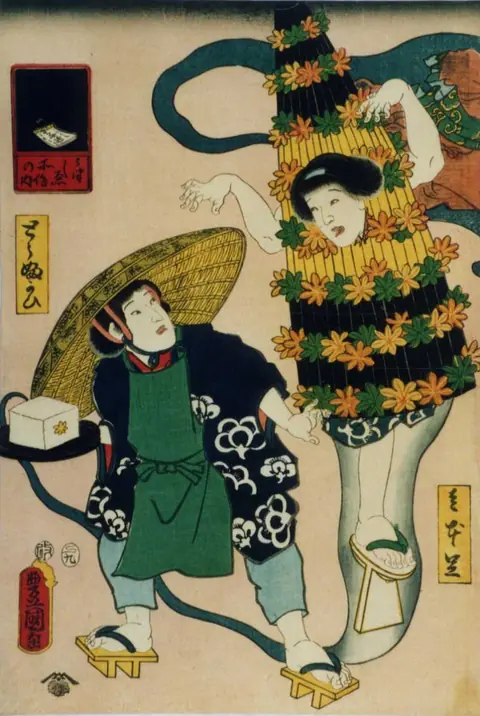
A kasa-obake is an old paper umbrella with one eye and a single leg where the handle should be, and it hops [1][2]. Pictures often give it a long tongue, and some give it two arms or two eyes [1][2]. A few scrolls even give it two legs [1].
That look comes from the Edo period. One-eyed, one-legged umbrellas appear in Edo pictures, and the picture cards of the obake karuta, a ghost-card game played from the Edo period into the Taishō era, show it again and again [1]. Kabuki dancers dressed as it, with their own faces showing through the paper [1]. A dance staged at the Nakamura-za theatre in September 1857 had a role called ippon-ashi (一本足), "one leg" [1].
What does a kasa-obake do?
A kasa-obake hops out at people and startles them, and that is about all: there are almost no local stories about it [1][2]. Some books on yokai class it as a yokai that exists only in pictures [1][2].
The few traces are thin. In Sasakami, a village in Niigata, people said a karakasa bakemon, an umbrella monster, appeared at a place called Sanjūgari [1]. A collection of strange tales from 1762 lists "the umbrella of Tōkabō" among seven monsters of Kōfuku-ji, the temple in Nara, without saying what it did [1].
Is the kasa-obake evil?
Where does the kasa-obake come from?
The kasa-obake is usually explained as a tsukumogami, a tool that gains a spirit with age, but no classical text says so [1][2]. The idea of the tsukumogami is old. A dictionary defines it as a spirit that lives in an object 100 years old and can change shape or harm people [3].
The Muromachi scroll Tsukumogami Emaki opens with that rule: a tool that passes 100 years changes, gains a spirit and deceives people [4][5]. It then tells the story behind the lore. Each year, at the soot-sweeping before the new year, people threw their old tools into the lanes so they would not reach 100 [4][5]. The tools, discarded one year short, were furious, became yokai on the night of Setsubun and took revenge, until they were defeated and turned to Buddhism [4]. Heibonsha's encyclopedia sums it up from the scroll: worn-out tools thrown away become demons called tsukumogami [3]. The word itself is read as "ninety-nine", one year short of a hundred [4].
That is the tale the umbrella's lore borrows, but the scroll never names an umbrella. The Muromachi Hyakki Yagyō scrolls do show an umbrella yokai among the walking tools, but it is a figure wearing a folded umbrella on its head, not the one-legged umbrella [1][2]. The kasa-obake as people know it was drawn in the Edo period, and the books that call it a tsukumogami came later [1].
The kasa-obake in Japanese
The name kasa-obake joins 傘, an umbrella, to お化け, a ghost or a thing that changes its shape. Its older name, karakasa (唐傘), is the oiled-paper umbrella, literally a "Chinese umbrella". In Yomimaru, an app for learning Japanese, the Yomimaru 6k vocabulary deck prints the ghost in kana, おばけ.
Six words from its tales, and the levels where you learn them:
- 傘かさumbrellaLevel 4 · Komainu
- 雨あめrainLevel 2 · Kasa-obake
- 目めeyeLevel 1 · Kitsune
- 足あしfootLevel 1 · Kitsune
- 舌したtongueLevel 8 · Rokurokubi
- 古いふるいoldLevel 2 · Kasa-obake
Yomimaru 6k vocabulary deck words 251 to 500
These are the 250 Japanese words of level 2. Complete the level in Yomimaru to unlock the Kasa-obake. By JLPT level: 134 N5, 114 N4 and 2 outside the JLPT lists. The easiest come first.
| Rank | Word | Reading | Meaning | JLPT |
|---|---|---|---|---|
| 253 | 家族 | かぞく | family | N5 |
| 255 | 難しい | むずかしい | difficult | N5 |
| 256 | 一日 | いちにち | one day | N5 |
| 259 | 夏 | なつ | summer | N5 |
| 261 | 会社 | かいしゃ | company | N5 |
| 264 | 空 | そら | sky | N5 |
| 265 | 全部 | ぜんぶ | all | N5 |
| 266 | 雨 | あめ | rain | N5 |
| 267 | 結婚 | けっこん | marriage | N5 |
| 270 | 小さい | ちいさい | small | N5 |
| 271 | 色 | いろ | colour | N5 |
| 272 | 電話 | でんわ | telephone call | N5 |
| 275 | ありがとう | thank you | N5 | |
| 277 | 降る | ふる | to fall (of rain, snow, ash, etc.) | N5 |
| 278 | あれ | that | N5 | |
| 279 | 遅い | おそい | slow | N5 |
| 280 | 付く | つく | to be attached | N5 |
| 284 | 駅 | えき | railway station | N5 |
| 286 | 元気 | げんき | lively | N5 |
| 287 | 猫 | ねこ | cat (esp. the domestic cat, Felis catus) | N5 |
| 292 | 少ない | すくない | few | N5 |
| 294 | 海 | うみ | sea | N5 |
| 296 | 重い | おもい | heavy | N5 |
| 298 | 飛ぶ | とぶ | to fly | N5 |
| 299 | 写真 | しゃしん | photograph | N5 |
| 300 | 一人 | ひとり | one person | N5 |
| 301 | 三 | さん | three | N5 |
| 303 | どうして | how | N5 | |
| 305 | ちょうど | exactly | N5 | |
| 306 | いくら | how much | N5 | |
| 307 | 絵 | え | picture | N5 |
| 308 | 服 | ふく | clothes (esp. Western clothes) | N5 |
| 309 | 綺麗 | きれい | pretty | N5 |
| 313 | 年 | とし | year | N5 |
| 315 | 古い | ふるい | old | N5 |
| 316 | 今年 | ことし | this year | N5 |
| 317 | 切る | きる | to cut | N5 |
| 318 | どうぞ | please; here you are | N5 | |
| 320 | おる | to be (animate) | N5 | |
| 322 | 大切 | たいせつ | important | N5 |
| 323 | 寒い | さむい | cold (e.g. weather) | N5 |
| 324 | 近い | ちかい | near | N5 |
| 326 | 座る | すわる | to sit (down) | N5 |
| 327 | 消える | きえる | to disappear | N5 |
| 331 | 泣く | なく | to cry | N5 |
| 333 | 痛い | いたい | painful | N5 |
| 334 | 遊ぶ | あそぶ | to play (games, sports) | N5 |
| 335 | 変 | へん | strange | N5 |
| 337 | 歌 | うた | song | N5 |
| 338 | 頼む | たのむ | to request | N5 |
| 339 | かわいい | cute | N5 | |
| 342 | 優しい | やさしい | tender | N5 |
| 344 | 借りる | かりる | to borrow | N5 |
| 345 | 十 | じゅう | ten | N5 |
| 346 | 止まる | とまる | to stop (moving) | N5 |
| 349 | 火 | ひ | fire | N5 |
| 350 | 大丈夫 | だいじょうぶ | all right; no thanks | N5 |
| 353 | 有名 | ゆうめい | famous | N5 |
| 354 | ニュース | news | N5 | |
| 355 | お酒 | おさけ | alcohol | N5 |
| 356 | 多分 | たぶん | probably | N5 |
| 357 | 春 | はる | spring | N5 |
| 360 | アメリカ | (United States of) America | N5 | |
| 364 | やめる | to stop (an activity) | N5 | |
| 366 | 川 | かわ | river | N5 |
| 367 | 返す | かえす | to return (something) | N5 |
| 370 | 病気 | びょうき | illness (usu. excluding minor ailments, e.g. common cold) | N5 |
| 371 | 歌う | うたう | to sing | N5 |
| 372 | さあ | come (on) | N5 | |
| 374 | 着る | きる | to wear (from the shoulders down) | N5 |
| 377 | 村 | むら | village | N5 |
| 380 | 窓 | まど | window | N5 |
| 381 | 勉強 | べんきょう | study | N5 |
| 383 | 音楽 | おんがく | music | N5 |
| 385 | 料理 | りょうり | cooking | N5 |
| 387 | 質問 | しつもん | question | N5 |
| 390 | 雪 | ゆき | snow | N5 |
| 394 | 髪 | かみ | hair (on the head) | N5 |
| 396 | 広い | ひろい | spacious | N5 |
| 397 | 皆さん | みなさん | all | N5 |
| 400 | お願い | おねがい | request | N5 |
| 408 | 箱 | はこ | box | N5 |
| 412 | 薬 | くすり | medicine | N5 |
| 413 | 女の子 | おんなのこ | girl | N5 |
| 414 | 午後 | ごご | afternoon | N5 |
| 418 | 出かける | でかける | to go out (e.g. on an excursion or outing) | N5 |
| 423 | おいしい | good(-tasting) | N5 | |
| 424 | 鳥 | とり | bird | N5 |
| 426 | 旅行 | りょこう | travel | N5 |
| 430 | ええ | yes | N5 | |
| 433 | 耳 | みみ | ear | N5 |
| 434 | 忙しい | いそがしい | busy | N5 |
| 435 | 二つ | ふたつ | two | N5 |
| 437 | 映画 | えいが | movie | N5 |
| 438 | 肉 | にく | meat; flesh | N5 |
| 440 | 妹 | いもうと | younger sister | N5 |
| 441 | 引く | ひく | to pull | N5 |
| 443 | 新聞 | しんぶん | newspaper | N5 |
| 444 | あんな | that sort of | N5 | |
| 445 | 五 | ご | five | N5 |
| 446 | 動物 | どうぶつ | animal | N5 |
| 447 | 弟 | おとうと | younger brother | N5 |
| 448 | 隣 | となり | next (to) | N5 |
| 450 | 白い | しろい | white | N5 |
| 452 | 赤い | あかい | red | N5 |
| 453 | ああ | ah! | N5 | |
| 454 | 石 | いし | stone | N5 |
| 459 | 低い | ひくい | low (rank, degree, value, content, quality, etc.) | N5 |
| 464 | 冬 | ふゆ | winter | N5 |
| 465 | これから | from now on | N5 | |
| 466 | お母さん | おかあさん | mother | N5 |
| 467 | 電車 | でんしゃ | train | N5 |
| 468 | 右 | みぎ | right | N5 |
| 470 | 大学 | だいがく | university | N5 |
| 473 | 一 | いち | one | N5 |
| 476 | 安い | やすい | cheap | N5 |
| 477 | 渡る | わたる | to cross over | N5 |
| 479 | 生まれる | うまれる | to be born | N5 |
| 480 | 円 | えん | yen (Japanese monetary unit) | N5 |
| 481 | 兄 | あに | older brother | N5 |
| 482 | 病院 | びょういん | hospital | N5 |
| 483 | 軽い | かるい | light (i.e. not heavy) | N5 |
| 484 | 上る | のぼる | to ascend | N5 |
| 485 | 魚 | さかな | fish | N5 |
| 487 | 静か | しずか | quiet | N5 |
| 488 | 後ろ | うしろ | back | N5 |
| 489 | 秋 | あき | autumn | N5 |
| 490 | 時々 | ときどき | sometimes | N5 |
| 492 | 手紙 | てがみ | letter | N5 |
| 494 | 休む | やすむ | to be absent | N5 |
| 495 | どうも | thank you | N5 | |
| 496 | 半分 | はんぶん | half | N5 |
| 497 | 紙 | かみ | paper | N5 |
| 498 | 靴 | くつ | shoe | N5 |
| 251 | 深い | ふかい | deep | N4 |
| 252 | 合う | あう | to come together | N4 |
| 254 | 進む | すすむ | to advance | N4 |
| 257 | 怖い | こわい | scary | N4 |
| 258 | まず | first (of all) | N4 | |
| 260 | 動く | うごく | to move | N4 |
| 262 | 開く | ひらく | to open | N4 |
| 263 | 慣れる | なれる | to get used to | N4 |
| 268 | 用 | よう | for the use of ...; business | N4 |
| 269 | 最も | もっとも | most | N4 |
| 273 | だめ | no good | N4 | |
| 274 | 驚く | おどろく | to be surprised | N4 |
| 276 | 聞こえる | きこえる | to be heard | N4 |
| 281 | 警察 | けいさつ | police | N4 |
| 282 | もし | if | N4 | |
| 283 | 危険 | きけん | danger | N4 |
| 285 | 計画 | けいかく | plan | N4 |
| 288 | 必ず | かならず | always | N4 |
| 289 | くださる | to give | N4 | |
| 290 | いただく | to receive | N4 | |
| 291 | もちろん | of course | N4 | |
| 293 | いけない | bad | N4 | |
| 295 | 簡単 | かんたん | simple | N4 |
| 297 | 起こす | おこす | to raise | N4 |
| 302 | 女性 | じょせい | woman | N4 |
| 304 | 鳴る | なる | to sound | N4 |
| 310 | 無理 | むり | unreasonable | N4 |
| 311 | 払う | はらう | to pay (e.g. money, bill) | N4 |
| 312 | 怒る | おこる | to get angry | N4 |
| 314 | 通る | とおる | to go by | N4 |
| 319 | 喜ぶ | よろこぶ | to be delighted | N4 |
| 321 | 当たる | あたる | to be hit | N4 |
| 325 | まあ | just (e.g. "just wait here") | N4 | |
| 328 | 勝つ | かつ | to win | N4 |
| 329 | 光 | ひかり | light | N4 |
| 330 | 全然 | ぜんぜん | (not) at all | N4 |
| 332 | そんなに | so much | N4 | |
| 336 | 失敗 | しっぱい | failure | N4 |
| 340 | つける | to attach | N4 | |
| 341 | 嘘 | うそ | lie | N4 |
| 343 | 素晴らしい | すばらしい | wonderful | N4 |
| 347 | 親 | おや | parent | N4 |
| 348 | 始め | はじめ | beginning | N4 |
| 351 | 一杯 | いっぱい | one cup (of) | N4 |
| 352 | 特に | とくに | particularly | N4 |
| 358 | 捨てる | すてる | to throw away | N4 |
| 359 | 予定 | よてい | plans | N4 |
| 361 | 形 | かたち | form | N4 |
| 362 | 反対 | はんたい | opposition | N4 |
| 363 | 眠る | ねむる | to sleep | N4 |
| 365 | お客さん | おきゃくさん | guest | N4 |
| 368 | 食事 | しょくじ | meal | N4 |
| 369 | 確か | たしか | sure | N4 |
| 373 | 落ちる | おちる | to fall | N4 |
| 375 | 打つ | うつ | to hit | N4 |
| 376 | 壁 | かべ | wall | N4 |
| 378 | 経験 | けいけん | experience | N4 |
| 379 | 自由 | じゆう | freedom | N4 |
| 382 | いたす | to do | N4 | |
| 384 | 準備 | じゅんび | preparation | N4 |
| 386 | 用意 | ようい | preparation | N4 |
| 388 | 息子 | むすこ | son | N4 |
| 391 | 妻 | つま | wife | N4 |
| 392 | 決める | きめる | to decide | N4 |
| 393 | 亡くなる | なくなる | to die | N4 |
| 395 | 席 | せき | seat | N4 |
| 398 | 大事 | だいじ | important | N4 |
| 399 | 残念 | ざんねん | regrettable | N4 |
| 401 | 違い | ちがい | difference | N4 |
| 402 | やっと | at last | N4 | |
| 403 | 約束 | やくそく | promise | N4 |
| 404 | おかしい | funny | N4 | |
| 405 | 船 | ふね | ship | N4 |
| 406 | すごい | terrible | N4 | |
| 407 | はっきり | clearly | N4 | |
| 409 | 正しい | ただしい | right | N4 |
| 410 | 紹介 | しょうかい | introduction | N4 |
| 411 | 決して | けっして | (not) ever | N4 |
| 415 | 感じ | かんじ | feeling | N4 |
| 416 | 興味 | きょうみ | interest (in something) | N4 |
| 417 | 事故 | じこ | accident | N4 |
| 419 | 気分 | きぶん | feeling | N4 |
| 420 | 見つかる | みつかる | to be found | N4 |
| 421 | 森 | もり | forest | N4 |
| 422 | 思い | おもい | thought | N4 |
| 425 | 落とす | おとす | to drop | N4 |
| 427 | 社会 | しゃかい | society | N4 |
| 428 | 腕 | うで | arm | N4 |
| 429 | 急ぐ | いそぐ | to hurry | N4 |
| 431 | なさる | to do | N4 | |
| 432 | 周り | まわり | circumference | N4 |
| 436 | 決まる | きまる | to be decided | N4 |
| 439 | 星 | ほし | star (usu. excluding the Sun) | N4 |
| 442 | 夫 | おっと | husband | N4 |
| 449 | 悲しい | かなしい | sad | N4 |
| 451 | 失礼 | しつれい | discourtesy | N4 |
| 455 | 空気 | くうき | air | N4 |
| 456 | 迎える | むかえる | to go out to meet | N4 |
| 457 | 指 | ゆび | finger | N4 |
| 458 | 歴史 | れきし | history | N4 |
| 460 | びっくり | to be surprised | N4 | |
| 461 | 押す | おす | to push | N4 |
| 462 | 特別 | とくべつ | special | N4 |
| 463 | 集まる | あつまる | to gather | N4 |
| 469 | 回る | まわる | to turn | N4 |
| 471 | 今夜 | こんや | this evening | N4 |
| 472 | 比べる | くらべる | to compare | N4 |
| 474 | 厳しい | きびしい | severe | N4 |
| 475 | 答え | こたえ | answer | N4 |
| 478 | 馬 | うま | horse | N4 |
| 486 | 解く | とく | to untie | N4 |
| 491 | 面 | めん | face | N4 |
| 493 | 首 | くび | neck | N4 |
| 499 | 小説 | しょうせつ | novel | N4 |
| 389 | 三人 | さんにん | three people | |
| 500 | 私たち | わたしたち | we |
Sources
- EncyclopediaJapanese Wikipedia, "からかさ小僧"
- EncyclopediaEnglish Wikipedia, "Kasa-obake"
- EncyclopediaKotobank, "付喪神", from Digital Daijisen (Shogakukan) and Sekai Daihyakka Jiten (Heibonsha)
- EncyclopediaJapanese Wikipedia, "付喪神"
- EncyclopediaEnglish Wikipedia, "Tsukumogami"
The art on this page was drawn for Yomimaru.
Questions
Is the kasa-obake a tsukumogami?
Usually it is counted as one: a tsukumogami is an old tool that gains a spirit, said to happen at 100 years. But no classical text says the umbrella yokai came about that way; books made the link later. See where the kasa-obake comes from.
Is the kasa-obake dangerous?
No. It hops about, stares with its one eye and licks people with its long tongue, which is frightening but harmless. See whether the kasa-obake is evil.
Why does the kasa-obake have one leg?
Its handle became the leg. Edo pictures and ghost cards drew it hopping on one leg, often in a wooden sandal, and a kabuki costume of the 1850s was simply called "one leg". See what a kasa-obake looks like.