
- Japanese
- 雪女 (ゆきおんな)
- Means
- snow woman
- Also called
- yuki-jorō (雪女郎), yuki-musume, yuki-onba, yukinba, tsurara-onna
- Found in
- Snowy regions of Japan, from Aomori and Niigata to Nagano, and as far south as Ehime and Ōita
What does a yuki-onna look like?
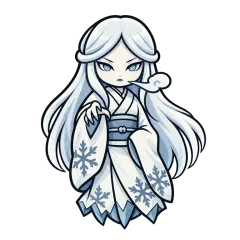
A yuki-onna looks like a woman dressed in white, with a white face, who appears on deep snowy nights [3]. Her touch is cold as ice: in a tale from Kaminoyama in Yamagata, an old man takes a visitor's hand to keep her by the fire, finds it freezing, and watches her turn to a swirl of snow that leaves by the smoke hole [5].
Hearn's version made her beautiful. His snow woman is very lovely, "though her eyes made him afraid", and her breath is "like a bright white smoke" [1]. Japanese tradition is less settled. The folklorist Inokuchi Shōji notes that the beauties of the woodblock prints are a literary development, and that many local tellings picture an old woman, or the ghost of a woman who died in childbirth [3].
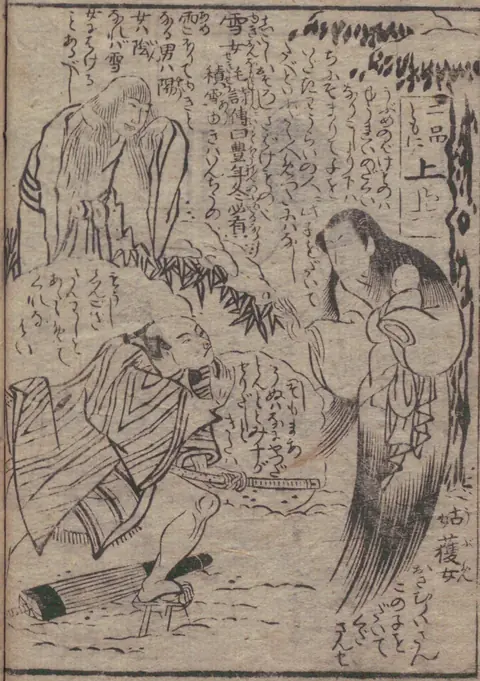
Some accounts make her a giant. The Sōgi Shokoku Monogatari says she stood about one jō, some three metres, and Hearn heard in Matsue of a snow woman with a huge white face who grew taller than the trees at night [5].
What does a yuki-onna do?
A yuki-onna comes out on snowy nights, and what she does depends on the region. In Iwate and Miyagi she drains a person's life, in Niigata she freezes people to death, and in Nishimonai in Akita anyone who sees her face or speaks to her is eaten [5].
Others punish the wrong reply. In Ibaraki and in Iwaki in Fukushima, if she calls to you and you don't answer, she pushes you into a ravine [5].
A common tale has her hand over a child. In Aomori a beautiful woman on a snowy road asks a passer-by to hold her baby, and it grows heavier and heavier in his arms. A man who holds a short sword in his teeth, so the blade stays near the baby's head, keeps it from growing. When the woman comes back for her child, she gives him treasure or great strength [3][5].
In Tōno, in Iwate, she comes out to play on the night of Little New Year, or on a full-moon night in winter, with a crowd of children behind her. Village children sledging on the hills were told to come home early on that night, though few people said they had seen her [4].
Is the yuki-onna good or evil?
The yuki-onna is both a killer and a giver. Many tales make her deadly, but the man who holds her child is rewarded, and in one tale a girl given shelter on a night of blizzard leaves gold in her white robe the next morning [3].
Folklorists read this double side as a sign of an older god. She comes on fixed days: in Aomori she comes down on New Year's Day and goes back on the first day of the hare, which matches the visit of the year god [3]. The man who earns great strength by holding her heavy child matches the ubume, a mother's ghost who tests passers-by the same way [3]. Inokuchi Shōji sets her against the dangers of snow and the long winter shut indoors, which tied her both to the ghosts of the dead and to the year god [3].
Is Hearn's "Yuki-Onna" an old Japanese legend?
Lafcadio Hearn's "Yuki-Onna", in Kwaidan (1904), is the most famous telling, but whether it is an old legend is disputed. Hearn wrote that a farmer of Chōfu in Musashi province told it to him as a legend of his village, and that he did not know whether it had ever been written down [1].
In Hearn's story, two woodcutters shelter from a blizzard in a ferryman's hut. A woman in white breathes on old Mosaku and kills him, then spares the young Minokichi, as long as he never tells anyone [1]. The next winter Minokichi meets a girl called O-Yuki and marries her, and she bears him ten children without growing older. One night he tells her about the woman in the hut. O-Yuki cries that it was her, spares him for the children's sake, and melts into white mist [1].
Researchers have since traced Hearn's tellers to a parent and child from Chōfu village, now part of Ōme in western Tokyo, who worked in his household. A stone marking the story's home was set up by the Chōfu Bridge in Ōme in 2002 [5]. A very similar tale is recorded as a folk tale from Nagano and Toyama [3].
Older accounts differ from Hearn on the main point. The folklorist Fujisawa Morihiko held that the yuki-onna belongs with the ubume, and that no old tale has her marry a man under a promise; Komatsu Kazuhiko traces the yuki-onna bride to Hearn [5]. A version from Yonezawa in Yamagata has a charcoal burner marry a snow wife with no promise of silence at all [5]. The scholar Makino Yōko notes that no version of Hearn's plot is known from before he published it, and that later ones may come from his widely read story [5].
Where does the yuki-onna come from?
The yuki-onna is at least as old as the late Muromachi period. The Nihon Kokugo Daijiten's earliest example comes from the Kōwaka ballad Fushimi Tokiwa, where heavy snow makes someone wonder whether "a thing called a yuki-onna" is about [3].
The Sōgi Shokoku Monogatari, tales about the Muromachi poet Sōgi printed in 1685, has him see a yuki-onna while staying in Echigo, today's Niigata [5][7]. In the Edo period the scholar Yamaoka Genrin argued that she is born from snow itself: deep water breeds fish and thick woods breed birds, so snow, which is yin like woman, might breed a snow woman in Echigo's deep drifts [5].
Folklorists see several strands in her. Ōshima Hiroshi notes that she comes with a child in almost every tale, a sign of a mother-and-child god, and that as the god faded she split into horror stories and comic tales [3]. In the comic ones, a snow wife or snow child who refuses the bath is pushed in at last and melts away, leaving only bubbles or bits of icicle [3][5].
Stories about the yuki-onna


The yuki-onna in Japanese
The name yuki-onna (雪女) means "snow woman": 雪 is snow and 女 is woman. She is also called 雪女郎, and in haiku 雪女 is a word for late winter [3][5].
Hearn's story is easy to find in Japanese. Tanabe Ryūji's translation is on Aozora Bunko, the online library of out-of-copyright texts [2], and Yomimaru, an app for learning Japanese, has it in its library as The Snow Woman (雪女), with furigana.
Six words from her tales, and the levels where you learn them:
- 雪ゆきsnowLevel 2 · Kasa-obake
- 女おんなwomanLevel 1 · Kitsune
- 吹雪ふぶきsnow stormLevel 19 · Gashadokuro
- 息いきbreathLevel 4 · Komainu
- 約束やくそくpromiseLevel 2 · Kasa-obake
- 子供こどもchildLevel 1 · Kitsune
Yomimaru 6k vocabulary deck words 4,751 to 5,000
These are the 250 Japanese words of level 20. Complete the level in Yomimaru to unlock the Yuki-onna. By JLPT level: 57 N3, 106 N2, 50 N1 and 37 outside the JLPT lists. The easiest come first.
| Rank | Word | Reading | Meaning | JLPT |
|---|---|---|---|---|
| 4,756 | 汽車 | きしゃ | train (esp. long distance train) | N3 |
| 4,763 | 鳴き声 | なきごえ | cry (of an animal) | N3 |
| 4,769 | スタンド | stands | N3 | |
| 4,775 | 年中 | ねんじゅう | whole year | N3 |
| 4,779 | 夜中 | よなか | middle of the night | N3 |
| 4,782 | くず | waste | N3 | |
| 4,790 | 食器 | しょっき | tableware | N3 |
| 4,796 | 仮定 | かてい | assumption | N3 |
| 4,803 | ぶどう | grape | N3 | |
| 4,807 | 起き上がる | おきあがる | to rise | N3 |
| 4,812 | 代金 | だいきん | price | N3 |
| 4,816 | 作物 | さくもつ | crop | N3 |
| 4,817 | ソフト | soft | N3 | |
| 4,818 | 年月 | としつき | months and years | N3 |
| 4,831 | くるくる | whirling | N3 | |
| 4,836 | 雑草 | ざっそう | weed | N3 |
| 4,839 | ダイエット | diet | N3 | |
| 4,845 | なし | nashi (esp. Pyrus pyrifolia) | N3 | |
| 4,849 | 何も | なにも | (not) anything | N3 |
| 4,851 | 両足 | りょうそく | both feet | N3 |
| 4,852 | パッと | suddenly | N3 | |
| 4,856 | 帯 | おび | obi (kimono sash) | N3 |
| 4,859 | ライブ | live (broadcasting, music, etc.) | N3 | |
| 4,866 | トン | ton (esp. a metric ton, i.e. 1000 kg) | N3 | |
| 4,867 | 日付 | ひづけ | date | N3 |
| 4,877 | 敗れる | やぶれる | to be defeated | N3 |
| 4,881 | 論じる | ろんじる | to discuss | N3 |
| 4,882 | リーダー | leader | N3 | |
| 4,885 | 予期 | よき | expectation | N3 |
| 4,888 | 競う | きそう | to compete | N3 |
| 4,894 | 差す | さす | to shine | N3 |
| 4,895 | 急ぎ | いそぎ | haste | N3 |
| 4,900 | 用紙 | ようし | blank form | N3 |
| 4,907 | 唸る | うなる | to groan | N3 |
| 4,921 | 臨む | のぞむ | to look out on | N3 |
| 4,922 | マスター | to master (a skill) | N3 | |
| 4,924 | 櫛 | くし | comb | N3 |
| 4,928 | グラウンド | (sports) ground | N3 | |
| 4,929 | 粗末 | そまつ | crude | N3 |
| 4,933 | 野原 | のはら | field | N3 |
| 4,935 | 夕日 | ゆうひ | evening sun | N3 |
| 4,937 | 帰国 | きこく | return to one's country | N3 |
| 4,938 | タワー | tower | N3 | |
| 4,940 | 実家 | じっか | (one's parents') home | N3 |
| 4,946 | ひな | young bird | N3 | |
| 4,951 | 擦る | する | to rub | N3 |
| 4,953 | ダブル | double | N3 | |
| 4,954 | 同級生 | どうきゅうせい | classmate | N3 |
| 4,955 | 裏側 | うらがわ | the reverse (side) | N3 |
| 4,959 | スペース | space | N3 | |
| 4,962 | 稲 | いね | rice plant (Oryza sativa) | N3 |
| 4,967 | 将棋 | しょうぎ | shogi | N3 |
| 4,974 | 至急 | しきゅう | urgent | N3 |
| 4,980 | アドバイス | advice | N3 | |
| 4,984 | 日本一 | にほんいち | Japan's best | N3 |
| 4,985 | 梅 | うめ | Japanese apricot (Prunus mume) | N3 |
| 4,994 | どく | to step aside | N3 | |
| 4,752 | やかましい | noisy | N2 | |
| 4,755 | 増大 | ぞうだい | enlargement | N2 |
| 4,758 | 麓 | ふもと | foot (of a mountain or hill) | N2 |
| 4,762 | 水準 | すいじゅん | level | N2 |
| 4,764 | 探検 | たんけん | exploration | N2 |
| 4,766 | 上がり | あがり | rise | N2 |
| 4,771 | 力強い | ちからづよい | powerful | N2 |
| 4,772 | こつ | knack | N2 | |
| 4,773 | 推理 | すいり | reasoning | N2 |
| 4,776 | 担ぐ | かつぐ | to shoulder | N2 |
| 4,777 | 乗り出す | のりだす | to set out | N2 |
| 4,781 | 出演 | しゅつえん | appearance (in a film, play, TV show, etc.) | N2 |
| 4,783 | 競馬 | けいば | horse racing | N2 |
| 4,791 | 梅雨 | つゆ | (East Asian) rainy season (in Japan, usu. from early June to mid-July) | N2 |
| 4,792 | 速やか | すみやか | quick | N2 |
| 4,793 | 鈍い | にぶい | dull (e.g. a knife) | N2 |
| 4,794 | ネジ | screw | N2 | |
| 4,798 | 受け取り | うけとり | receiving | N2 |
| 4,800 | 方式 | ほうしき | form | N2 |
| 4,801 | 日差し | ひざし | sunlight | N2 |
| 4,805 | 規制 | きせい | regulation | N2 |
| 4,806 | かじる | to gnaw | N2 | |
| 4,809 | 比 | ひ | ratio | N2 |
| 4,810 | 補う | おぎなう | to supplement | N2 |
| 4,811 | 身内 | みうち | relatives | N2 |
| 4,813 | ろうそく | candle | N2 | |
| 4,815 | はしご | ladder | N2 | |
| 4,820 | 仰向け | あおむけ | facing upward | N2 |
| 4,822 | 意地 | いじ | stubbornness | N2 |
| 4,823 | 上流 | じょうりゅう | upper stream | N2 |
| 4,824 | 定義 | ていぎ | definition | N2 |
| 4,827 | 銅 | どう | copper (Cu) | N2 |
| 4,830 | 逃走 | とうそう | flight | N2 |
| 4,832 | 相互 | そうご | mutual | N2 |
| 4,833 | 観測 | かんそく | observation | N2 |
| 4,835 | 歓声 | かんせい | cheer | N2 |
| 4,838 | 駆ける | かける | to run | N2 |
| 4,841 | 放る | ほうる | to throw | N2 |
| 4,844 | 教養 | きょうよう | (understanding or appreciation of) culture | N2 |
| 4,847 | 見分ける | みわける | to distinguish | N2 |
| 4,854 | 何かと | なにかと | one way or another | N2 |
| 4,855 | 再会 | さいかい | meeting again | N2 |
| 4,857 | 調節 | ちょうせつ | regulation | N2 |
| 4,861 | 騒動 | そうどう | riot | N2 |
| 4,862 | 兵隊 | へいたい | soldier | N2 |
| 4,864 | 会合 | かいごう | meeting | N2 |
| 4,865 | 脱走 | だっそう | escape | N2 |
| 4,869 | 寮 | りょう | hostel | N2 |
| 4,870 | アプローチ | approach (to a problem, issue, etc.) | N2 | |
| 4,874 | 体格 | たいかく | build | N2 |
| 4,876 | 行事 | ぎょうじ | event | N2 |
| 4,878 | 長 | ちょう | head | N2 |
| 4,883 | 車輪 | しゃりん | (vehicle) wheel | N2 |
| 4,884 | すれ違う | すれちがう | to pass (by) each other | N2 |
| 4,886 | 投入 | とうにゅう | throwing in | N2 |
| 4,891 | 稽古 | けいこ | practice | N2 |
| 4,892 | 会談 | かいだん | talks (i.e. formal discussions) | N2 |
| 4,896 | 応募 | おうぼ | application | N2 |
| 4,897 | 仰ぐ | あおぐ | to look up (at) | N2 |
| 4,898 | 区域 | くいき | area | N2 |
| 4,899 | 航海 | こうかい | (sea) voyage | N2 |
| 4,901 | 振り回す | ふりまわす | to wield | N2 |
| 4,903 | 花嫁 | はなよめ | bride | N2 |
| 4,904 | 無効 | むこう | invalid | N2 |
| 4,909 | 若干 | じゃっかん | some | N2 |
| 4,910 | 笑み | えみ | smile | N2 |
| 4,911 | 喫煙 | きつえん | smoking (tobacco) | N2 |
| 4,912 | 破産 | はさん | bankruptcy | N2 |
| 4,915 | 調理 | ちょうり | cooking | N2 |
| 4,917 | 騎士 | きし | (medieval) knight | N2 |
| 4,918 | 見抜く | みぬく | to see through | N2 |
| 4,926 | こぐ | to row | N2 | |
| 4,927 | 無断 | むだん | absence of permission | N2 |
| 4,930 | 商業 | しょうぎょう | commerce | N2 |
| 4,931 | 辛抱 | しんぼう | patience | N2 |
| 4,932 | 汚染 | おせん | pollution | N2 |
| 4,934 | 指名 | しめい | naming | N2 |
| 4,939 | 透明 | とうめい | transparent | N2 |
| 4,941 | 起源 | きげん | origin | N2 |
| 4,942 | 美女 | びじょ | beautiful woman | N2 |
| 4,944 | 修正 | しゅうせい | amendment | N2 |
| 4,945 | 正反対 | せいはんたい | exactly the opposite (of) | N2 |
| 4,947 | 清潔 | せいけつ | clean | N2 |
| 4,949 | 暗黒 | あんこく | darkness | N2 |
| 4,950 | 検証 | けんしょう | verification | N2 |
| 4,956 | 高額 | こうがく | large sum (of money) | N2 |
| 4,958 | 牧場 | ぼくじょう | farm (livestock) | N2 |
| 4,961 | 放置 | ほうち | leaving as is | N2 |
| 4,965 | 名乗る | なのる | to give one's name (as) | N2 |
| 4,968 | 中年 | ちゅうねん | middle-age | N2 |
| 4,970 | 知事 | ちじ | prefectural governor | N2 |
| 4,971 | 中毒 | ちゅうどく | poisoning | N2 |
| 4,972 | 目当て | めあて | mark | N2 |
| 4,976 | 交流 | こうりゅう | exchange (e.g. cultural) | N2 |
| 4,977 | 海軍 | かいぐん | navy | N2 |
| 4,979 | 大通り | おおどおり | main street | N2 |
| 4,981 | 呪う | のろう | to curse | N2 |
| 4,983 | 間抜け | まぬけ | stupid | N2 |
| 4,986 | てっぺん | top | N2 | |
| 4,988 | 意義 | いぎ | meaning | N2 |
| 4,991 | 平日 | へいじつ | weekday | N2 |
| 4,993 | かぶせる | to cover (with something) | N2 | |
| 4,996 | 彫刻 | ちょうこく | carving | N2 |
| 4,997 | 頑丈 | がんじょう | solid | N2 |
| 4,998 | よっぽど | very | N2 | |
| 5,000 | 水分 | すいぶん | water | N2 |
| 4,754 | 授ける | さずける | to grant | N1 |
| 4,757 | 爆破 | ばくは | destructive blast | N1 |
| 4,759 | 途切れる | とぎれる | to break off | N1 |
| 4,765 | 破裂 | はれつ | bursting | N1 |
| 4,767 | 利点 | りてん | advantage | N1 |
| 4,770 | 知的 | ちてき | intellectual | N1 |
| 4,774 | 支給 | しきゅう | provision | N1 |
| 4,784 | 痕跡 | こんせき | trace | N1 |
| 4,785 | 滅びる | ほろびる | to go to ruin | N1 |
| 4,788 | ねだる | to beg | N1 | |
| 4,789 | 上陸 | じょうりく | landing | N1 |
| 4,795 | 色彩 | しきさい | colour | N1 |
| 4,799 | 小銭 | こぜに | small change | N1 |
| 4,802 | 侵略 | しんりゃく | invasion (e.g. of a country) | N1 |
| 4,804 | 緩やか | ゆるやか | loose | N1 |
| 4,814 | 貧困 | ひんこん | poverty | N1 |
| 4,826 | 育ち | そだち | growth | N1 |
| 4,828 | 日向 | ひなた | sunny place | N1 |
| 4,837 | 繁栄 | はんえい | prosperity | N1 |
| 4,840 | 営む | いとなむ | to run (a business) | N1 |
| 4,842 | 寝かせる | ねかせる | to put to bed | N1 |
| 4,843 | 侍 | さむらい | warrior (esp. of military retainers of daimyos in the Edo period) | N1 |
| 4,848 | 前提 | ぜんてい | condition | N1 |
| 4,850 | あたかも | as if | N1 | |
| 4,853 | 口実 | こうじつ | excuse | N1 |
| 4,860 | 人柄 | ひとがら | personality | N1 |
| 4,868 | 圧迫 | あっぱく | pressure | N1 |
| 4,879 | 刺 | とげ | thorn | N1 |
| 4,880 | 滑稽 | こっけい | funny | N1 |
| 4,887 | 無論 | むろん | of course | N1 |
| 4,889 | まとう | to put on | N1 | |
| 4,890 | 機構 | きこう | mechanism | N1 |
| 4,893 | 包囲 | ほうい | siege | N1 |
| 4,902 | 仕上げる | しあげる | to finish up | N1 |
| 4,905 | きっぱり | clearly | N1 | |
| 4,908 | 補助 | ほじょ | assistance | N1 |
| 4,914 | 閉鎖 | へいさ | closing | N1 |
| 4,919 | もっぱら | wholly | N1 | |
| 4,920 | 傲慢 | ごうまん | haughty | N1 |
| 4,925 | ことごとく | altogether | N1 | |
| 4,936 | 腕前 | うでまえ | ability | N1 |
| 4,943 | 終始 | しゅうし | beginning and end | N1 |
| 4,948 | 取り扱い | とりあつかい | treatment | N1 |
| 4,960 | お供 | おとも | attendant | N1 |
| 4,964 | 兼 | けん | and (concurrently; e.g. chauffeur and secretary) | N1 |
| 4,978 | 演出 | えんしゅつ | direction (of a play, film, etc.) | N1 |
| 4,989 | 改良 | かいりょう | improvement | N1 |
| 4,990 | 無言 | むごん | silence (not speaking) | N1 |
| 4,992 | 訴訟 | そしょう | lawsuit | N1 |
| 4,995 | 救済 | きゅうさい | relief | N1 |
| 4,751 | 一人暮らし | ひとりぐらし | living by oneself | |
| 4,753 | 生き返る | いきかえる | to revive | |
| 4,760 | 無責任 | むせきにん | irresponsibility | |
| 4,761 | 悪事 | あくじ | evil deed | |
| 4,768 | 遺憾 | いかん | regrettable | |
| 4,778 | 仕草 | しぐさ | gesture | |
| 4,780 | 心地よい | ここちよい | comfortable | |
| 4,786 | 生き残る | いきのこる | to survive | |
| 4,787 | 絆 | きずな | bond (between people) | |
| 4,797 | 引き裂く | ひきさく | to tear up | |
| 4,808 | ギリシャ | Greece | ||
| 4,819 | 一員 | いちいん | one person | |
| 4,821 | お出かけ | おでかけ | about to start out | |
| 4,825 | 受信 | じゅしん | receiving (a message, letter, email, etc.) | |
| 4,829 | 指紋 | しもん | fingerprint | |
| 4,834 | 買収 | ばいしゅう | acquisition (esp. corporate) | |
| 4,846 | 一年間 | いちねんかん | (period of) one year | |
| 4,858 | 持ち帰る | もちかえる | to take home | |
| 4,863 | 誰も | だれも | everyone | |
| 4,871 | やりとり | giving and taking | ||
| 4,872 | 道理 | どうり | reason | |
| 4,873 | 取り残す | とりのこす | to leave behind | |
| 4,875 | 一緒に | いっしょに | together (with) | |
| 4,906 | 差し込む | さしこむ | to insert | |
| 4,913 | 遺言 | ゆいごん | will | |
| 4,916 | 炎上 | えんじょう | going up in flames | |
| 4,923 | 備え | そなえ | preparation | |
| 4,952 | そうすると | having done that | ||
| 4,957 | 絶好 | ぜっこう | best | |
| 4,963 | 一人で | ひとりで | alone | |
| 4,966 | 身元 | みもと | (one's) identity | |
| 4,969 | 当事者 | とうじしゃ | person concerned | |
| 4,973 | 処刑 | しょけい | execution | |
| 4,975 | 損ねる | そこねる | to harm | |
| 4,982 | 短時間 | たんじかん | short time | |
| 4,987 | 遺伝 | いでん | heredity | |
| 4,999 | 体内 | たいない | interior of the body |
Sources
- Folklore studyLafcadio Hearn, Kwaidan: Stories and Studies of Strange Things (1904), "Yuki-Onna" and the author's preface, Project Gutenberg text
- Classic textKoizumi Yakumo (Lafcadio Hearn), 「雪女」, translated by Tanabe Ryūji (1937), Aozora Bunko
- EncyclopediaKotobank, "雪女", from Nihon Kokugo Daijiten, Heibonsha's Sekai Daihyakka Jiten (entry by Ōshima Hiroshi) and Nihon Daihyakka Zensho (entry by Inokuchi Shōji)
- Folklore studyYanagita Kunio, Tōno Monogatari (1910), section 103, Aozora Bunko
- EncyclopediaJapanese Wikipedia, "雪女"
- Archive recordNational Diet Library, Koikawa Harumachi, Bakemono Shiuchi Hyōbanki (妖怪仕内評判記, 1779), scan
- EncyclopediaKotobank, "宗祇諸国物語", from Heibonsha's Sekai Daihyakka Jiten, under the publisher Nishimura Ichirōemon
The art on this page was drawn for Yomimaru.
Questions
What does a yuki-onna do?
She appears on snowy nights. In different regions she freezes travellers with her breath, drains their life, pushes them into ravines, or asks them to hold a baby that grows heavier and heavier. See what a yuki-onna does.
Is the yuki-onna good or evil?
Both. Many tales make her deadly, but in others she rewards a man who holds her child, or a kind household that shelters her turns out to have sheltered gold. See whether the yuki-onna is good or evil.
Is Lafcadio Hearn's "Yuki-Onna" an old Japanese legend?
Hearn said a farmer from Chōfu, in old Musashi province, told it to him as a legend of his village. Scholars disagree on how old it is: the snow woman is old, but no one has found her marriage story written down before Hearn. See Hearn's yuki-onna.
What does yuki-onna mean?
Yuki-onna (雪女) means "snow woman": 雪 is snow and 女 is woman. She is also called yuki-jorō. See the yuki-onna in Japanese.