
- Japanese
- 山姥 (やまうば)
- Means
- mountain old woman
- Also called
- yamanba (山姥), yamahaha (山母), yamahime (山姫), yamajorō (山女郎)
- Found in
- Deep in the mountains, in tales told all over Japan
What does a yama-uba look like?
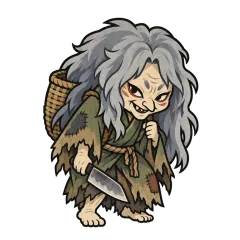
A yama-uba looks like an old woman of the mountains, and in the frightening tales she is a monster. The folk tale of the yama-uba's spinning wheel makes her a white-haired old woman, while the tales of the packhorse driver and of the three charms give her a mouth split to her ears and piercing eyes [1]. In Kusuyama Masao's retelling she wears a ragged grey kimono, and her red hair stands on end as she chews [6].
She is not always old. In Okayama a yamahime of the deep mountains was a beautiful woman of about twenty in a rare-coloured kimono. A hunter shot at her, and she caught the bullet in her hand and smiled [2].
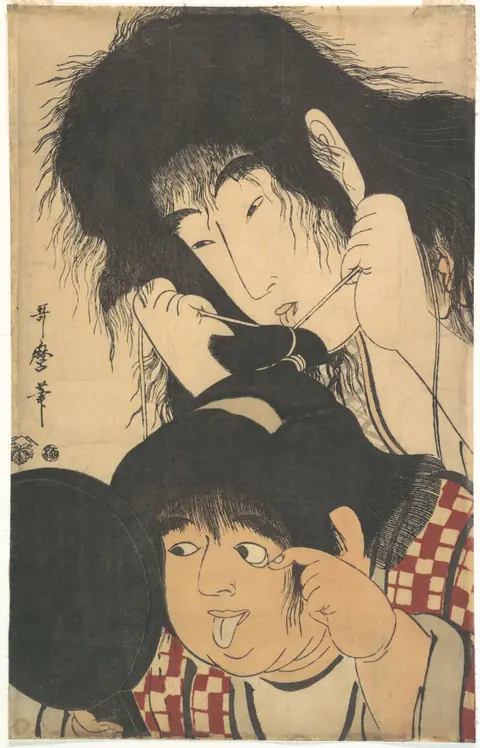
Utamaro's print shows a third yama-uba, young and beautiful, with long wild hair [5]. That one comes from the theatre. Chikamatsu Monzaemon's puppet play Komochi Yamamba (1712) has a courtesan become a yama-uba and raise the strong boy Kaidōmaru in the mountains, and he grows up to be the warrior Sakata no Kintoki, the Kintarō of the folk tale [1].
What does a yama-uba do?
In many folk tales the yama-uba takes in travellers who are lost in the mountains, feeds them, then tries to eat them once they fall asleep [2]. The people she catches are often travelling workers, such as packhorse drivers, coopers and peddlers, who walked the mountain roads and probably spread the tales [2].
In one tale, a packhorse driver crossing a pass at dusk hears his name called behind him. The yama-uba begs a radish from his load, then another, and eats every radish, then takes his horse. He runs and hides in an empty house, which turns out to be hers. When she climbs into her great cooking pot to sleep, he weighs down the lid and lights a fire under it [6].
The tale told most widely is "The Three Charms", found almost everywhere in Japan [4]. A temple boy goes into the mountains to gather chestnuts or flowers and spends the night with an old woman, who turns out to be a yama-uba. He escapes from the privy while a charm answers for him, and throws the other charms behind him to raise rivers and mountains in her path [3][4]. At the temple the priest challenges her to a contest of shape-changing and dares her to turn into a bean. She does, and he wraps her in a rice cake and eats her [3][4].
Is the yama-uba good or evil?
The yama-uba is both [1][2]. The same figure who eats travellers gives birth to children on mountain rocks and nurses them, and she watches over Kintarō on Mount Hakone [1].
She can bring luck. In the tale "Nukafuku Komefuku" she gives treasure to the kind elder sister whom a stepmother bullies, and trouble to the spiteful younger one [1][2]. She is said to come down to the year-end markets and give unexpected wealth to the pure of heart [1]. Charcoal burners and woodcutters told of a yama-uba who dropped in at their huts to drink sake, eat toasted rice cakes and warm herself by the fire [1].
The Noh play Yamamba puts the two sides into words: she is feared as a demon woman, but she says that good and evil are one [1].
Where does the yama-uba come from?
The yama-uba has no single origin, and folklorists offer several. One view makes her a shrine maiden who once served the mountain god, turned into a yokai over time [2]. In Iki, the 20th day of the twelfth month is the yama-uba's washing day, when no one should use water, and it is also called the mountain god's washing day [1]. Others see in her the real people who lived in the mountains apart from the villages [1][2].
The tales may be old. Tsugane Miono compares "The Three Charms" with the Noh plays Yamamba and Kurozuka, both of the Muromachi period, where a lone woman also appears to travellers at dusk in the hills. She suggests the folk tale may carry material as old as those plays [3].
Stories about the yama-uba

The yama-uba in Japanese
The name yama-uba (山姥) means "mountain old woman": 山 is mountain and 姥 is an old word for an old woman. It is also read yamanba (やまんば), and the Noh play is called Yamamba [1].
"The Three Charms" is a story many Japanese children know, and it is told with everyday words: a 小僧, a temple boy, 逃げる, runs away, from an おばあさん, an old woman, who becomes a 豆, a bean, and is eaten in a 餅, a rice cake.
Six words from her tales, and the levels where you learn them:
- 山やまmountainLevel 1 · Kitsune
- おばあさんgrandmotherLevel 6 · Bake-danuki
- 小僧こぞうyoungsterLevel 21 · Kamaitachi
- 逃げるにげるto run awayLevel 4 · Komainu
- 豆まめlegume (esp. edible legumes or their seeds, e.g. beans, peas, pulses)Level 16 · Jorōgumo
- 餅もちmochiLevel 21 · Kamaitachi
Yomimaru 6k vocabulary deck words 3,251 to 3,500
These are the 250 Japanese words of level 14. Complete the level in Yomimaru to unlock the Yama-uba. By JLPT level: 67 N4, 56 N3, 72 N2, 38 N1 and 17 outside the JLPT lists. The easiest come first.
| Rank | Word | Reading | Meaning | JLPT |
|---|---|---|---|---|
| 3,434 | チューリップ | tulip | N4 | |
| 3,435 | 研究室 | けんきゅうしつ | laboratory | N4 |
| 3,436 | おかげさまで | thankfully | N4 | |
| 3,437 | 会議室 | かいぎしつ | conference room | N4 |
| 3,438 | お先に | おさきに | before | N4 |
| 3,439 | かしこまりました | certainly! | N4 | |
| 3,440 | ガソリンスタンド | gas station | N4 | |
| 3,441 | 留める | とどめる | to stop | N4 |
| 3,442 | 展覧会 | てんらんかい | exhibition | N4 |
| 3,443 | ドーナツ | doughnut | N4 | |
| 3,444 | ミリ | milli- | N4 | |
| 3,445 | 消しゴム | けしゴム | eraser | N4 |
| 3,446 | リットル | litre | N4 | |
| 3,447 | パイナップル | pineapple (Ananas comosus) | N4 | |
| 3,448 | 特急 | とっきゅう | limited express (train for which a limited-express ticket is required) | N4 |
| 3,449 | くるむ | to wrap up (in) | N4 | |
| 3,450 | ワンピース | dress | N4 | |
| 3,451 | エスカレーター | escalator | N4 | |
| 3,452 | ティッシュ | tissue | N4 | |
| 3,453 | ファックス | fax | N4 | |
| 3,454 | コアラ | koala | N4 | |
| 3,455 | イヤリング | earring | N4 | |
| 3,456 | 木綿 | もめん | cotton (material) | N4 |
| 3,457 | ケチャップ | ketchup | N4 | |
| 3,458 | ピーマン | bell pepper (esp. green) | N4 | |
| 3,459 | 水色 | みずいろ | light blue | N4 |
| 3,460 | フルーツ | fruit | N4 | |
| 3,461 | 暑さ | あつさ | heat (of the weather) | N4 |
| 3,462 | 帰り | かえり | return | N4 |
| 3,463 | ゴールデンウィーク | Golden Week | N4 | |
| 3,464 | シール | seal | N4 | |
| 3,465 | サンダル | sandal | N4 | |
| 3,466 | ヨーグルト | yogurt | N4 | |
| 3,467 | スマホ | smartphone | N4 | |
| 3,468 | 毛 | け | hair | N4 |
| 3,469 | プリン | pudding (esp. custard) | N4 | |
| 3,470 | マヨネーズ | mayonnaise | N4 | |
| 3,471 | 羽 | わ | counter for birds or rabbits | N4 |
| 3,472 | カンガルー | kangaroo | N4 | |
| 3,473 | 冷ます | さます | to cool (e.g. from a high temperature to room temperature) | N4 |
| 3,474 | 手洗い | てあらい | washing one's hands | N4 |
| 3,475 | 昼休み | ひるやすみ | lunch break | N4 |
| 3,476 | ラーメン | ramen | N4 | |
| 3,477 | チョーク | chalk | N4 | |
| 3,478 | スニーカー | sneaker | N4 | |
| 3,479 | つぐ | to pour (into a vessel) | N4 | |
| 3,480 | ご主人 | ごしゅじん | your husband | N4 |
| 3,481 | ロッカー | locker | N4 | |
| 3,482 | スパゲティ | spaghetti | N4 | |
| 3,483 | レタス | lettuce (Lactuca sativa) | N4 | |
| 3,484 | おかわり | another helping | N4 | |
| 3,485 | アイスコーヒー | iced coffee | N4 | |
| 3,486 | お邪魔します | おじゃまします | please excuse the intrusion | N4 |
| 3,487 | 東口 | ひがしぐち | east entrance | N4 |
| 3,488 | 休み時間 | やすみじかん | recess | N4 |
| 3,489 | 非常に | ひじょうに | very | N4 |
| 3,490 | 再来週 | さらいしゅう | week after next | N4 |
| 3,491 | 初めに | はじめに | first | N4 |
| 3,492 | 米 | べい | (United States of) America | N4 |
| 3,493 | ごめんください | may I come in? | N4 | |
| 3,494 | お酢 | おす | vinegar | N4 |
| 3,495 | おや | oh! | N4 | |
| 3,496 | ママ | mom | N4 | |
| 3,497 | 再来月 | さらいげつ | month after next | N4 |
| 3,498 | 仮名 | かな | kana | N4 |
| 3,499 | ガム | chewing gum | N4 | |
| 3,500 | バレー | volleyball | N4 | |
| 3,255 | スパイ | spy | N3 | |
| 3,257 | 旗 | はた | flag | N3 |
| 3,263 | 王子 | おうじ | prince | N3 |
| 3,264 | アジア | Asia | N3 | |
| 3,268 | 眠り | ねむり | sleep | N3 |
| 3,271 | お返し | おかえし | return gift | N3 |
| 3,277 | バー | bar | N3 | |
| 3,279 | のんびり | at leisure | N3 | |
| 3,280 | あれこれ | this and that | N3 | |
| 3,282 | 賭ける | かける | to wager | N3 |
| 3,284 | 署名 | しょめい | signature | N3 |
| 3,289 | そいつ | he | N3 | |
| 3,291 | 思考 | しこう | thought | N3 |
| 3,294 | 物事 | ものごと | things | N3 |
| 3,296 | 実 | み | fruit | N3 |
| 3,297 | 刀 | かたな | sword (esp. Japanese single-edged) | N3 |
| 3,299 | 突く | つく | to prick | N3 |
| 3,301 | レース | race | N3 | |
| 3,306 | 肘 | ひじ | elbow | N3 |
| 3,308 | 湿る | しめる | to become damp | N3 |
| 3,311 | 袖 | そで | sleeve | N3 |
| 3,312 | 岸 | きし | bank | N3 |
| 3,313 | たびたび | often | N3 | |
| 3,314 | 苦しみ | くるしみ | pain | N3 |
| 3,323 | 建築 | けんちく | construction | N3 |
| 3,325 | 吠える | ほえる | to bark | N3 |
| 3,327 | 合図 | あいず | sign | N3 |
| 3,330 | 片方 | かたほう | one side | N3 |
| 3,332 | 請求 | せいきゅう | claim | N3 |
| 3,334 | 国境 | こっきょう | border (between countries) | N3 |
| 3,335 | 花火 | はなび | fireworks | N3 |
| 3,340 | ぼんやり | dimly | N3 | |
| 3,342 | 悲劇 | ひげき | tragedy | N3 |
| 3,345 | 外れ | はずれ | end | N3 |
| 3,358 | 右側 | みぎがわ | right side | N3 |
| 3,360 | 祝う | いわう | to celebrate | N3 |
| 3,362 | 逆らう | さからう | to go against | N3 |
| 3,363 | 留学 | りゅうがく | studying abroad | N3 |
| 3,367 | 損害 | そんがい | damage | N3 |
| 3,370 | 夜明け | よあけ | dawn | N3 |
| 3,371 | 見舞い | みまい | visit (to someone affected by illness or misfortune) | N3 |
| 3,381 | 桃 | もも | peach (Prunus persica) | N3 |
| 3,383 | イベント | event | N3 | |
| 3,390 | 課 | か | lesson | N3 |
| 3,392 | 向い | むかい | facing | N3 |
| 3,394 | 見方 | みかた | viewpoint | N3 |
| 3,398 | ロシア | Russia | N3 | |
| 3,399 | 遅刻 | ちこく | lateness | N3 |
| 3,405 | 順 | じゅん | order | N3 |
| 3,414 | 酸素 | さんそ | oxygen (O) | N3 |
| 3,415 | 申し込む | もうしこむ | to apply for | N3 |
| 3,417 | 離婚 | りこん | divorce | N3 |
| 3,418 | 通学 | つうがく | commuting to school | N3 |
| 3,425 | なぜか | somehow | N3 | |
| 3,432 | 湿気 | しっけ | moisture | N3 |
| 3,433 | 正解 | せいかい | correct answer | N3 |
| 3,253 | 固定 | こてい | fixing (in place) | N2 |
| 3,258 | 当日 | とうじつ | day in question | N2 |
| 3,259 | 自体 | じたい | itself | N2 |
| 3,260 | 候補 | こうほ | candidate | N2 |
| 3,265 | 専用 | せんよう | (one's) exclusive use | N2 |
| 3,266 | 欲 | よく | greed | N2 |
| 3,267 | 衣服 | いふく | clothes | N2 |
| 3,269 | 特有 | とくゆう | characteristic (of) | N2 |
| 3,272 | もったいない | wasteful | N2 | |
| 3,274 | 講義 | こうぎ | lecture | N2 |
| 3,275 | 交わす | かわす | to exchange (messages, greetings, arguments, etc.) | N2 |
| 3,278 | 恵まれる | めぐまれる | to be blessed with | N2 |
| 3,281 | 違反 | いはん | violation | N2 |
| 3,283 | 争う | あらそう | to compete | N2 |
| 3,287 | 唱える | となえる | to recite | N2 |
| 3,290 | 重なる | かさなる | to be piled up | N2 |
| 3,293 | いちいち | one-by-one | N2 | |
| 3,295 | 役目 | やくめ | duty | N2 |
| 3,298 | 振舞う | ふるまう | to behave | N2 |
| 3,300 | 通知 | つうち | notice | N2 |
| 3,302 | 憧れる | あこがれる | to long for | N2 |
| 3,304 | 素材 | そざい | ingredient | N2 |
| 3,307 | 好意 | こうい | kindness | N2 |
| 3,309 | 素人 | しろうと | amateur | N2 |
| 3,310 | 行方 | ゆくえ | (one's) whereabouts | N2 |
| 3,315 | 言い出す | いいだす | to begin to say | N2 |
| 3,317 | 燃やす | もやす | to burn | N2 |
| 3,319 | 前進 | ぜんしん | advance | N2 |
| 3,320 | したがって | therefore | N2 | |
| 3,322 | ぶつける | to hit (e.g. one's head) | N2 | |
| 3,328 | 情熱 | じょうねつ | passion | N2 |
| 3,331 | こぼす | to spill | N2 | |
| 3,333 | 油断 | ゆだん | negligence | N2 |
| 3,336 | 友情 | ゆうじょう | friendship | N2 |
| 3,337 | 無関係 | むかんけい | unrelated | N2 |
| 3,341 | 塊 | かたまり | lump | N2 |
| 3,343 | 限定 | げんてい | limit | N2 |
| 3,346 | 潰す | つぶす | to smash | N2 |
| 3,348 | 実力 | じつりょく | (real) ability | N2 |
| 3,350 | 削る | けずる | to shave (wood, leather, etc.) | N2 |
| 3,353 | 配置 | はいち | arrangement (of resources) | N2 |
| 3,355 | 機関 | きかん | engine | N2 |
| 3,364 | 急激 | きゅうげき | sudden | N2 |
| 3,365 | 芽 | め | sprout | N2 |
| 3,366 | 呼び出す | よびだす | to call (someone) to (the door, phone, etc.) | N2 |
| 3,369 | 狩り | かり | hunting | N2 |
| 3,372 | 外れる | はずれる | to be disconnected | N2 |
| 3,373 | まとも | the front | N2 | |
| 3,374 | 惜しい | おしい | regrettable | N2 |
| 3,375 | 吸収 | きゅうしゅう | absorption | N2 |
| 3,377 | 尊重 | そんちょう | respect | N2 |
| 3,378 | 液体 | えきたい | liquid | N2 |
| 3,380 | 不正 | ふせい | injustice | N2 |
| 3,384 | 刈る | かる | to cut (grass, hair, etc.) | N2 |
| 3,385 | 身分 | みぶん | (social) standing | N2 |
| 3,387 | 固まる | かたまる | to harden | N2 |
| 3,395 | 秘める | ひめる | to hide | N2 |
| 3,396 | 大金 | たいきん | large amount of money | N2 |
| 3,401 | 対立 | たいりつ | confrontation | N2 |
| 3,403 | 編集 | へんしゅう | editing | N2 |
| 3,406 | 文書 | ぶんしょ | document | N2 |
| 3,408 | 一流 | いちりゅう | first-class | N2 |
| 3,409 | 恋しい | こいしい | yearned for | N2 |
| 3,411 | ふざける | to joke | N2 | |
| 3,412 | 醜い | みにくい | ugly | N2 |
| 3,416 | 転がる | ころがる | to roll | N2 |
| 3,419 | 我が国 | わがくに | our country | N2 |
| 3,421 | 豪華 | ごうか | extravagant | N2 |
| 3,422 | 憎む | にくむ | to hate | N2 |
| 3,426 | 純粋 | じゅんすい | pure | N2 |
| 3,427 | 作り出す | つくりだす | to manufacture | N2 |
| 3,428 | 鶴 | つる | crane (any bird of the family Gruidae, esp. the red-crowned crane, Grus japonensis) | N2 |
| 3,251 | 空間 | くうかん | space | N1 |
| 3,252 | 禁じる | きんじる | to forbid | N1 |
| 3,261 | 作戦 | さくせん | tactics | N1 |
| 3,262 | 申し出 | もうしで | proposal | N1 |
| 3,270 | 侮辱 | ぶじょく | insult | N1 |
| 3,276 | ハマる | to fit | N1 | |
| 3,285 | 我 | われ | I | N1 |
| 3,292 | 古代 | こだい | ancient times | N1 |
| 3,303 | 捧げる | ささげる | to lift up | N1 |
| 3,305 | 脅威 | きょうい | threat | N1 |
| 3,316 | 差し出す | さしだす | to hold out | N1 |
| 3,318 | 添える | そえる | to garnish | N1 |
| 3,321 | 把握 | はあく | grasp (of the situation, meaning, etc.) | N1 |
| 3,338 | 掲げる | かかげる | to put up (a notice, sign, etc.) | N1 |
| 3,339 | 遂げる | とげる | to accomplish | N1 |
| 3,344 | 敏感 | びんかん | sensitive | N1 |
| 3,347 | 受け継ぐ | うけつぐ | to inherit | N1 |
| 3,351 | 落ち込む | おちこむ | to feel down | N1 |
| 3,352 | 拒絶 | きょぜつ | refusal | N1 |
| 3,354 | 勢力 | せいりょく | influence | N1 |
| 3,359 | 抜け出す | ぬけだす | to slip out | N1 |
| 3,361 | 根拠 | こんきょ | basis | N1 |
| 3,379 | 導入 | どうにゅう | introduction | N1 |
| 3,382 | 極端 | きょくたん | extreme | N1 |
| 3,386 | 頻繁 | ひんぱん | frequent | N1 |
| 3,389 | 使い | つかい | errand | N1 |
| 3,391 | 費やす | ついやす | to spend | N1 |
| 3,393 | じっくり | (slowly and) carefully | N1 | |
| 3,397 | 誘惑 | ゆうわく | temptation | N1 |
| 3,400 | 復讐 | ふくしゅう | revenge | N1 |
| 3,404 | 快い | こころよい | pleasant | N1 |
| 3,410 | 一連 | いちれん | series | N1 |
| 3,413 | 汚れ | よごれ | dirt | N1 |
| 3,420 | 空腹 | くうふく | empty stomach | N1 |
| 3,423 | 成り立つ | なりたつ | to consist of | N1 |
| 3,424 | 捜索 | そうさく | search (esp. for someone or something missing) | N1 |
| 3,429 | 傷つく | きずつく | to be wounded | N1 |
| 3,431 | 憧れ | あこがれ | yearning | N1 |
| 3,254 | 後半 | こうはん | second half | |
| 3,256 | 乗り越える | のりこえる | to climb over | |
| 3,273 | やる気 | やるき | will (to do something) | |
| 3,286 | 何時間 | なんじかん | how many hours | |
| 3,288 | 謝罪 | しゃざい | apology | |
| 3,324 | 休日 | きゅうじつ | holiday | |
| 3,326 | みなす | to regard (as) | ||
| 3,329 | 制御 | せいぎょ | control (of a machine, device, etc.) | |
| 3,349 | 大型 | おおがた | large | |
| 3,356 | 容疑 | ようぎ | suspicion | |
| 3,357 | 一行 | いっこう | party | |
| 3,368 | 正気 | しょうき | sanity | |
| 3,376 | わくわく | to be excited | ||
| 3,388 | 閉じ込める | とじこめる | to lock up | |
| 3,402 | 何千 | なんぜん | many thousands | |
| 3,407 | 表示 | ひょうじ | indication | |
| 3,430 | 好奇心 | こうきしん | curiosity |
Sources
- EncyclopediaKotobank, "山姥", from Nihon Kokugo Daijiten, Heibonsha's Sekai Daihyakka Jiten and Nihon Daihyakka Zensho (entries by Nomura Jun'ichi and Masuda Shōzō)
- EncyclopediaJapanese Wikipedia, "山姥"
- Folklore studyTsugane Miono, 「昔話「三枚のお札」と謡曲「黒塚」「山姥」:山と里の対比から」, Bulletin of the National Museum of Japanese History 240 (2023), pp. 55 to 76
- EncyclopediaJapanese Wikipedia, "三枚のお札" (Sanmai no Ofuda, "The three charms")
- Archive recordThe Metropolitan Museum of Art, Kitagawa Utamaro, Yamauba Tying Kintarō's Topknot (about 1795), JP982
- Classic textKusuyama Masao, 「山姥の話」, in Nihon no Shokoku Monogatari, Aozora Bunko
The art on this page was drawn for Yomimaru.
Questions
What does a yama-uba do?
In many folk tales she gives a lost traveller a bed and a meal, then tries to eat him in the night. She chases packhorse drivers for their loads, and a temple boy who stays with her has to run for his life. See what a yama-uba does.
Is the yama-uba good or evil?
Both. She eats people in some tales, but in others she raises the boy hero Kintarō, gives treasure to a kind girl, or brings luck to a house. See whether the yama-uba is good or evil.
Is the yama-uba Kintarō's mother?
In the theatre, yes. Chikamatsu Monzaemon's puppet play of 1712 made her the mother who raises the strong boy Kintarō in the mountains, and later kabuki dances and prints followed it. See what a yama-uba looks like.