
- Japanese
- 八岐大蛇 (やまたのおろち)
- Means
- eight-forked great serpent
- Also called
- Yamata no Orochi (八俣遠呂智, the Kojiki spelling), Koshi no Yamata no Orochi
- Found in
- The upper reaches of the Hi River in Izumo, now the Hii River in Shimane
What does Yamata no Orochi look like?
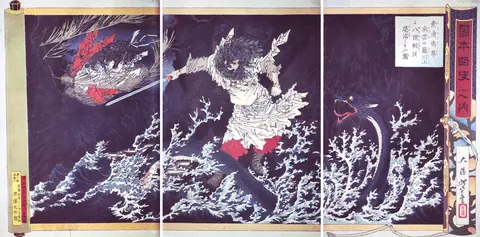
Yamata no Orochi has one body with eight heads and eight tails, and eyes as red as the winter cherry, a red-fruited plant called hōzuki [1][2]. The Kojiki goes on: "on its body grows moss, and also chamæcyparis and cryptomerias. Its length extends over eight valleys and eight hills, and if one look at its belly, it is all constantly bloody and inflamed" [1]. The trees are Japanese cypress (hinoki) and Japanese cedar (sugi) [1].
The Nihon Shoki paints nearly the same picture with small changes. Its main account puts the trees "on its back" and has the serpent stretch over eight hills and eight valleys as it crawls [2]. Another version in the Nihon Shoki says rock-firs grow on each of its heads and there is a mountain on each of its sides [2].
What did Yamata no Orochi do?
Yamata no Orochi came every year and ate a daughter of an old couple, until the god Susanoo killed it [1][2]. Susanoo, thrown out of heaven, came down by the Hi River in Izumo. Chopsticks floating down the river told him people lived upstream, and there he found an old man and an old woman weeping with a girl between them [1].
The old man was Ashinazuchi, his wife Tenazuchi, and the girl Kushinada-hime [1][2]. They had had eight daughters, and the serpent had eaten one each year; now it was coming for the last [1][2]. Susanoo asked for the girl as his wife, and the couple agreed [1][2].
He turned Kushinada-hime into a comb and put it in his hair [1][2]. Then he had the couple brew sake refined eight times, build a fence with eight gates, and set a vat of sake at each gate [1]. The serpent came, dipped each of its eight heads into a vat, drank, and fell asleep drunk. Susanoo drew his sword and cut it to pieces, and the Hi River ran with blood [1].
What was the sword in its tail?
The sword in the serpent's tail is Kusanagi, one of the three imperial regalia of Japan [3]. When Susanoo cut the middle tail, the edge of his blade chipped. He split the tail open and found a great sword inside [1][2]. The Nihon Shoki has him offer it up to the gods of heaven [2][4]. Commentators and translators of the Kojiki differ on whether he sent it to the sun goddess Amaterasu or only told her about it [1].
The two books name it differently. The Kojiki calls it the Kusanagi sword [1]. The Nihon Shoki adds that its first name was Ama no Murakumo, "gathering clouds of heaven", perhaps because clouds always hung over the place where the serpent was, and that it was renamed Kusanagi in the time of the hero Yamato Takeru [2]. The Nihon Kokugo Daijiten notes one more difference: by the Kojiki the blade that came out was called the Tsumugari sword [3].
Is Yamata no Orochi good or evil?
In the myth Yamata no Orochi is a monster that eats young women, and its death is Susanoo's great deed [1][2]. Yet the old texts and the scholars both hint that it was once a god.
In one version of the Nihon Shoki, Susanoo greets it before he pours the sake: "Thou art an Awful Deity. Can I dare to neglect to feast thee?" [2] Japanese Wikipedia says it was probably a mountain god or a water god at first [4]. Sakashita Keihachi reads it as a dragon god ruling the water, its size taken from the Hi River and its seasonal floods, with Kushinada-hime standing for the rice fields [3]. Britannica records the reading of the serpent as a river with eight branches [3].
Where does Yamata no Orochi come from?
Yamata no Orochi comes from two 8th-century histories of Japan, the Kojiki of 712 and the Nihon Shoki of 720 [3][5]. Both set it in Izumo, on the upper Hi River, now the Hii River in Shimane [3][4].
The two tell it differently. The Kojiki calls it the serpent "of Koshi". Chamberlain explains Koshi as a vague name for the north-western provinces; Japanese Wikipedia adds the theory that it means a village of that name in Izumo [1][4]. It writes the girl's name with the character for a comb, which suits her change into one, while the Nihon Shoki writes 奇稲田姫, which Aston translates "Wondrous Inada-princess" [1][2][4]. The Nihon Shoki also keeps several other versions. In one, the serpent lives by the River E in Aki and eats each child the couple have as soon as it is born, and Susanoo has sake brewed from all kinds of fruit [2]. The versions give Susanoo's own sword different names [2].
Scholars have long compared the story with Perseus and Andromeda, the hero who saves a woman given to a monster [2][3]. Yoshii Iwao traces it instead to the worship of a snake god at harvest festivals along the Suga River in Izumo, later joined to Susanoo's story [3].
Stories about Yamata no Orochi

Yamata no Orochi in Japanese
The Nihon Shoki writes the name 八岐大蛇: 八, eight, 岐, a fork, and 大蛇, a great serpent [3][4]. The Kojiki writes 八俣遠呂智, spelling orochi with three characters chosen only for their sound [3][4]. Orochi is an old word for a large serpent [2]. Its chi is an old word for divine power, as in ikazuchi, the thunder [3], and Aston notes that eight in these myths can simply mean "many" [2].
In Yomimaru, an app for learning Japanese, you collect Yamata no Orochi by completing level 23 of the Yomimaru 6k vocabulary deck.
Six words from its myth, and the levels where you learn them:
- 蛇へびsnakeLevel 5 · Chōchin-obake
- 頭あたまheadLevel 1 · Kitsune
- 尾おtail (of an animal)Level 12 · Tengu
- お酒おさけalcoholLevel 2 · Kasa-obake
- 櫛くしcombLevel 20 · Yuki-onna
- 剣けんsword (esp. a large, double-edged one)Level 12 · Tengu
Yomimaru 6k vocabulary deck words 5,501 to 5,750
These are the 250 Japanese words of level 23. Complete the level in Yomimaru to unlock the Yamata no Orochi. By JLPT level: 43 N3, 97 N2, 42 N1 and 68 outside the JLPT lists. The easiest come first.
| Rank | Word | Reading | Meaning | JLPT |
|---|---|---|---|---|
| 5,513 | 障る | さわる | to be harmful to | N3 |
| 5,514 | 有料 | ゆうりょう | fee-charging | N3 |
| 5,515 | デモ | demonstration | N3 | |
| 5,518 | 人ごみ | ひとごみ | crowd of people | N3 |
| 5,519 | 平ら | たいら | flat | N3 |
| 5,530 | 議長 | ぎちょう | chair | N3 |
| 5,534 | インパクト | impact (on) | N3 | |
| 5,543 | くしゃみ | sneeze | N3 | |
| 5,548 | 汲む | くむ | to draw (water) | N3 |
| 5,551 | ところどころ | here and there | N3 | |
| 5,554 | 飴 | あめ | (hard) candy | N3 |
| 5,565 | 豆腐 | とうふ | tofu | N3 |
| 5,579 | ファッション | fashion | N3 | |
| 5,582 | 楽器 | がっき | musical instrument | N3 |
| 5,585 | センス | taste (in fashion, music, etc.) | N3 | |
| 5,596 | リラックス | relaxing | N3 | |
| 5,602 | 泳ぎ | およぎ | swimming | N3 |
| 5,609 | いつまでも | forever | N3 | |
| 5,612 | 作曲 | さっきょく | composition (of music) | N3 |
| 5,616 | 学期 | がっき | school term | N3 |
| 5,620 | キャンセル | cancellation | N3 | |
| 5,623 | 檻 | おり | cage | N3 |
| 5,630 | テーマ | theme | N3 | |
| 5,637 | 水道 | すいどう | water supply | N3 |
| 5,642 | ライト | light | N3 | |
| 5,644 | 沈める | しずめる | to sink (e.g. a ship) | N3 |
| 5,645 | 見当 | けんとう | estimate | N3 |
| 5,648 | オイル | oil | N3 | |
| 5,651 | 題 | だい | title | N3 |
| 5,653 | 覚ます | さます | to awaken | N3 |
| 5,661 | プラス | plus | N3 | |
| 5,672 | ふるさと | hometown | N3 | |
| 5,680 | シンプル | simple | N3 | |
| 5,697 | バタバタ | flapping | N3 | |
| 5,699 | デッキ | deck (of a ship) | N3 | |
| 5,706 | マイナス | minus | N3 | |
| 5,709 | コツコツ | steadily | N3 | |
| 5,715 | 大概 | たいがい | generally | N3 |
| 5,716 | ボーナス | bonus | N3 | |
| 5,730 | ブロック | block (solid piece of material) | N3 | |
| 5,742 | おす | male (animal, plant) | N3 | |
| 5,747 | 花見 | はなみ | cherry blossom viewing | N3 |
| 5,750 | セックス | sex | N3 | |
| 5,504 | 修繕 | しゅうぜん | repair | N2 |
| 5,511 | 前者 | ぜんしゃ | the former | N2 |
| 5,521 | 大衆 | たいしゅう | general public | N2 |
| 5,526 | 埋もれる | うもれる | to be buried | N2 |
| 5,527 | 芯 | しん | wick | N2 |
| 5,528 | 縮む | ちぢむ | to shrink | N2 |
| 5,529 | 繁殖 | はんしょく | breeding | N2 |
| 5,531 | 感染 | かんせん | infection | N2 |
| 5,536 | ありのまま | as it is | N2 | |
| 5,537 | 軸 | じく | axis | N2 |
| 5,544 | 錯覚 | さっかく | optical illusion | N2 |
| 5,547 | 街道 | かいどう | highway (esp. one existing from the Edo period) | N2 |
| 5,549 | 実用 | じつよう | practical use | N2 |
| 5,550 | 一服 | いっぷく | a puff | N2 |
| 5,552 | 苗字 | みょうじ | surname | N2 |
| 5,553 | 物価 | ぶっか | prices of commodities | N2 |
| 5,557 | 中でも | なかでも | among (other things) | N2 |
| 5,562 | 直線 | ちょくせん | straight line | N2 |
| 5,563 | 何しろ | なにしろ | in any case | N2 |
| 5,564 | 当選 | とうせん | being elected | N2 |
| 5,571 | 工作 | こうさく | handicraft | N2 |
| 5,574 | 山々 | やまやま | (many) mountains | N2 |
| 5,576 | めがける | to aim at | N2 | |
| 5,577 | 孤児 | こじ | orphan | N2 |
| 5,580 | そらす | to turn away (one's eyes, face, etc.) | N2 | |
| 5,583 | 一刻 | いっこく | a moment | N2 |
| 5,584 | わがまま | selfish | N2 | |
| 5,587 | 公演 | こうえん | public performance | N2 |
| 5,588 | 手法 | しゅほう | technique | N2 |
| 5,590 | 核 | かく | stone (of a fruit) | N2 |
| 5,591 | ピカピカ | with a glitter | N2 | |
| 5,592 | プロセス | process | N2 | |
| 5,593 | 散らばる | ちらばる | to be scattered about | N2 |
| 5,595 | 浴びせる | あびせる | to pour on | N2 |
| 5,598 | どっと | bursting out (laughter) | N2 | |
| 5,600 | 湾 | わん | bay | N2 |
| 5,601 | 婚約 | こんやく | engagement | N2 |
| 5,603 | 叩きつける | たたきつける | to throw violently against | N2 |
| 5,606 | さまよう | to loiter | N2 | |
| 5,607 | 兆候 | ちょうこう | sign | N2 |
| 5,608 | 勧誘 | かんゆう | invitation | N2 |
| 5,614 | 取り返す | とりかえす | to get back | N2 |
| 5,615 | 原理 | げんり | principle | N2 |
| 5,617 | 森林 | しんりん | forest | N2 |
| 5,618 | 月末 | げつまつ | end of the month | N2 |
| 5,619 | 手ごろ | てごろ | handy | N2 |
| 5,621 | 壮大 | そうだい | magnificent | N2 |
| 5,622 | のんき | easy | N2 | |
| 5,625 | 失恋 | しつれん | disappointed love | N2 |
| 5,626 | 最善 | さいぜん | the very best | N2 |
| 5,627 | 見本 | みほん | sample | N2 |
| 5,628 | 愛しい | いとしい | lovely | N2 |
| 5,629 | 包帯 | ほうたい | bandage | N2 |
| 5,632 | 受験 | じゅけん | taking an examination (esp. for entrance to a school or university) | N2 |
| 5,634 | 当面 | とうめん | current | N2 |
| 5,639 | しびれる | to become numb | N2 | |
| 5,640 | 艶 | つや | gloss | N2 |
| 5,646 | 削除 | さくじょ | deletion | N2 |
| 5,650 | 記入 | きにゅう | filling in | N2 |
| 5,654 | 際立つ | きわだつ | to be prominent | N2 |
| 5,655 | 召す | めす | to call | N2 |
| 5,656 | 漁師 | りょうし | fisherman | N2 |
| 5,657 | 満点 | まんてん | perfect score | N2 |
| 5,658 | 年配 | ねんぱい | (approximate) age | N2 |
| 5,662 | 関節 | かんせつ | joint | N2 |
| 5,666 | 線路 | せんろ | railway track | N2 |
| 5,668 | 白状 | はくじょう | confession | N2 |
| 5,670 | 品質 | ひんしつ | quality (of a product or a service) | N2 |
| 5,671 | 舞い上がる | まいあがる | to soar | N2 |
| 5,675 | 木材 | もくざい | lumber | N2 |
| 5,677 | 光線 | こうせん | beam | N2 |
| 5,683 | 児童 | じどう | children | N2 |
| 5,685 | 駆け込む | かけこむ | to run into | N2 |
| 5,688 | 日の出 | ひので | sunrise | N2 |
| 5,690 | 濡らす | ぬらす | to wet | N2 |
| 5,691 | 飾り | かざり | decoration | N2 |
| 5,692 | 同盟 | どうめい | alliance | N2 |
| 5,693 | 実績 | じっせき | achievements | N2 |
| 5,694 | うっとり | ecstatically | N2 | |
| 5,698 | 同感 | どうかん | same feeling | N2 |
| 5,700 | せっせと | diligently | N2 | |
| 5,705 | 福 | ふく | good fortune | N2 |
| 5,710 | 更新 | こうしん | renewal | N2 |
| 5,713 | 溶け込む | とけこむ | to melt into | N2 |
| 5,714 | 対等 | たいとう | equality (esp. of status) | N2 |
| 5,721 | 温まる | あたたまる | to warm oneself | N2 |
| 5,723 | 切らす | きらす | to run out of | N2 |
| 5,724 | ちくしょう | damn it | N2 | |
| 5,726 | 空き | あき | space | N2 |
| 5,728 | 観戦 | かんせん | watching a (sports) game | N2 |
| 5,729 | 演劇 | えんげき | drama | N2 |
| 5,732 | 代物 | しろもの | article | N2 |
| 5,737 | 盗難 | とうなん | theft | N2 |
| 5,738 | 配布 | はいふ | distribution | N2 |
| 5,740 | 無力 | むりょく | powerlessness | N2 |
| 5,743 | 回数 | かいすう | number of times | N2 |
| 5,745 | ひょっとしたら | possibly | N2 | |
| 5,503 | 諦め | あきらめ | resignation | N1 |
| 5,506 | 人民 | じんみん | the people | N1 |
| 5,507 | 抜かす | ぬかす | to omit | N1 |
| 5,509 | 乱れる | みだれる | to be disordered | N1 |
| 5,510 | 花びら | はなびら | petal | N1 |
| 5,512 | すする | to slurp | N1 | |
| 5,520 | 見落とす | みおとす | to overlook | N1 |
| 5,540 | 兵器 | へいき | arms | N1 |
| 5,546 | 慕う | したう | to yearn for | N1 |
| 5,555 | 世論 | よろん | public opinion | N1 |
| 5,556 | 厳格 | げんかく | strict | N1 |
| 5,558 | 受け入れ | うけいれ | receiving | N1 |
| 5,570 | 前もって | まえもって | in advance | N1 |
| 5,581 | 功績 | こうせき | achievement | N1 |
| 5,594 | 思いつき | おもいつき | idea | N1 |
| 5,597 | 野心 | やしん | ambition | N1 |
| 5,599 | ささやか | small | N1 | |
| 5,605 | 復旧 | ふっきゅう | restoration | N1 |
| 5,610 | だるい | sluggish | N1 | |
| 5,611 | 封鎖 | ふうさ | blockade | N1 |
| 5,613 | 暗殺 | あんさつ | assassination | N1 |
| 5,631 | 統治 | とうち | rule | N1 |
| 5,652 | サボる | to be truant | N1 | |
| 5,659 | 発作 | ほっさ | fit | N1 |
| 5,667 | もろい | brittle | N1 | |
| 5,669 | 特権 | とっけん | privilege | N1 |
| 5,674 | 称える | たたえる | to praise | N1 |
| 5,678 | 償う | つぐなう | to make up for | N1 |
| 5,682 | 日頃 | ひごろ | usually | N1 |
| 5,684 | 結晶 | けっしょう | crystal | N1 |
| 5,686 | 主任 | しゅにん | person in charge | N1 |
| 5,695 | 復活 | ふっかつ | revival (of an old system, custom, fashion, etc.) | N1 |
| 5,702 | 一貫 | いっかん | consistency | N1 |
| 5,707 | 厳密 | げんみつ | strict | N1 |
| 5,708 | 投げ出す | なげだす | to throw down | N1 |
| 5,719 | 覆す | くつがえす | to overturn | N1 |
| 5,720 | 浴室 | よくしつ | bathroom | N1 |
| 5,722 | 執行 | しっこう | execution | N1 |
| 5,727 | 情け | なさけ | pity | N1 |
| 5,733 | きたす | to cause | N1 | |
| 5,746 | 歩み | あゆみ | walking | N1 |
| 5,748 | 究極 | きゅうきょく | ultimate | N1 |
| 5,501 | 患う | わずらう | to be ill | |
| 5,502 | 編成 | へんせい | composition | |
| 5,505 | 怒らせる | おこらせる | to make (someone) angry | |
| 5,508 | 放火 | ほうか | arson | |
| 5,516 | 彼氏 | かれし | boyfriend | |
| 5,517 | 生き延びる | いきのびる | to survive | |
| 5,522 | 風味 | ふうみ | taste | |
| 5,523 | 生き方 | いきかた | way of life | |
| 5,524 | 不公平 | ふこうへい | unfairness | |
| 5,525 | 受賞 | じゅしょう | winning (a prize) | |
| 5,532 | 髪型 | かみがた | hair style | |
| 5,533 | 開業 | かいぎょう | opening a business | |
| 5,535 | ハワイ | Hawaii | ||
| 5,538 | 立候補 | りっこうほ | candidacy | |
| 5,539 | 実在 | じつざい | actual existence | |
| 5,541 | 猶予 | ゆうよ | postponement | |
| 5,542 | 自分自身 | じぶんじしん | oneself | |
| 5,545 | 魔女 | まじょ | witch | |
| 5,559 | 本社 | ほんしゃ | head office | |
| 5,560 | 勝ち取る | かちとる | to win | |
| 5,561 | 広範囲 | こうはんい | extensive | |
| 5,566 | 行き先 | いきさき | destination | |
| 5,567 | 告発 | こくはつ | indictment | |
| 5,568 | 修復 | しゅうふく | restoration | |
| 5,569 | しすぎる | to overdo | ||
| 5,572 | 海水 | かいすい | seawater | |
| 5,573 | 不可解 | ふかかい | incomprehensible | |
| 5,575 | 魅力的 | みりょくてき | charming | |
| 5,578 | どうしたの | what's the matter? | ||
| 5,586 | 拠点 | きょてん | base (of operations) | |
| 5,589 | わきまえる | to discern (e.g. right from wrong) | ||
| 5,604 | 麻薬 | まやく | narcotic | |
| 5,624 | どのように | how | ||
| 5,633 | 最適 | さいてき | most suitable | |
| 5,635 | 飛び越える | とびこえる | to jump over | |
| 5,636 | 一般的 | いっぱんてき | general | |
| 5,638 | 繰り広げる | くりひろげる | to unfold | |
| 5,641 | 虐待 | ぎゃくたい | abuse | |
| 5,643 | 掲示板 | けいじばん | bulletin board | |
| 5,647 | 目が覚める | めがさめる | to wake up | |
| 5,649 | この辺 | このへん | this area | |
| 5,660 | 幅広い | はばひろい | extensive | |
| 5,663 | 有用 | ゆうよう | useful | |
| 5,664 | 仇 | あだ | foe | |
| 5,665 | 激怒 | げきど | rage | |
| 5,673 | 新作 | しんさく | new work | |
| 5,676 | 入力 | にゅうりょく | input | |
| 5,679 | 誘い | さそい | invitation | |
| 5,681 | 手作り | てづくり | handmade | |
| 5,687 | 路上 | ろじょう | on the road | |
| 5,689 | 投じる | とうじる | to throw | |
| 5,696 | 残業 | ざんぎょう | overtime (work) | |
| 5,701 | 話し方 | はなしかた | way of talking | |
| 5,703 | 選択肢 | せんたくし | choices | |
| 5,704 | 運行 | うんこう | operation (of a bus or train service) | |
| 5,711 | 車内 | しゃない | inside a car (train, bus, etc.) | |
| 5,712 | おっさん | middle-aged man | ||
| 5,717 | 手に入る | てにはいる | to obtain | |
| 5,718 | 野獣 | やじゅう | wild beast | |
| 5,725 | やばい | dangerous | ||
| 5,731 | 閉店 | へいてん | closing up shop (for the day) | |
| 5,734 | 傷口 | きずぐち | (opening of a) wound | |
| 5,735 | 仕方がない | しかたがない | there's no (other) way | |
| 5,736 | 手渡す | てわたす | to hand (over) | |
| 5,739 | 無謀 | むぼう | reckless | |
| 5,741 | 志願 | しがん | aspiration | |
| 5,744 | 部員 | ぶいん | staff | |
| 5,749 | 寸前 | すんぜん | just before |
Sources
- Classic textKojiki (712), Section XVIII, "The Eight-Forked Serpent", in Basil Hall Chamberlain's translation (1882), Wikisource
- Classic textNihon Shoki (720), Book I, in W. G. Aston's translation, Nihongi (1896), Wikisource
- EncyclopediaKotobank, "八岐大蛇", with Sakashita Keihachi's entry in Heibonsha's Sekai Daihyakka Jiten, Yoshii Iwao's in Shogakukan's Nihon Daihyakka Zensho, the Nihon Kokugo Daijiten and Britannica
- EncyclopediaJapanese Wikipedia, "ヤマタノオロチ"
- EncyclopediaKotobank, "日本書紀", with the Daijisen, Heibonsha's Sekai Daihyakka Jiten and Shogakukan's Nihon Daihyakka Zensho
The art on this page was drawn for Yomimaru.
Questions
What is Yamata no Orochi?
Yamata no Orochi is a giant serpent with eight heads and eight tails from the myths of the Kojiki and the Nihon Shoki, two 8th-century histories of Japan. Every year it ate one of an old couple's daughters, until the god Susanoo killed it. See what it looks like.
How did Susanoo kill Yamata no Orochi?
He had eight vats of strong sake set out. Each of the serpent's eight heads drank one, and when it fell asleep drunk he cut it to pieces with his sword. See how Susanoo killed it.
What sword was found in Yamata no Orochi's tail?
When Susanoo cut the middle tail, his blade chipped on a sword hidden inside. It is the sword known as Kusanagi, later one of the three imperial regalia of Japan. The Nihon Shoki says its first name was Ama no Murakumo. See the sword in its tail.
Is Yamata no Orochi a god?
Susanoo calls it a god in one version of the Nihon Shoki, and scholars read it as a mountain or water god, perhaps the river itself and its floods. See whether it is good or evil.