
- Japanese
- 犬神 (いぬがみ)
- Means
- dog god
- Also called
- inugame, ingame, irigami (local names), 狗神
- Found in
- Shikoku above all, and western Chūgoku, Kyushu and the islands south to Okinawa
What does an inugami look like?
In the old picture books an inugami looks like a dog dressed as a person. Toriyama Sekien drew it in 1776 as a dog in loose robes and a tall black cap, sitting before a painted screen with a paper wand in its hand [5]. A boy with his hair tied up in a page's topknot kneels beside it, writing in a book. Sekien named him shirachigo, the white child [4][5].
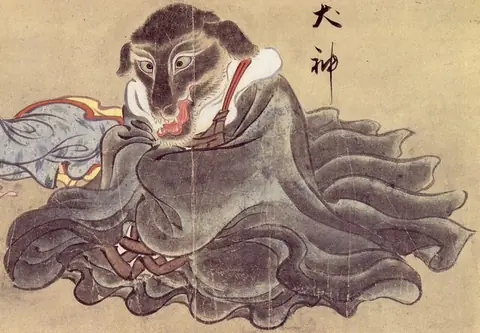
Sekien was not the first to draw it. Forty years earlier, the painter Sawaki Sūshi gave it a page of his yokai scroll, the Hyakkai Zukan, as a big dog wrapped in grey robes [6]. Sekien is thought to have worked from scrolls of that family, which share many of his yokai [6].
Later books gave the boy a role. Yokai guides from the Shōwa period on call the shirachigo the inugami's servant or pupil, only because he sits at its side [4]. An anonymous scroll, the Bakemono Zukushi, drew him as a puppy in a kimono [4].
Folk belief pictured something quite different. Accounts from western Japan describe an inugami as a small spotted creature about the size of a mouse, with a tail split at the tip [2][3]. In Ōita it looked like a shrew, and an early Edo tale from Tosa made it no bigger than a grain of rice [2]. The Nihon Kokugo Daijiten calls it a small animal the eye cannot see [1].
What does an inugami do?
In folk belief an inugami brought sickness and harm. People in Shikoku, western Chūgoku and Kyushu blamed it for aches and illness that no doctor could cure [1].
Shikoku was its heartland. One theory makes Shikoku, where fox spirits held no sway, the inugami's true home [2][3]. Traces of the belief reach the islands south of Kyushu and Okinawa. On Yakushima it is called ingame, and on Tanegashima irigami [2].
The Edo stage turned it into a sorcerer's tool. In a kabuki dance first played in Edo in 1812, a villain who commands an inugami steals a precious jewel, and a fox in disguise wins it back [1].
Is the inugami good or evil?
Where does the inugami come from?
The inugami has several origin legends. In one, it was born from a picture of a dog that Kōbō Daishi, the monk Kūkai, painted to keep wild boars off the fields [2][3]. Another version gives him a paper charm with the character 犬, dog, and says the inugami spread from that [1].
Other legends tie it to monsters of older tales. When the warrior Minamoto no Yorimasa killed the monster nue, its body split in four, and the pieces flew off to become inugami [2][3]. When the monk Gennō split the cursed Killing Stone, the shards that flew to Shikoku became inugami [2][3].
Scholars look further back. Japanese Wikipedia traces the inugami to sorcery with animal spirits that was banned as early as the Heian period [2]. Takeda Akira notes a theory that it came from China, where the Soushen Ji, a book of marvels by Gan Bao of the Jin dynasty, already records a feared dog spirit [1]. In Japanese writing, the Nihon Kokugo Daijiten finds the word in a comic verse of 1702 [1].
The inugami in Japanese
The name inugami (犬神) means "dog god": 犬 is dog and 神 is god or spirit. It is also written 狗神, with an older character for dog, and in parts of Kyushu and its islands it is said ingame or irigami [2].
Its origin legend uses everyday words: a 絵, a picture, of a 犬 that Kūkai 描いた, drew, to 守る, guard, the 畑, the fields.
Six words from its legend, and the levels where you learn them:
- 犬いぬdog (Canis (lupus) familiaris)Level 1 · Kitsune
- 神かみgodLevel 3 · Tōfu-kozō
- 絵えpictureLevel 2 · Kasa-obake
- 描くえがくto drawLevel 3 · Tōfu-kozō
- 守るまもるto protectLevel 3 · Tōfu-kozō
- 畑はたけfield (for growing wheat, fruit, vegetables, etc.)Level 9 · Inugami
Yomimaru 6k vocabulary deck words 2,001 to 2,250
These are the 250 Japanese words of level 9. Complete the level in Yomimaru to unlock the Inugami. By JLPT level: 67 N4, 93 N3, 87 N2 and 3 outside the JLPT lists. The easiest come first.
| Rank | Word | Reading | Meaning | JLPT |
|---|---|---|---|---|
| 2,007 | 一時 | いちじ | one o'clock | N4 |
| 2,009 | 巡る | めぐる | to go around | N4 |
| 2,014 | まっすぐ | straight (ahead) | N4 | |
| 2,023 | サービス | service | N4 | |
| 2,025 | 警官 | けいかん | police officer | N4 |
| 2,030 | 陰 | かげ | shade | N4 |
| 2,047 | 砂 | すな | sand | N4 |
| 2,073 | 以内 | いない | within | N4 |
| 2,080 | 棚 | たな | shelf | N4 |
| 2,093 | 台風 | たいふう | typhoon | N4 |
| 2,101 | 止む | やむ | to cease | N4 |
| 2,104 | 赤ちゃん | あかちゃん | baby | N4 |
| 2,107 | 承知 | しょうち | knowledge | N4 |
| 2,115 | 片付ける | かたづける | to put in order | N4 |
| 2,117 | 載る | のる | to be placed on | N4 |
| 2,119 | 予約 | よやく | reservation | N4 |
| 2,120 | 下げる | さげる | to hang | N4 |
| 2,138 | 夕食 | ゆうしょく | evening meal | N4 |
| 2,140 | 細かい | こまかい | small | N4 |
| 2,142 | 勤める | つとめる | to work (for) | N4 |
| 2,145 | 飾る | かざる | to decorate | N4 |
| 2,149 | 痩せる | やせる | to become thin | N4 |
| 2,151 | ビル | multi-floor building | N4 | |
| 2,154 | 小学校 | しょうがっこう | primary school | N4 |
| 2,157 | 入院 | にゅういん | hospitalization | N4 |
| 2,165 | 招待 | しょうたい | invitation | N4 |
| 2,179 | 回り | まわり | rotation | N4 |
| 2,181 | ダンス | dance | N4 | |
| 2,182 | 海岸 | かいがん | coast | N4 |
| 2,185 | 柔らかい | やわらかい | soft | N4 |
| 2,206 | 故障 | こしょう | fault | N4 |
| 2,207 | 枝 | えだ | branch | N4 |
| 2,210 | 朝食 | ちょうしょく | breakfast | N4 |
| 2,216 | 遠慮 | えんりょ | reserve | N4 |
| 2,217 | 昼間 | ひるま | daytime | N4 |
| 2,218 | 別れる | わかれる | to part (usu. of people) | N4 |
| 2,219 | 祖父 | そふ | grandfather | N4 |
| 2,220 | 表 | ひょう | table | N4 |
| 2,221 | 半年 | はんとし | half a year | N4 |
| 2,222 | 糸 | いと | thread | N4 |
| 2,223 | 揺れる | ゆれる | to shake | N4 |
| 2,224 | 溶ける | とける | to melt | N4 |
| 2,225 | 申す | もうす | to say | N4 |
| 2,226 | 洗濯 | せんたく | washing | N4 |
| 2,227 | 修理 | しゅうり | repair | N4 |
| 2,228 | 先輩 | せんぱい | senior (at work or school) | N4 |
| 2,229 | この間 | このあいだ | the other day | N4 |
| 2,230 | 港 | みなと | harbour | N4 |
| 2,231 | 店員 | てんいん | employee (of a store) | N4 |
| 2,232 | 昨年 | さくねん | last year | N4 |
| 2,234 | トランプ | (Western) playing cards | N4 | |
| 2,235 | キス | kiss | N4 | |
| 2,236 | 辺 | へん | area | N4 |
| 2,237 | 日記 | にっき | diary | N4 |
| 2,238 | 引き出す | ひきだす | to pull out | N4 |
| 2,239 | ロボット | robot | N4 | |
| 2,240 | ベル | bell | N4 | |
| 2,241 | それに | besides | N4 | |
| 2,242 | 年上 | としうえ | older | N4 |
| 2,243 | 県 | けん | prefecture (of Japan) | N4 |
| 2,244 | トラック | truck | N4 | |
| 2,245 | 右手 | みぎて | right hand | N4 |
| 2,246 | ベンチ | bench | N4 | |
| 2,247 | 坂 | さか | slope | N4 |
| 2,248 | 混む | こむ | to be crowded | N4 |
| 2,249 | 数学 | すうがく | mathematics | N4 |
| 2,250 | 祖母 | そぼ | grandmother | N4 |
| 2,001 | 畑 | はたけ | field (for growing wheat, fruit, vegetables, etc.) | N3 |
| 2,003 | 借金 | しゃっきん | debt | N3 |
| 2,005 | 狂う | くるう | to go mad | N3 |
| 2,006 | 当てる | あてる | to hit | N3 |
| 2,010 | とりあえず | first of all | N3 | |
| 2,012 | 生物 | せいぶつ | living thing | N3 |
| 2,013 | 数字 | すうじ | numeral | N3 |
| 2,015 | 脇 | わき | armpit | N3 |
| 2,016 | 記念 | きねん | commemoration | N3 |
| 2,017 | 全国 | ぜんこく | the whole country | N3 |
| 2,018 | 髪の毛 | かみのけ | hair (on the head) | N3 |
| 2,019 | たまらない | intolerable | N3 | |
| 2,020 | 偉い | えらい | great | N3 |
| 2,021 | ねずみ | mouse | N3 | |
| 2,026 | 虎 | とら | tiger (Panthera tigris) | N3 |
| 2,027 | 親しい | したしい | close (e.g. friend) | N3 |
| 2,031 | 流行 | りゅうこう | fashion | N3 |
| 2,033 | 単純 | たんじゅん | simple | N3 |
| 2,034 | 鬼 | おに | ogre | N3 |
| 2,035 | 沿う | そう | to run along | N3 |
| 2,037 | 掘る | ほる | to dig | N3 |
| 2,039 | 両手 | りょうて | both hands | N3 |
| 2,041 | 誕生 | たんじょう | birth | N3 |
| 2,042 | 満ちる | みちる | to fill | N3 |
| 2,043 | 迷惑 | めいわく | trouble | N3 |
| 2,044 | 地 | ち | earth | N3 |
| 2,046 | さっぱり | feeling refreshed | N3 | |
| 2,050 | 向き | むき | direction | N3 |
| 2,052 | 恋人 | こいびと | lover | N3 |
| 2,053 | 材料 | ざいりょう | materials | N3 |
| 2,054 | 抱える | かかえる | to hold in one's arms | N3 |
| 2,058 | 衝突 | しょうとつ | collision | N3 |
| 2,059 | 納得 | なっとく | consent | N3 |
| 2,060 | 奥 | おく | inner part | N3 |
| 2,061 | 地上 | ちじょう | above ground | N3 |
| 2,062 | 尊敬 | そんけい | respect | N3 |
| 2,063 | 炎 | ほのお | flame | N3 |
| 2,066 | いきなり | abruptly | N3 | |
| 2,067 | 大声 | おおごえ | loud voice | N3 |
| 2,070 | 瓶 | びん | bottle | N3 |
| 2,075 | 追いつく | おいつく | to catch up (with) | N3 |
| 2,077 | 住民 | じゅうみん | inhabitant | N3 |
| 2,083 | じっと | motionlessly (e.g. stand, wait) | N3 | |
| 2,085 | 真剣 | しんけん | serious | N3 |
| 2,088 | チャンス | chance | N3 | |
| 2,090 | 贈る | おくる | to give (as a gift) | N3 |
| 2,095 | 学者 | がくしゃ | scholar | N3 |
| 2,096 | 出身 | しゅっしん | one's origin (e.g. city, country, parentage, school) | N3 |
| 2,097 | 下る | くだる | to descend | N3 |
| 2,099 | 役割 | やくわり | part | N3 |
| 2,100 | 印 | しるし | mark | N3 |
| 2,102 | 単なる | たんなる | mere | N3 |
| 2,103 | 計る | はかる | to measure | N3 |
| 2,105 | 油 | あぶら | oil | N3 |
| 2,106 | 泥 | どろ | mud | N3 |
| 2,108 | 広告 | こうこく | advertisement | N3 |
| 2,110 | 教会 | きょうかい | church | N3 |
| 2,111 | 国内 | こくない | internal | N3 |
| 2,113 | 風 | ふう | method | N3 |
| 2,121 | その間 | そのあいだ | in the meanwhile | N3 |
| 2,123 | 得 | とく | profit | N3 |
| 2,124 | 互いに | たがいに | mutually | N3 |
| 2,125 | 働き | はたらき | work | N3 |
| 2,126 | 鋭い | するどい | sharp (knife, claws, etc.) | N3 |
| 2,128 | 針 | はり | needle | N3 |
| 2,130 | きつい | tough | N3 | |
| 2,133 | 適当 | てきとう | suitable | N3 |
| 2,134 | さる | monkey (esp. the Japanese macaque, Macaca fuscata) | N3 | |
| 2,136 | 銀 | ぎん | silver (Ag) | N3 |
| 2,144 | 少々 | しょうしょう | just a minute | N3 |
| 2,146 | 文章 | ぶんしょう | writing | N3 |
| 2,147 | 競争 | きょうそう | competition | N3 |
| 2,148 | 自宅 | じたく | one's home | N3 |
| 2,152 | 谷 | たに | valley | N3 |
| 2,153 | 建つ | たつ | to be erected | N3 |
| 2,156 | 風景 | ふうけい | scenery | N3 |
| 2,163 | 国際 | こくさい | international | N3 |
| 2,167 | 裏切る | うらぎる | to betray | N3 |
| 2,173 | 一種 | いっしゅ | a kind | N3 |
| 2,177 | そこで | so | N3 | |
| 2,178 | 金属 | きんぞく | metal | N3 |
| 2,180 | 芸術 | げいじゅつ | art | N3 |
| 2,183 | 振り | ふり | swing | N3 |
| 2,187 | モデル | model | N3 | |
| 2,190 | ひも | string | N3 | |
| 2,191 | 支える | ささえる | to support | N3 |
| 2,194 | たっぷり | plentifully | N3 | |
| 2,198 | 通じる | つうじる | to be open (to traffic) | N3 |
| 2,199 | そっと | softly | N3 | |
| 2,202 | 男子 | だんし | boy | N3 |
| 2,203 | 集団 | しゅうだん | group | N3 |
| 2,204 | 通り | どおり | in accordance with | N3 |
| 2,233 | 地下 | ちか | underground | N3 |
| 2,002 | 関心 | かんしん | concern | N2 |
| 2,004 | 全身 | ぜんしん | whole (body) | N2 |
| 2,008 | 記者 | きしゃ | reporter | N2 |
| 2,011 | 障害 | しょうがい | obstacle | N2 |
| 2,022 | 会場 | かいじょう | assembly hall | N2 |
| 2,024 | 余計 | よけい | extra | N2 |
| 2,028 | どうせ | anyhow | N2 | |
| 2,029 | 発 | はつ | departure | N2 |
| 2,032 | 州 | しゅう | state (of the US, Australia, India, Germany, etc.) | N2 |
| 2,036 | 指導 | しどう | guidance | N2 |
| 2,038 | 埋める | うめる | to bury (e.g. in the ground) | N2 |
| 2,040 | 望み | のぞみ | wish | N2 |
| 2,045 | 支持 | しじ | support | N2 |
| 2,048 | 非 | ひ | fault | N2 |
| 2,049 | 装置 | そうち | equipment | N2 |
| 2,051 | 展開 | てんかい | development | N2 |
| 2,055 | ぶつかる | to bump into | N2 | |
| 2,056 | 紳士 | しんし | gentleman | N2 |
| 2,057 | 警告 | けいこく | warning | N2 |
| 2,064 | 詰まる | つまる | to be packed (with) | N2 |
| 2,065 | 抑える | おさえる | to keep within limits (e.g. spending) | N2 |
| 2,068 | まれ | rare | N2 | |
| 2,069 | 雷 | かみなり | lightning | N2 |
| 2,071 | 比較 | ひかく | comparison | N2 |
| 2,072 | さっさと | quickly | N2 | |
| 2,074 | 強調 | きょうちょう | emphasis | N2 |
| 2,076 | 成す | なす | to form | N2 |
| 2,078 | 言語 | げんご | language | N2 |
| 2,079 | 不利 | ふり | disadvantage | N2 |
| 2,081 | 場面 | ばめん | scene | N2 |
| 2,082 | 表面 | ひょうめん | surface | N2 |
| 2,084 | 愛情 | あいじょう | love | N2 |
| 2,086 | 塔 | とう | tower | N2 |
| 2,087 | 天井 | てんじょう | ceiling | N2 |
| 2,089 | 戦闘 | せんとう | battle | N2 |
| 2,092 | 共通 | きょうつう | common | N2 |
| 2,094 | 青年 | せいねん | youth | N2 |
| 2,098 | 検討 | けんとう | consideration | N2 |
| 2,109 | 背景 | はいけい | background | N2 |
| 2,112 | 途端 | とたん | just (now, at the moment, etc.) | N2 |
| 2,114 | 刑事 | けいじ | (police) detective | N2 |
| 2,116 | 完璧 | かんぺき | perfect | N2 |
| 2,118 | 所有 | しょゆう | one's possessions | N2 |
| 2,122 | 持ち主 | もちぬし | owner | N2 |
| 2,127 | 服装 | ふくそう | attire | N2 |
| 2,129 | 課題 | かだい | subject | N2 |
| 2,131 | 周辺 | しゅうへん | circumference | N2 |
| 2,132 | 以降 | いこう | on and after | N2 |
| 2,135 | 価格 | かかく | price | N2 |
| 2,137 | 矢 | や | arrow | N2 |
| 2,139 | 抵抗 | ていこう | resistance | N2 |
| 2,141 | 幽霊 | ゆうれい | ghost | N2 |
| 2,143 | 生涯 | しょうがい | life | N2 |
| 2,150 | はるか | far away | N2 | |
| 2,155 | 巣 | す | nest | N2 |
| 2,158 | 方針 | ほうしん | policy | N2 |
| 2,159 | 改めて | あらためて | another time | N2 |
| 2,160 | 才能 | さいのう | talent | N2 |
| 2,161 | 愚か | おろか | foolish | N2 |
| 2,162 | 見守る | みまもる | to watch over | N2 |
| 2,164 | 市民 | しみん | citizen (of a country) | N2 |
| 2,166 | あえて | purposely (of something needless, unexpected or seemingly counterproductive, etc.) | N2 | |
| 2,168 | 模様 | もよう | pattern | N2 |
| 2,169 | 脳 | のう | brain | N2 |
| 2,170 | 策 | さく | plan | N2 |
| 2,171 | 上司 | じょうし | (one's) superior | N2 |
| 2,172 | 挑戦 | ちょうせん | challenge | N2 |
| 2,174 | 端 | はし | end (e.g. of street) | N2 |
| 2,175 | 拒否 | きょひ | refusal | N2 |
| 2,176 | 誓う | ちかう | to swear | N2 |
| 2,184 | 問う | とう | to ask | N2 |
| 2,186 | 慎重 | しんちょう | careful | N2 |
| 2,188 | ただし | but | N2 | |
| 2,189 | 率 | りつ | rate | N2 |
| 2,192 | 晒す | さらす | to expose (to the sun, public, danger, etc.) | N2 |
| 2,195 | 未だに | いまだに | still | N2 |
| 2,196 | 就く | つく | to take (seat, position, course, office, etc.) | N2 |
| 2,197 | 枯れる | かれる | to wither (of a plant) | N2 |
| 2,200 | 天才 | てんさい | genius | N2 |
| 2,201 | 資金 | しきん | funds | N2 |
| 2,205 | 雰囲気 | ふんいき | atmosphere | N2 |
| 2,209 | 飛び込む | とびこむ | to jump in | N2 |
| 2,211 | 同情 | どうじょう | sympathy | N2 |
| 2,212 | 自己 | じこ | self | N2 |
| 2,213 | 労働 | ろうどう | labor | N2 |
| 2,214 | 貴重 | きちょう | precious | N2 |
| 2,215 | 覗く | のぞく | to peek (through a keyhole, gap, etc.) | N2 |
| 2,091 | 連れて行く | つれていく | to take (someone to a place) | |
| 2,193 | 一回 | いっかい | once | |
| 2,208 | 持っていく | もっていく | to take (something) along |
Sources
- EncyclopediaKotobank, "犬神", from Nihon Kokugo Daijiten, Nihon Daihyakka Zensho (entry by Takeda Akira), Heibonsha's Sekai Daihyakka Jiten (entry by Komatsu Kazuhiko) and Britannica Kokusai Daihyakka Jiten
- EncyclopediaJapanese Wikipedia, "犬神"
- EncyclopediaEnglish Wikipedia, "Inugami"
- EncyclopediaJapanese Wikipedia, "白児" (Shirachigo)
- Edo picture bookToriyama Sekien, Gazu Hyakki Yagyō (1776), "犬神・白児" (Inugami and Shirachigo), scan on Wikimedia Commons
- EncyclopediaJapanese Wikipedia, "百怪図巻" (Hyakkai Zukan)
The art on this page was drawn for Yomimaru.
Questions
What does an inugami look like?
The painters drew a dog: a big dog wrapped in grey robes in 1737, and a dog in robes and a tall cap in Sekien's book of 1776. Folk belief pictured something else, a spotted creature about the size of a mouse. See what an inugami looks like.
Is the inugami good or evil?
It was feared. Folk belief blamed it for sickness and harm, and one Japanese encyclopedia reads it as people's own spite given an animal's shape. See whether the inugami is good or evil.
Where does the inugami come from?
The legends differ. One says it was born from a dog that the monk Kūkai painted to keep boars away; others trace it to the monster nue or to the shattered Killing Stone. See where the inugami comes from.