
- Japanese
- がしゃどくろ
- Means
- rattling skull
- Found in
- Wherever the dead were left unburied, such as old battlefields
- First recorded
- Saitō Morihiro, in the girls' magazine Bessatsu Shōjo Friend, November 1966 [1]
What does a gashadokuro look like?
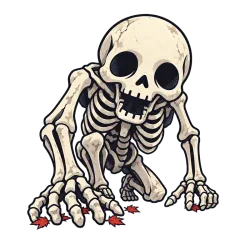
A gashadokuro is a giant skeleton, many times taller than a person [1]. The 1966 article that introduced it described "a giant skeleton with only its eyeballs popping out, that clatters with every step" [1].
Its bones are said to come from people who died and were never buried, such as soldiers killed in war and people who died by the roadside [1]. English accounts often add that its eyes burn, and put its height at ten metres or more, but English Wikipedia gives no source for either [2].
Most pictures of it share one look: an enormous skull leaning in from the dark, with long arms of bone reaching forward. That image is older than the yokai. It comes from a print by Utagawa Kuniyoshi, made more than a hundred years before anyone used the name [1][3].
What does a gashadokuro do?
A gashadokuro wanders at night, clattering as it walks, and attacks living people [1]. In the Japanese accounts it crushes and eats the people it catches [1].
Its name comes from that clatter. Gasha gasha is the Japanese sound of something hard and loose rattling, and the yokai is named after the noise its bones make [1]. English retellings add a time, two in the morning, and a sound of chattering teeth as it creeps up on its victim [2].
Can a gashadokuro be killed?
No Japanese account gives the gashadokuro a weakness or a way to kill it [1].
English books have filled that gap. They say it is invisible and cannot be destroyed, that Shinto charms keep it away, or that it falls apart once its anger is spent. English Wikipedia notes that Japanese sources don't support the claims of invisibility and indestructibility, and it cites the rest to English books, not Japanese ones [2]. Treat all of it as modern invention on top of a modern yokai.
Is the gashadokuro evil?
The gashadokuro is hostile in every version, with none of the kind side that many older yokai have [1]. A kappa may sign an apology and a fox may repay a favour, but no tale has the gashadokuro help anyone.
It is made from the bones and the resentment of the dead who were left where they fell [1]. Read that way, it is less a monster that chose to be evil than the anger of people nobody buried or mourned.
Where does the gashadokuro come from?
The gashadokuro was invented in 1966 by the writer Saitō Morihiro, for a feature called "Japanese yokai who are right beside you" in the November issue of the girls' magazine Bessatsu Shōjo Friend [1]. It is not an Edo yokai, and no older folk tradition stands behind it [1].
Saitō later said he took the idea from an English ghost story, "The Black Knight of Glamis Castle", which the boys' magazine Bokura had printed in May 1965 [1]. His article was reprinted in 1968 in a book of the world's monsters, and in 1972 Satō Arifumi's illustrated yokai encyclopedia gave it a picture based on Kuniyoshi's skeleton [1]. Satō and the yokai artist Mizuki Shigeru both kept it in their yokai books through the 1970s and after, and that is how it became widely known [1].
Some English pages trace the gashadokuro back to the 10th century and the rebel Taira no Masakado [2]. That link runs only through Kuniyoshi's picture. English Wikipedia's own article says the yokai began in the 20th century, and Japanese Wikipedia says the print doesn't show a gashadokuro at all [1][2].
A tale in the old Buddhist collection Nihon Ryōiki, about a skull with a bamboo shoot growing through its eye socket, is sometimes mixed up with it. The two are unrelated [1].
Is Kuniyoshi's giant skeleton a gashadokuro?
Kuniyoshi's giant skeleton is not a gashadokuro. Utagawa Kuniyoshi's triptych Sōma no Furudairi (相馬の古内裏, "the old palace at Sōma"), printed about 1844, shows a different story, more than a century before the gashadokuro was invented [1][3].
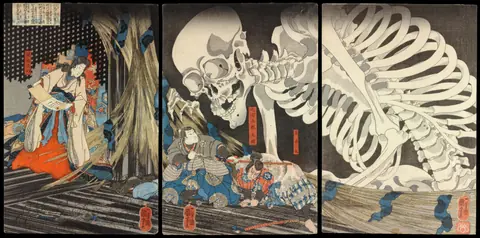
After the rebel Taira no Masakado was killed, the ghosts of his fallen soldiers haunted his palace at Sōma. In the print his daughter, Princess Takiyasha, gathers them into a skeleton spectre, and the warrior Ōya no Tarō Mitsukuni, sent by the court to hunt down Masakado's last allies, stands up to it [3][4].
The scene comes from Santō Kyōden's novel Utō Yasukata Chūgiden (1806) [1][5]. In Kyōden's text there are many skeletons, each the size of a person. Kuniyoshi drew a single giant one leaning across all three sheets [1]. Because it shows a giant skull, the yokai books used it as the gashadokuro's picture early on, and the modern image of the yokai still follows it [1].
The gashadokuro in Japanese
The name gashadokuro means "rattling skull". It is written in kana, がしゃどくろ, because it was put together from two plain words: がしゃがしゃ, a rattle, and どくろ, a skull, which is written 髑髏 in kanji [1]. You will sometimes see it as 餓者髑髏, "a starving person's skull". Those kanji were chosen later for their sound and meaning, and the name has no traditional spelling [1]. The 1966 article itself used everyday words: a 骸骨, a skeleton, that goes ガチガチ, clack clack.
Six words from its story, and the levels where you learn them:
- 骨ほねboneLevel 6 · Bake-danuki
- 巨人きょじんgiantLevel 22 · Ōmukade
- 死者ししゃdead personLevel 13 · Ittan-momen
- 戦場せんじょうbattlefieldLevel 16 · Jorōgumo
- 埋めるうめるto bury (e.g. in the ground)Level 9 · Inugami
- 雑誌ざっしmagazineLevel 3 · Tōfu-kozō
Yomimaru 6k vocabulary deck words 4,501 to 4,750
These are the 250 Japanese words of level 19. Complete the level in Yomimaru to unlock the Gashadokuro. By JLPT level: 50 N3, 122 N2, 40 N1 and 38 outside the JLPT lists. The easiest come first.
| Rank | Word | Reading | Meaning | JLPT |
|---|---|---|---|---|
| 4,503 | かつ | and | N3 | |
| 4,505 | 双子 | ふたご | twins | N3 |
| 4,506 | ビジネス | business | N3 | |
| 4,509 | 以後 | いご | after this | N3 |
| 4,522 | ランプ | lamp | N3 | |
| 4,525 | 伸び | のび | growth | N3 |
| 4,530 | 器用 | きよう | skillful | N3 |
| 4,533 | 絵画 | かいが | painting | N3 |
| 4,541 | コンクリート | concrete | N3 | |
| 4,554 | よそ | another place | N3 | |
| 4,557 | 不自然 | ふしぜん | unnatural | N3 |
| 4,558 | 貝 | かい | shellfish | N3 |
| 4,561 | 泊める | とめる | to give shelter to | N3 |
| 4,567 | スタイル | (one's) figure | N3 | |
| 4,568 | 居眠り | いねむり | nodding off (while sitting) | N3 |
| 4,569 | プラスチック | plastic | N3 | |
| 4,570 | 休息 | きゅうそく | rest | N3 |
| 4,577 | 及ぼす | およぼす | to exert (influence) | N3 |
| 4,579 | 欠席 | けっせき | absence | N3 |
| 4,585 | ふらふら | unsteadily (e.g. on one's feet) | N3 | |
| 4,587 | 鈴 | すず | bell (often globular) | N3 |
| 4,588 | ボランティア | volunteer | N3 | |
| 4,599 | 着せる | きせる | to put clothes on (someone) | N3 |
| 4,602 | ある程度 | あるていど | to some extent | N3 |
| 4,609 | 課長 | かちょう | section manager | N3 |
| 4,612 | 神聖 | しんせい | holiness | N3 |
| 4,616 | 蜂 | はち | bee | N3 |
| 4,619 | ガタガタ | rattling | N3 | |
| 4,622 | チェック | check (pattern) | N3 | |
| 4,623 | マーク | mark | N3 | |
| 4,629 | 省く | はぶく | to omit | N3 |
| 4,642 | くじら | whale (Cetacea spp.) | N3 | |
| 4,651 | 分 | ふん | minute (unit of time) | N3 |
| 4,652 | ボス | boss | N3 | |
| 4,653 | 微笑 | びしょう | smile | N3 |
| 4,658 | 単語 | たんご | word | N3 |
| 4,663 | 脂肪 | しぼう | fat | N3 |
| 4,671 | ダイヤモンド | diamond | N3 | |
| 4,675 | まく | to scatter | N3 | |
| 4,676 | 風船 | ふうせん | balloon (toy or decoration) | N3 |
| 4,680 | ローン | loan | N3 | |
| 4,684 | 村人 | むらびと | villager | N3 |
| 4,690 | 読み | よみ | reading | N3 |
| 4,698 | 班 | はん | group | N3 |
| 4,716 | 体操 | たいそう | gymnastics | N3 |
| 4,727 | 電灯 | でんとう | electric light | N3 |
| 4,728 | リズム | rhythm | N3 | |
| 4,738 | 手のひら | てのひら | palm (of the hand) | N3 |
| 4,739 | あだ名 | あだな | nickname | N3 |
| 4,744 | 仮 | かり | temporary | N3 |
| 4,501 | 羽目 | はめ | panel | N2 |
| 4,504 | 通路 | つうろ | passage | N2 |
| 4,507 | 消滅 | しょうめつ | extinction | N2 |
| 4,508 | 幻想 | げんそう | fantasy | N2 |
| 4,514 | 地帯 | ちたい | zone | N2 |
| 4,516 | 神話 | しんわ | myth | N2 |
| 4,517 | 苦情 | くじょう | complaint | N2 |
| 4,518 | 唾 | つば | saliva | N2 |
| 4,519 | 寄せる | よせる | to come near | N2 |
| 4,520 | 長男 | ちょうなん | eldest son (may be the only son) | N2 |
| 4,521 | 空想 | くうそう | daydream | N2 |
| 4,526 | 護衛 | ごえい | guard | N2 |
| 4,528 | 人体 | じんたい | human body | N2 |
| 4,529 | お辞儀 | おじぎ | bow | N2 |
| 4,531 | 見下ろす | みおろす | to overlook | N2 |
| 4,532 | 詰め込む | つめこむ | to cram | N2 |
| 4,534 | 創造 | そうぞう | creation | N2 |
| 4,535 | 電力 | でんりょく | electric power | N2 |
| 4,537 | 視界 | しかい | field of vision | N2 |
| 4,539 | 泡 | あわ | bubble | N2 |
| 4,542 | 紫 | むらさき | purple | N2 |
| 4,543 | 一族 | いちぞく | family | N2 |
| 4,544 | 尖る | とがる | to taper to a point | N2 |
| 4,545 | 真理 | しんり | truth | N2 |
| 4,546 | 証人 | しょうにん | witness | N2 |
| 4,547 | 褒美 | ほうび | reward | N2 |
| 4,548 | 外交 | がいこう | diplomacy | N2 |
| 4,549 | 解散 | かいさん | breaking up (a meeting, gathering, etc.) | N2 |
| 4,550 | すり | pickpocket | N2 | |
| 4,551 | 少数 | しょうすう | small number | N2 |
| 4,555 | 木々 | きぎ | (many) trees | N2 |
| 4,556 | 成分 | せいぶん | ingredient | N2 |
| 4,559 | 夢見る | ゆめみる | to dream (of) | N2 |
| 4,564 | 飛びつく | とびつく | to jump at | N2 |
| 4,565 | にらむ | to glare at | N2 | |
| 4,571 | 大気 | たいき | atmosphere | N2 |
| 4,572 | 直径 | ちょっけい | diameter | N2 |
| 4,574 | 手帳 | てちょう | notebook | N2 |
| 4,575 | 出入り | でいり | going in and out | N2 |
| 4,576 | 浸かる | つかる | to be submerged | N2 |
| 4,578 | 応える | こたえる | to respond | N2 |
| 4,580 | 山中 | さんちゅう | in the mountains | N2 |
| 4,581 | ばれる | to leak out (of a secret) | N2 | |
| 4,583 | 柄 | がら | pattern | N2 |
| 4,589 | 四方 | しほう | the four cardinal directions | N2 |
| 4,591 | 音声 | おんせい | voice | N2 |
| 4,592 | 軍人 | ぐんじん | serviceman | N2 |
| 4,593 | 直感 | ちょっかん | intuition | N2 |
| 4,595 | 頭上 | ずじょう | overhead | N2 |
| 4,597 | 実物 | じつぶつ | real thing | N2 |
| 4,598 | 支店 | してん | branch office | N2 |
| 4,601 | 属する | ぞくする | to belong to | N2 |
| 4,604 | 加工 | かこう | manufacturing | N2 |
| 4,605 | 浸る | ひたる | to be soaked in | N2 |
| 4,608 | はめる | to fit (e.g. a pane into a frame) | N2 | |
| 4,610 | 宮殿 | きゅうでん | palace | N2 |
| 4,611 | 講演 | こうえん | lecture | N2 |
| 4,617 | 上京 | じょうきょう | going (up) to the capital | N2 |
| 4,618 | 決定的 | けっていてき | definite | N2 |
| 4,621 | 返答 | へんとう | reply | N2 |
| 4,624 | 高速 | こうそく | high-speed | N2 |
| 4,625 | 不意 | ふい | sudden | N2 |
| 4,628 | 浪費 | ろうひ | waste | N2 |
| 4,632 | 弱点 | じゃくてん | weak point | N2 |
| 4,634 | 夜間 | やかん | night | N2 |
| 4,635 | 偽物 | にせもの | spurious article | N2 |
| 4,637 | 裁判官 | さいばんかん | judge | N2 |
| 4,638 | ぶつぶつ | grunt | N2 | |
| 4,641 | 衝動 | しょうどう | impulse | N2 |
| 4,645 | 適応 | てきおう | adaptation | N2 |
| 4,647 | 面積 | めんせき | area (measurement) | N2 |
| 4,648 | 細胞 | さいぼう | cell | N2 |
| 4,654 | 死人 | しにん | corpse | N2 |
| 4,655 | 恐縮 | きょうしゅく | feeling (much) obliged | N2 |
| 4,656 | 協会 | きょうかい | association | N2 |
| 4,659 | 技 | わざ | technique | N2 |
| 4,660 | あほ | fool | N2 | |
| 4,662 | 臨時 | りんじ | temporary | N2 |
| 4,666 | ゆったり | comfortable | N2 | |
| 4,667 | 不要 | ふよう | unnecessary | N2 |
| 4,669 | 馬車 | ばしゃ | coach (horse-drawn) | N2 |
| 4,670 | 電子 | でんし | electron | N2 |
| 4,673 | 愛想 | あいそ | amiability | N2 |
| 4,678 | 火山 | かざん | volcano | N2 |
| 4,679 | 上り | のぼり | ascent | N2 |
| 4,686 | 折 | おり | opportunity | N2 |
| 4,687 | 重み | おもみ | weight | N2 |
| 4,689 | 敷地 | しきち | site | N2 |
| 4,691 | 火星 | かせい | Mars (planet) | N2 |
| 4,692 | 大地 | だいち | earth | N2 |
| 4,693 | 工夫 | くふう | devising (a way) | N2 |
| 4,694 | 進路 | しんろ | route | N2 |
| 4,695 | 吹雪 | ふぶき | snow storm | N2 |
| 4,696 | 電波 | でんぱ | radio wave | N2 |
| 4,700 | 出勤 | しゅっきん | going to work | N2 |
| 4,701 | 容赦 | ようしゃ | pardon | N2 |
| 4,703 | ひっくり返す | ひっくりかえす | to turn over | N2 |
| 4,705 | 刺さる | ささる | to stick into (of something with a sharp point) | N2 |
| 4,706 | 公共 | こうきょう | public (facilities, service, etc.) | N2 |
| 4,707 | 点数 | てんすう | marks | N2 |
| 4,708 | 見舞う | みまう | to visit and comfort or console | N2 |
| 4,712 | 集会 | しゅうかい | meeting | N2 |
| 4,713 | 停車 | ていしゃ | stopping (of a train, car, etc.) | N2 |
| 4,714 | 行儀 | ぎょうぎ | manners | N2 |
| 4,715 | 器具 | きぐ | utensil | N2 |
| 4,717 | 通行 | つうこう | passage (of people or vehicles) | N2 |
| 4,719 | 汚す | よごす | to pollute | N2 |
| 4,720 | 万事 | ばんじ | all | N2 |
| 4,722 | 凄まじい | すさまじい | terrible | N2 |
| 4,729 | 確立 | かくりつ | establishment | N2 |
| 4,730 | 経費 | けいひ | expenses | N2 |
| 4,732 | 標準 | ひょうじゅん | standard | N2 |
| 4,736 | 強制 | きょうせい | compulsion | N2 |
| 4,740 | 向上 | こうじょう | elevation | N2 |
| 4,741 | 悲惨 | ひさん | disastrous | N2 |
| 4,742 | 視覚 | しかく | (sense of) sight | N2 |
| 4,743 | キリスト | Christ | N2 | |
| 4,745 | よくも | how dare ... | N2 | |
| 4,746 | 旨 | むね | principle | N2 |
| 4,747 | 主役 | しゅやく | leading part | N2 |
| 4,749 | 待遇 | たいぐう | treatment | N2 |
| 4,750 | 傑作 | けっさく | masterpiece | N2 |
| 4,502 | 憎しみ | にくしみ | hatred | N1 |
| 4,527 | いじる | to finger | N1 | |
| 4,536 | 被る | こうむる | to suffer | N1 |
| 4,538 | 器 | うつわ | bowl | N1 |
| 4,560 | ないし | from ... to | N1 | |
| 4,563 | 深める | ふかめる | to deepen | N1 |
| 4,566 | 欠陥 | けっかん | defect | N1 |
| 4,573 | 生まれつき | うまれつき | by nature | N1 |
| 4,582 | 操る | あやつる | to operate (e.g. a machine) | N1 |
| 4,584 | 教訓 | きょうくん | lesson | N1 |
| 4,594 | 構える | かまえる | to set up (a house, store, etc.) | N1 |
| 4,607 | 駆る | かる | to spur on | N1 |
| 4,613 | かなた | beyond | N1 | |
| 4,615 | 偏見 | へんけん | prejudice | N1 |
| 4,627 | 家出 | いえで | running away from home | N1 |
| 4,636 | 快楽 | かいらく | pleasure | N1 |
| 4,639 | 設立 | せつりつ | establishment | N1 |
| 4,644 | 物資 | ぶっし | goods | N1 |
| 4,649 | しょっちゅう | always | N1 | |
| 4,650 | 眉 | まゆ | eyebrow | N1 |
| 4,657 | 宣告 | せんこく | sentence | N1 |
| 4,665 | 脈 | みゃく | pulse | N1 |
| 4,672 | 移住 | いじゅう | migration | N1 |
| 4,674 | しわ | wrinkle | N1 | |
| 4,681 | 付け加える | つけくわえる | to add (one thing to another) | N1 |
| 4,683 | 対話 | たいわ | dialogue | N1 |
| 4,685 | 喘ぐ | あえぐ | to gasp | N1 |
| 4,699 | たやすい | easy | N1 | |
| 4,702 | 歩む | あゆむ | to walk | N1 |
| 4,704 | 過剰 | かじょう | excess | N1 |
| 4,709 | たくましい | burly | N1 | |
| 4,711 | 崇拝 | すうはい | worship | N1 |
| 4,721 | 受け止める | うけとめる | to catch | N1 |
| 4,725 | 久しい | ひさしい | long (time that has passed) | N1 |
| 4,726 | 出血 | しゅっけつ | bleeding | N1 |
| 4,731 | 出産 | しゅっさん | childbirth | N1 |
| 4,733 | 不可欠 | ふかけつ | indispensable | N1 |
| 4,735 | 法廷 | ほうてい | court (of law) | N1 |
| 4,737 | 名声 | めいせい | fame | N1 |
| 4,748 | 携わる | たずさわる | to engage in | N1 |
| 4,510 | 突き止める | つきとめる | to determine (esp. a culprit or underlying cause) | |
| 4,511 | 引き続き | ひきつづき | continuously | |
| 4,512 | 遺産 | いさん | inheritance | |
| 4,513 | 新型 | しんがた | new type | |
| 4,515 | いちご | strawberry (esp. the garden strawberry, Fragaria x ananassa) | ||
| 4,523 | 無罪 | むざい | innocence | |
| 4,524 | 後方 | こうほう | rear | |
| 4,540 | 反論 | はんろん | objection | |
| 4,552 | 調達 | ちょうたつ | supply | |
| 4,553 | 住人 | じゅうにん | dweller | |
| 4,562 | 人前 | ひとまえ | presence of other people | |
| 4,586 | 立ち向かう | たちむかう | to fight against | |
| 4,590 | 向き合う | むきあう | to be opposite | |
| 4,596 | 標的 | ひょうてき | target | |
| 4,600 | 稼ぎ | かせぎ | earnings | |
| 4,603 | 言動 | げんどう | speech and conduct | |
| 4,606 | 誤って | あやまって | in error | |
| 4,614 | 悪意 | あくい | ill will | |
| 4,620 | 裁判所 | さいばんしょ | court | |
| 4,626 | 一周 | いっしゅう | one round | |
| 4,630 | 大物 | おおもの | important person | |
| 4,631 | 陰謀 | いんぼう | plot | |
| 4,633 | 取得 | しゅとく | obtaining (a qualification, right, object, etc.) | |
| 4,640 | 歩き回る | あるきまわる | to walk about | |
| 4,643 | 間近 | まぢか | near | |
| 4,646 | 数百 | すうひゃく | several hundred | |
| 4,661 | 百万 | ひゃくまん | 1,000,000 | |
| 4,664 | 通報 | つうほう | report | |
| 4,668 | 車両 | しゃりょう | rolling stock | |
| 4,677 | 朝日 | あさひ | morning sun | |
| 4,682 | 北部 | ほくぶ | northern part | |
| 4,688 | 着用 | ちゃくよう | wearing (e.g. a uniform, seat belt, helmet) | |
| 4,697 | 警報 | けいほう | alarm | |
| 4,710 | 無実 | むじつ | innocence | |
| 4,718 | 持ち物 | もちもの | one's property | |
| 4,723 | 特性 | とくせい | special characteristic | |
| 4,724 | 敵対 | てきたい | hostility | |
| 4,734 | 復帰 | ふっき | return |
Sources
- EncyclopediaJapanese Wikipedia, "がしゃどくろ"
- EncyclopediaEnglish Wikipedia, "Gashadokuro"
- Archive recordVictoria and Albert Museum, Utagawa Kuniyoshi, Takiyasha the Witch and the Skeleton Spectre (about 1844), E.1333:1 to 3-1922
- Archive recordBritish Museum, Utagawa Kuniyoshi, Sōma no furu-dairi ni Masakado no himegimi Takiyasha
- Classic textSantō Kyōden, Utō Yasukata Chūgiden (善知安方忠義伝), a yomihon novel (1806)
The art on this page was drawn for Yomimaru.
Questions
What does a gashadokuro do?
It walks at night with a clattering sound and attacks the living. In the Japanese accounts it crushes and eats the people it catches. See what a gashadokuro does.
Is the gashadokuro evil?
It is hostile in every telling, with no kind or helpful side. It is made from the resentment of the unburied dead, so it reads less as evil than as the anger of people nobody mourned.
Can a gashadokuro be killed?
The Japanese accounts give it no weakness and no way to kill it. Later English books give it extra powers, such as being invisible, which Japanese sources don't support. See whether it can be killed.
Is the gashadokuro an old Japanese legend?
No. It was first printed in 1966, in a feature on yokai in a girls' magazine. Its usual picture is older: a giant skeleton from a print by Utagawa Kuniyoshi from about 1844, which shows a different story. See where the gashadokuro comes from.