〜そうだ means “I heard that (hearsay)”. It is a JLPT N4 pattern: below are its construction, the nuances that trip learners up, and the sentences where real Japanese writers use it.
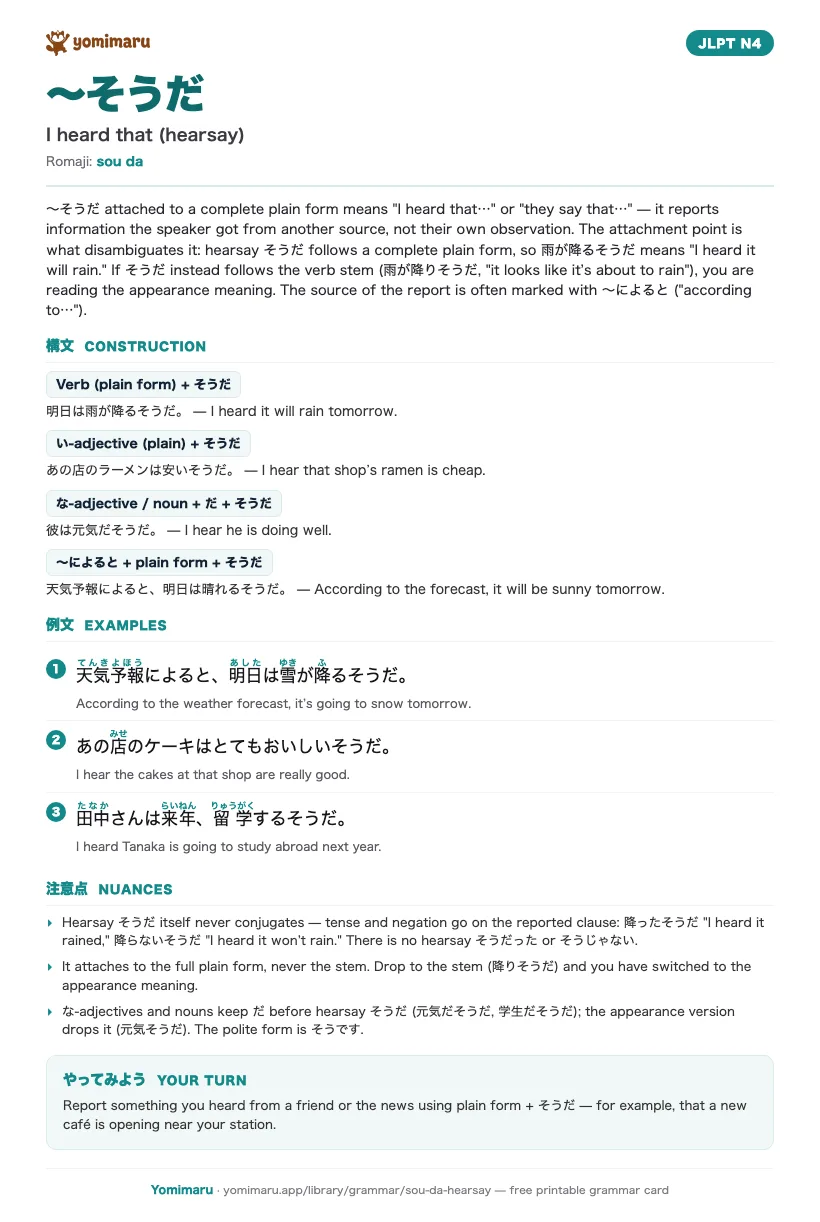
A free one-page study card for 〜そうだ (I heard that (hearsay)), JLPT N4: what it means, how it attaches, 3 example sentences with furigana, and the nuances that trip learners up. Read it right here, or take the PDF or PNG with you. We never ask for an email for this card.
The attachment point is what disambiguates it: hearsay そうだ follows a complete plain form, so 雨が降るそうだ means "I heard it will rain." If そうだ instead follows the verb stem (雨が降りそうだ, "it looks like it’s about to rain"), you are reading the appearance meaning. The source of the report is often marked with 〜によると ("according to…").
構文Construction
Verb (plain form) + そうだ
明日は雨が降るそうだ。 — I heard it will rain tomorrow.
い-adjective (plain) + そうだ
あの店のラーメンは安いそうだ。 — I hear that shop’s ramen is cheap.
な-adjective / noun + だ + そうだ
彼は元気だそうだ。 — I hear he is doing well.
〜によると + plain form + そうだ
天気予報によると、明日は晴れるそうだ。 — According to the forecast, it will be sunny tomorrow.
例文In a sentence
天気予報によると、明日は雪が降るそうだ。
According to the weather forecast, it’s going to snow tomorrow.
あの店のケーキはとてもおいしいそうだ。
I hear the cakes at that shop are really good.
田中さんは来年、留学するそうだ。
I heard Tanaka is going to study abroad next year.
注意点Nuances
It attaches to the full plain form, never the stem. Drop to the stem (降りそうだ) and you have switched to the appearance meaning.
な-adjectives and nouns keep だ before hearsay そうだ (元気だそうだ, 学生だそうだ); the appearance version drops it (元気そうだ). The polite form is そうです.
How 〜そうだ differs from similar patterns
〜そうだ — Same surface, different attachment: hearsay follows the complete plain form (降るそうだ = "I heard it will rain"), appearance follows the stem (降りそうだ = "it looks about to rain").
〜らしい — 〜らしい also reports secondhand information but adds the speaker’s own inference; hearsay 〜そうだ is a more direct relay of exactly what was heard or read.
練習Your Turn
Tip
Report something you heard from a friend or the news using plain form + そうだ — for example, that a new café is opening near your station.
〜そうだ (I heard that (hearsay)) in real sentences
Each one is quoted from a published Japanese text in this library and links to the story it came from. Some use older spellings, or break off where the sentence carried on. They are transcribed exactly as their authors wrote them.
〜そうだ sits at JLPT N4 in the 302-point taxonomy every text in this library is tagged against. Each text is read for the patterns it contains, which is what lets this page list every text that uses 〜そうだ and pull its example sentences out of them.
The example sentences were not written to demonstrate the rule. They are quoted from published Japanese texts in this library (The Miser God's Inn and The Black Scarf Gang's Evil Hand among them), and each one links back to the story it came from, so you can read the sentence where it actually happened.
質問Questions
〜そうだ: questions & answers
How do I tell hearsay そうだ apart from appearance そうだ?
Look at what comes right before そうだ. Hearsay attaches to a complete plain form — 降るそうだ, おいしいそうだ mean "I heard…" — while appearance attaches to the verb stem or an adjective with its い dropped: 降りそうだ, おいしそう mean "looks like…". If the word before そうだ could end a sentence on its own, you are reading hearsay.
How do I say "I heard it won’t rain"?
Negate the reported clause, not そうだ: 雨が降らないそうだ. Hearsay そうだ never changes form itself — a shape like 降りそうもない belongs to the appearance meaning, not hearsay.
What is the difference between hearsay 〜そうだ and 〜らしい?
Both pass on secondhand information. 〜そうだ presents it as a direct relay of what you heard or read, often with an explicit source like 〜によると; 〜らしい mixes in your own inference, so it feels a little more hedged — "apparently, it seems."
Is there a printable 〜そうだ cheat sheet?
Yes. A free one-page 〜そうだ (I heard that (hearsay)) study card sits at the top of this page, as both a PDF and a PNG. It carries the JLPT N4 meaning, how the pattern attaches, 3 example sentences with furigana, and the nuances learners get wrong. You do not need an account or an email address to download it.
始めるStart free
Read the grammar you just studied
Yomimaru turns every text in the library into a reading lesson: furigana tuned to your JLPT level, tap-to-look-up on any word, and an English breakdown of the vocabulary and grammar in each sentence. It is all free, and we never ask for a card.