〜ておく means “do in advance”. It is a JLPT N4 pattern: below are its construction, the nuances that trip learners up, and the sentences where real Japanese writers use it.
A free one-page study card for 〜ておく (do in advance), JLPT N4: what it means, how it attaches, 3 example sentences with furigana, and the nuances that trip learners up. Read it right here, or take the PDF or PNG with you. We never ask for an email for this card.
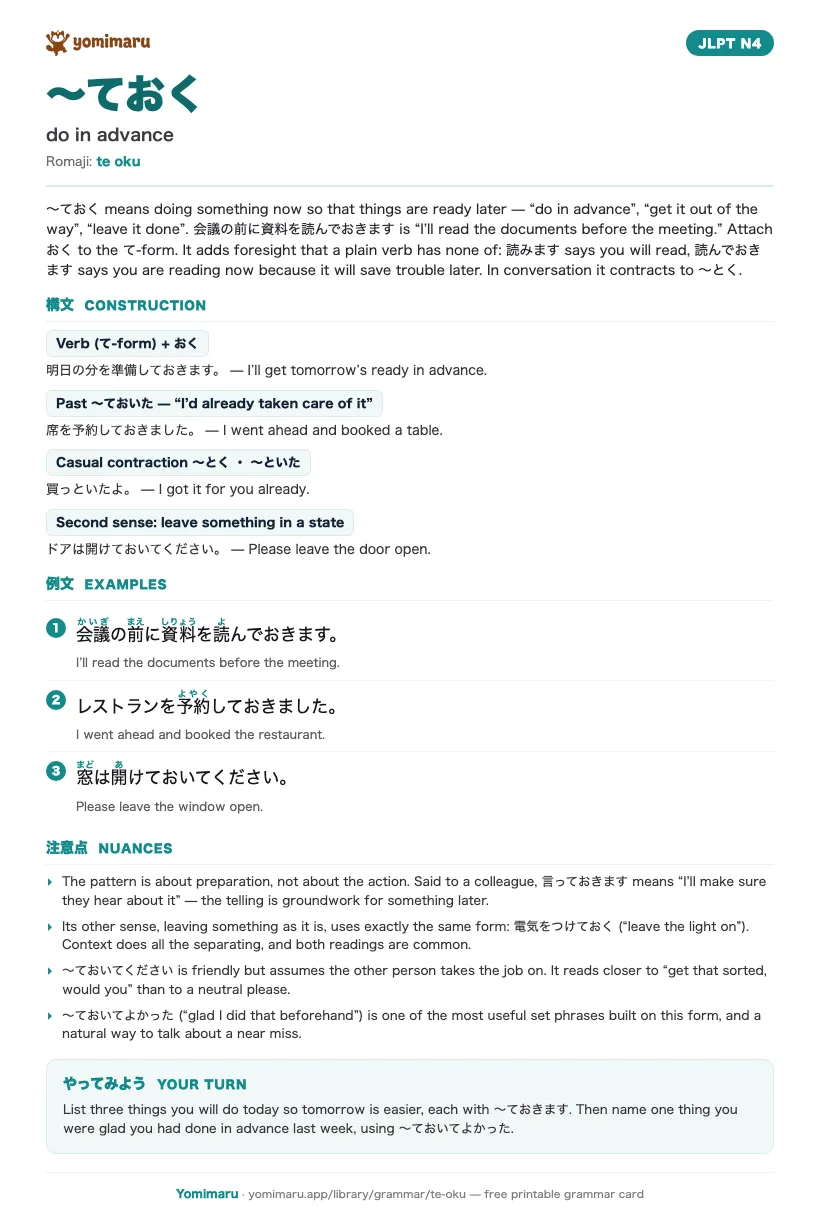
会議の前に資料を読んでおきます is “I’ll read the documents before the meeting.” Attach おく to the て-form. It adds foresight that a plain verb has none of: 読みます says you will read, 読んでおきます says you are reading now because it will save trouble later. In conversation it contracts to 〜とく.
構文Construction
Verb (て-form) + おく
明日の分を準備しておきます。 — I’ll get tomorrow’s ready in advance.
Past 〜ておいた — “I’d already taken care of it”
席を予約しておきました。 — I went ahead and booked a table.
Casual contraction 〜とく ・ 〜といた
買っといたよ。 — I got it for you already.
Second sense: leave something in a state
ドアは開けておいてください。 — Please leave the door open.
例文In a sentence
会議の前に資料を読んでおきます。
I’ll read the documents before the meeting.
レストランを予約しておきました。
I went ahead and booked the restaurant.
窓は開けておいてください。
Please leave the window open.
注意点Nuances
Said to a colleague, 言っておきます means “I’ll make sure they hear about it” — the telling is groundwork for something later.
Its other sense, leaving something as it is, uses exactly the same form: 電気をつけておく (“leave the light on”). Context does all the separating, and both readings are common.
〜ておいてください is friendly but assumes the other person takes the job on. It reads closer to “get that sorted, would you” than to a neutral please.
〜ておいてよかった (“glad I did that beforehand”) is one of the most useful set phrases built on this form, and a natural way to talk about a near miss.
How 〜ておく differs from similar patterns
〜てしまう — 〜てしまう finishes something off, often with regret or finality; 〜ておく finishes it early, on purpose, for later benefit.
〜てある — 〜てある describes the resulting state and hides who prepared it (書いてある — “it’s written there”); 〜ておく keeps the person who prepared it in view.
てみる — 〜てみる tries something out to see what happens; 〜ておく does something you are already sure about, just earlier than needed.
練習Your Turn
Tip
List three things you will do today so tomorrow is easier, each with 〜ておきます. Then name one thing you were glad you had done in advance last week, using 〜ておいてよかった.
〜ておく (do in advance) in real sentences
Each one is quoted from a published Japanese text in this library and links to the story it came from. Some use older spellings, or break off where the sentence carried on. They are transcribed exactly as their authors wrote them.
〜ておく sits at JLPT N4 in the 302-point taxonomy every text in this library is tagged against. Each text is read for the patterns it contains, which is what lets this page list every text that uses 〜ておく and pull its example sentences out of them.
The example sentences were not written to demonstrate the rule. They are quoted from published Japanese texts in this library (The Embassy's Cleanup Agency and The Kojiki's Eye Detective Files among them), and each one links back to the story it came from, so you can read the sentence where it actually happened.
質問Questions
〜ておく: questions & answers
What does 〜ておく add to a verb?
Foresight. The action is done now because it will help later: confirming a booking, charging a phone, telling someone in advance. 電話しておきます means you are ringing ahead so the call is out of the way before it matters.
What is 〜とく?
The spoken contraction of 〜ておく: 買っとく for 買っておく, やっといた for やっておいた. It is casual and extremely frequent in conversation, but keep the full form in writing.
What is the difference between 〜ておく and 〜てある?
〜ておく is the act of preparing, with a person behind it: メモを書いておいた (“I wrote a note in advance”). 〜てある is the state that resulted, with the person left out: メモが書いてある (“there’s a note written”).
Is there a printable 〜ておく cheat sheet?
Yes. A free one-page 〜ておく (do in advance) study card sits at the top of this page, as both a PDF and a PNG. It carries the JLPT N4 meaning, how the pattern attaches, 3 example sentences with furigana, and the nuances learners get wrong. You do not need an account or an email address to download it.
始めるStart free
Read the grammar you just studied
Yomimaru turns every text in the library into a reading lesson: furigana tuned to your JLPT level, tap-to-look-up on any word, and an English breakdown of the vocabulary and grammar in each sentence. It is all free, and we never ask for a card.