作品Free Graded Reading
お住の霊The Ghost of the Residence
Osumi no Rei
by 岡本 綺堂 · Okamoto Kido
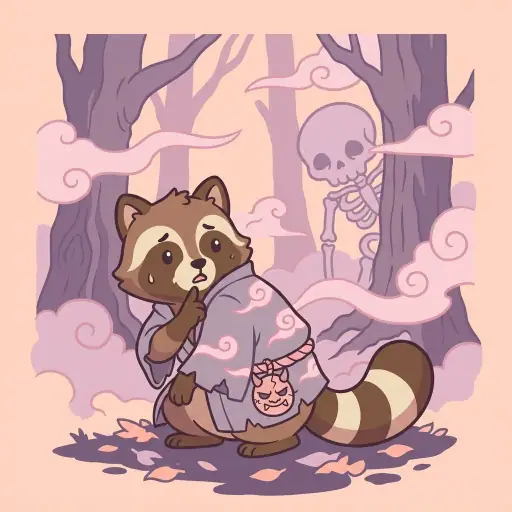
A chilling ghost story of a wet-haired apparition haunting a samurai's wife.
About this story
 About this story
A woman demands a divorce from her brother, then reveals the ghost story that drove her away.
Read a sample in Japanese
 Read a sample in Japanese
What you'll learn
 What you'll learn
The narrator introduces a ghost story from the Bunkyu era, heard from his friend's father, about a woman who seeks a divorce because she sees a ghost every night.
The brother goes to investigate at his sister's house. He confronts the husband, Hayato, who decides to search the pond for a possible drowned body.
The 80-year-old grandmother interrupts the pond-dredging and confesses a dark secret: 50 years ago, the owner's grandfather had an affair with a maid named Osumi, who was abused for becoming pregnant and drowned herself in the pond.
Key vocabulary
 Key vocabulary
| 怪談 (かいだん) | ghost story |
|---|---|
| 散し髪 (ちらしがみ) | disheveled hair |
| 懐妊 (かいにん) | pregnancy |
| 折檻 (せっかん) | chastisement, corporal punishment |
| 幽魂 (ゆうこん) | spirit, ghost |
| 五十回忌 (ごじっかいき) | 50th memorial service |
Grammar points you'll meet
 Grammar points you'll meet
- ~かどうか N4Used to express 'whether or not'. In the text: '成仏したかどうか知らぬ' (I don't know whether it became a Buddha or not).成仏したかどうか知らぬ
- ~ておく N4Indicates doing something in advance. In the text: '一応詮議致して見ましょう' (let's investigate first). Actually, ておく is implied but the text uses 致して見ましょう. Better to find explicit example. There is '打って置いた'? Not in text. Let's use another pattern.一応その掻堀をして見ろ
- ~ぬ N1Classical negative suffix. Equivalent to modern ない. Used frequently in the text, e.g., '知らぬ', '解らぬ', '信じられぬ'.知らぬ者の眼に怪しい影の映ろう筈がなく
- ~というもの N2Used to emphasize something as a concept. In text: '世には理外の理というものが有るものだ' (There are things beyond reason in this world).世には理外の理というものが有るものだ
- ~に相違ない N2Means 'without doubt'. In text: '正しくお住その者の幽魂が迷って出たに相違ない' (It is undoubtedly the ghost of Osumi).正しくお住その者の幽魂が迷って出たに相違ない
Cultural notes
 Cultural notes
- 旗本 (Hatamoto)A direct vassal of the shogun in the Edo period, holding a fief with income of at least 10,000 koku. The story mentions '旗下' (kaki), an alternate term for hatamoto, indicating the social status of the characters.
- 文久 (Bunkyu) EraA Japanese era name (1861-1864) towards the end of the Edo period. The story is set in this time, reflecting the historical backdrop.
- 幽霊 (Yurei) BeliefJapanese ghosts are often depicted with disheveled hair and white clothing, and are bound to the earthly realm by strong emotions. The ghost in the story is a classic example of a yurei seeking peace.
- 五十回忌 (Gojukkai Ki)A Buddhist memorial service held 50 years after a person's death, considered a significant milestone for the spirit's journey to enlightenment. The ghost appears exactly at this time.
Try a comprehension question
 Try a comprehension question
Who is the narrator's source for this ghost story?
- His own father
- The sister
- The grandmother
- The author
Sensei's reading tip
 Sensei's reading tip
Focus on understanding the nested narrative structure: the story is told by a narrator who heard it from a friend's father.
Topics & grammar
 Topics & grammar



同級More at N1

Fresh reads in your inbox
A short monthly note when we add new graded stories. No spam.