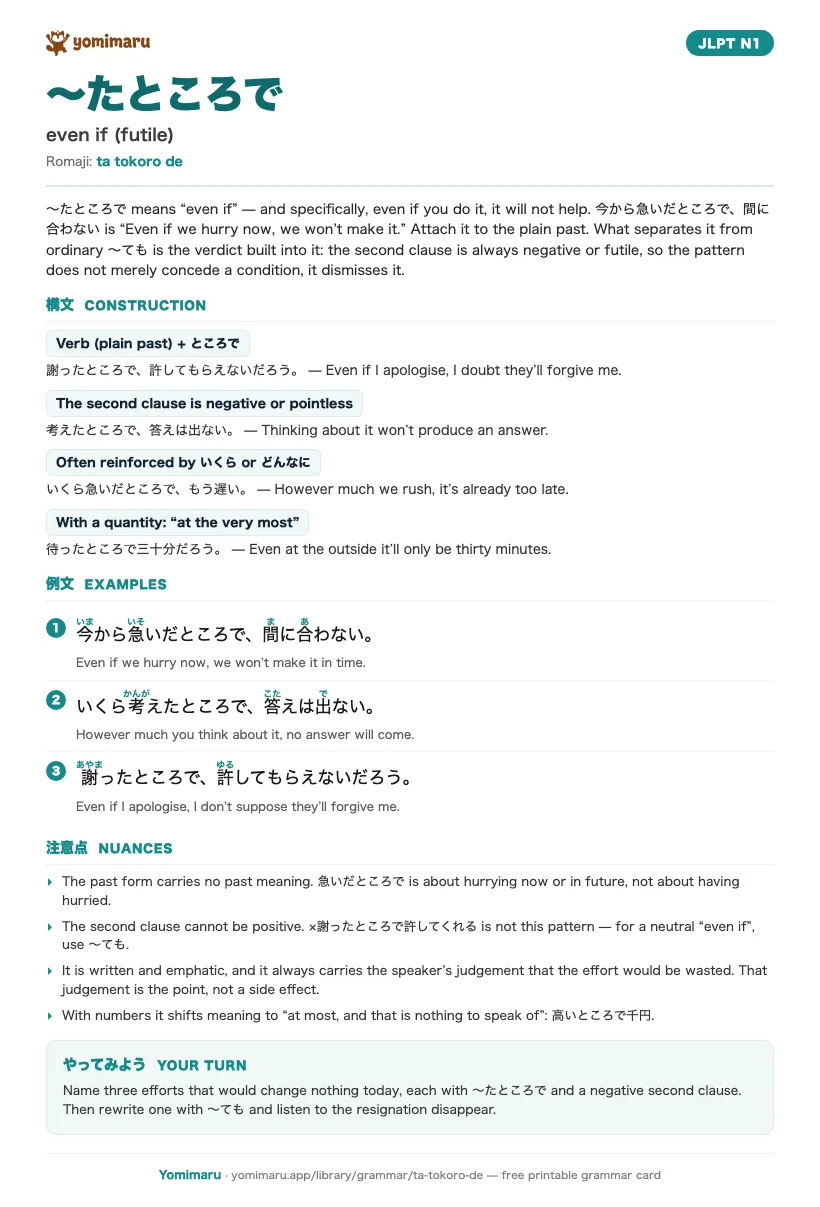
〜たところで means “even if (futile)”. It is a JLPT N1 pattern: below are its construction, the nuances that trip learners up, and the sentences where real Japanese writers use it.
A free one-page study card for 〜たところで (even if (futile)), JLPT N1: what it means, how it attaches, 3 example sentences with furigana, and the nuances that trip learners up. Read it right here, or take the PDF or PNG with you. We never ask for an email for this card.
今から急いだところで、間に合わない is “Even if we hurry now, we won’t make it.” Attach it to the plain past. What separates it from ordinary 〜ても is the verdict built into it: the second clause is always negative or futile, so the pattern does not merely concede a condition, it dismisses it.
構文Construction
Verb (plain past) + ところで
謝ったところで、許してもらえないだろう。 — Even if I apologise, I doubt they’ll forgive me.
The second clause is negative or pointless
考えたところで、答えは出ない。 — Thinking about it won’t produce an answer.
Often reinforced by いくら or どんなに
いくら急いだところで、もう遅い。 — However much we rush, it’s already too late.
With a quantity: “at the very most”
待ったところで三十分だろう。 — Even at the outside it’ll only be thirty minutes.
例文In a sentence
今から急いだところで、間に合わない。
Even if we hurry now, we won’t make it in time.
いくら考えたところで、答えは出ない。
However much you think about it, no answer will come.
謝ったところで、許してもらえないだろう。
Even if I apologise, I don’t suppose they’ll forgive me.
注意点Nuances
急いだところで is about hurrying now or in future, not about having hurried.
The second clause cannot be positive. ×謝ったところで許してくれる is not this pattern — for a neutral “even if”, use 〜ても.
It is written and emphatic, and it always carries the speaker’s judgement that the effort would be wasted. That judgement is the point, not a side effect.
With numbers it shifts meaning to “at most, and that is nothing to speak of”: 高いところで千円.
How 〜たところで differs from similar patterns
〜ても — 〜ても is the neutral “even if” and takes any kind of second clause. 〜たところで only takes a futile one, and adds the speaker’s resignation.
〜としたところで — 〜としたところで is the close relative used for suppositions rather than actions — “even supposing that were so”.
〜たって — 〜たって is the casual spoken “even if” (行ったって無駄だ), covering the same ground as 〜たところで in conversation.
練習Your Turn
Tip
Name three efforts that would change nothing today, each with 〜たところで and a negative second clause. Then rewrite one with 〜ても and listen to the resignation disappear.
〜たところで (even if (futile)) in real sentences
Each one is quoted from a published Japanese text in this library and links to the story it came from. Some use older spellings, or break off where the sentence carried on. They are transcribed exactly as their authors wrote them.
〜たところで sits at JLPT N1 in the 302-point taxonomy every text in this library is tagged against. Each text is read for the patterns it contains, which is what lets this page list every text that uses 〜たところで and pull its example sentences out of them.
The example sentences were not written to demonstrate the rule. They are quoted from published Japanese texts in this library (The Election Murder Case and The Secret of Macarger's Gulch among them), and each one links back to the story it came from, so you can read the sentence where it actually happened.
質問Questions
〜たところで: questions & answers
What does 〜たところで mean?
It means “even if — and it won’t help”. 今さら謝ったところで遅い says apologising now would be pointless. The futility is part of the grammar, not something you add with extra words.
Why is the verb in the past form?
The past shape marks the action as hypothetically completed, not as something that happened. 急いだところで still refers to the future, in the same way 〜たら does.
What is the difference between 〜たところで and 〜ても?
〜ても is neutral and accepts any outcome: 雨が降っても行きます. 〜たところで insists the outcome is useless, so it only takes a negative or futile second clause: 雨が降ったところで中止にはならない.
Is there a printable 〜たところで cheat sheet?
Yes. A free one-page 〜たところで (even if (futile)) study card sits at the top of this page, as both a PDF and a PNG. It carries the JLPT N1 meaning, how the pattern attaches, 3 example sentences with furigana, and the nuances learners get wrong. You do not need an account or an email address to download it.
始めるStart free
Read the grammar you just studied
Yomimaru turns every text in the library into a reading lesson: furigana tuned to your JLPT level, tap-to-look-up on any word, and an English breakdown of the vocabulary and grammar in each sentence. It is all free, and we never ask for a card.