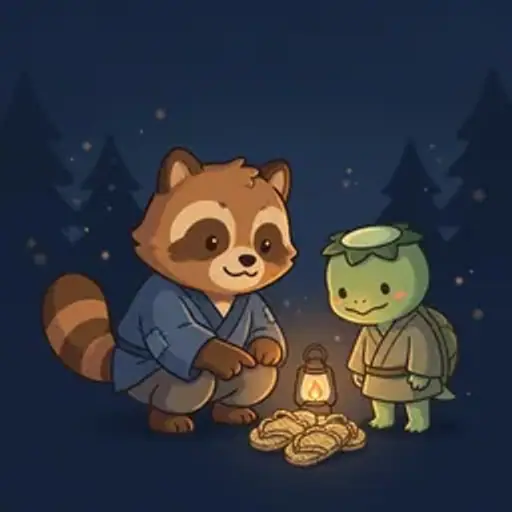
作品Free Graded Reading
こぞうさんの おきょうThe Young Monk and the Rabbit
Kozō-san no Okyō
by 新美 南吉 · Niimi Nankichi
A young monk forgets his sutra and instead sings about blooming peonies.
About this story
 About this story
A young monk forgets his sutra after playing with a rabbit, who teaches him a substitute verse. To everyone's surprise, he recites it at the temple and receives a treat.
Read a sample in Japanese
 Read a sample in Japanese
What you'll learn
 What you'll learn
A young monk goes to a parishioner's house to chant sutras because the head priest is ill. On the way, a rabbit distracts him and teaches him a silly song instead. He chants the song at the temple, amusing everyone, and receives a bun for his trouble.
Key vocabulary
 Key vocabulary
| おしょうさん | priest; head monk |
|---|---|
| こぞうさん | young monk; apprentice monk |
| おきょう | sutra; Buddhist scripture |
| うさぎ | rabbit |
| おまんじゅう | steamed bun (with filling) |
Grammar points you'll meet
 Grammar points you'll meet
- ~ので (reason/cause) N4Indicates reason; 'because' or 'so'.やまでらの おしょうさんが びょうきに なりましたので、かわりに こぞうさんが だんかへ おきょうを よみに いきました。
- ~に (purpose) N5Used after masu-stem to indicate purpose of going/coming.こぞうさんが だんかへ おきょうを よみに いきました。
- ~と (quotative) N5Indicates quotation or thought.「こぼうず、あおぼうず」と よびました。
- ~てしまう (completion/regret) N4Indicates completing an action unintentionally or with regret.おきょうを わすれちゃった
- ~てくれる (doing for me/us) N4Someone does an action for the benefit of the speaker.うさぎの おしえて くれたように
Cultural notes
 Cultural notes
- おきょう (Sutra Chanting)In Buddhism, sutras are chanted during ceremonies. Monks often travel to parishioners' homes for funeral or memorial services. Here, young monk substitutes for the head priest.
- おまんじゅう (Steamed Bun)A traditional Japanese confection often given as a gift or offering. In this story, the parishioner gives manjuu as compensation for the monk's service.
- だんか (Parishioner)A family or household that supports a Buddhist temple and receives services from its monks. The term reflects the lay community's relationship with the temple.
Try a comprehension question
 Try a comprehension question
Why did the young monk go to the parishioner's house?
- Because the head priest was sick.
- Because he wanted to play with the rabbit.
- Because he needed to get a manjuu bun.
- Because the rabbit told him to go.
Sensei's reading tip
 Sensei's reading tip
Read aloud to practice pronunciation, especially the repeated phrase 'さいた、さいた、さいた'.
Topics & grammar
 Topics & grammar
同級More at N4
- Real Japanese news written for N4Yominews · free, furigana on every kanji
- Short Japanese stories at N4Yomibunko · graded texts, free
- N4 grammar with example sentences57 points · free study cards
- The JLPT N4 kanji and vocabulary listStudy guide · what to know
- How to read a JLPT passage under timeStudy guide · reading strategy

Fresh reads in your inbox
A short monthly note when we add new graded stories. No spam.