〜がするsmells / sounds / feels like: Meaning & Examples
ga suru · JLPT N4
JLPT N45 textsStudy card
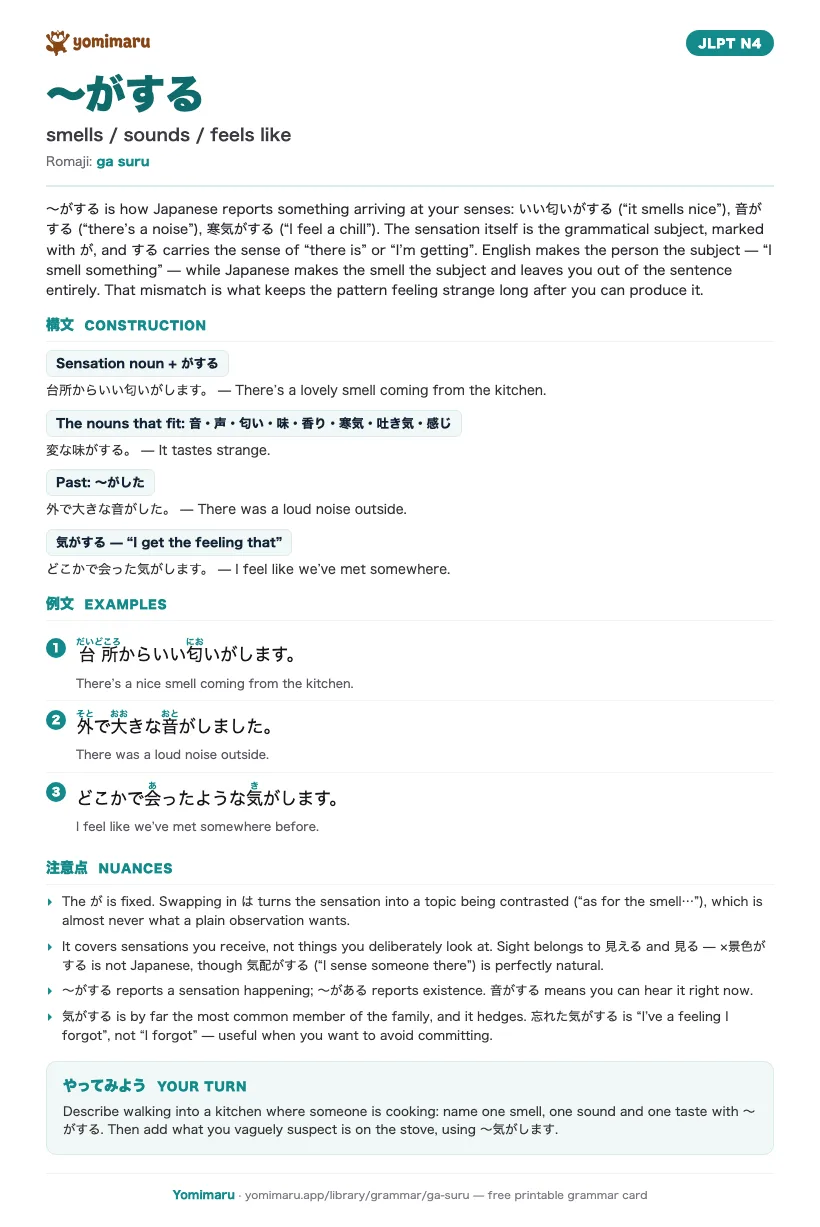
〜がする means “smells / sounds / feels like”. It is a JLPT N4 pattern: below are its construction, the nuances that trip learners up, and the sentences where real Japanese writers use it.
A free one-page study card for 〜がする (smells / sounds / feels like), JLPT N4: what it means, how it attaches, 3 example sentences with furigana, and the nuances that trip learners up. Read it right here, or take the PDF or PNG with you. We never ask for an email for this card.
The sensation itself is the grammatical subject, marked with が, and する carries the sense of “there is” or “I’m getting”. English makes the person the subject — “I smell something” — while Japanese makes the smell the subject and leaves you out of the sentence entirely. That mismatch is what keeps the pattern feeling strange long after you can produce it.
構文Construction
Sensation noun + がする
台所からいい匂いがします。 — There’s a lovely smell coming from the kitchen.
The nouns that fit: 音・声・匂い・味・香り・寒気・吐き気・感じ
変な味がする。 — It tastes strange.
Past: 〜がした
外で大きな音がした。 — There was a loud noise outside.
気がする — “I get the feeling that”
どこかで会った気がします。 — I feel like we’ve met somewhere.
例文In a sentence
台所からいい匂いがします。
There’s a nice smell coming from the kitchen.
外で大きな音がしました。
There was a loud noise outside.
どこかで会ったような気がします。
I feel like we’ve met somewhere before.
注意点Nuances
Swapping in は turns the sensation into a topic being contrasted (“as for the smell…”), which is almost never what a plain observation wants.
It covers sensations you receive, not things you deliberately look at. Sight belongs to 見える and 見る — ×景色がする is not Japanese, though 気配がする (“I sense someone there”) is perfectly natural.
〜がする reports a sensation happening; 〜がある reports existence. 音がする means you can hear it right now.
気がする is by far the most common member of the family, and it hedges. 忘れた気がする is “I’ve a feeling I forgot”, not “I forgot” — useful when you want to avoid committing.
How 〜がする differs from similar patterns
〜そうだ — 〜そうだ reports how something looks from outside (おいしそう); 〜がする reports a sensation reaching you (いい匂いがする). One is judgement by sight, the other is direct perception.
〜ような気がする — 〜ような気がする is the hedged extension of the 気がする use here — “I have a vague feeling that”, one more step away from asserting it.
練習Your Turn
Tip
Describe walking into a kitchen where someone is cooking: name one smell, one sound and one taste with 〜がする. Then add what you vaguely suspect is on the stove, using 〜気がします.
〜がする (smells / sounds / feels like) in real sentences
Each one is quoted from a published Japanese text in this library and links to the story it came from. Some use older spellings, or break off where the sentence carried on. They are transcribed exactly as their authors wrote them.
〜がする sits at JLPT N4 in the 302-point taxonomy every text in this library is tagged against. Each text is read for the patterns it contains, which is what lets this page list every text that uses 〜がする and pull its example sentences out of them.
The example sentences were not written to demonstrate the rule. They are quoted from published Japanese texts in this library (Untitled (Ten) and Summer Festival among them), and each one links back to the story it came from, so you can read the sentence where it actually happened.
質問Questions
〜がする: questions & answers
What does 〜がする mean?
It reports a sensation: a smell, sound, taste or physical feeling. The sensation is the subject and takes が, so “it smells burnt” becomes 焦げた匂いがする — literally “a burnt smell does”. There is no word for “I” in the sentence at all.
Which nouns can I use with 〜がする?
The senses and bodily feelings: 音 (sound), 声 (voice), 匂い/香り (smell), 味 (taste), 感じ (feeling), plus symptoms like 寒気 (chills), 吐き気 (nausea) and 頭痛. Sight is the exception — use 見える for that.
What does 気がする mean?
It means “I get the feeling that” and softens whatever comes before it. 違う気がする is “something feels off about that” rather than a flat “that’s wrong”, which makes it very useful for disagreeing politely.
Is there a printable 〜がする cheat sheet?
Yes. A free one-page 〜がする (smells / sounds / feels like) study card sits at the top of this page, as both a PDF and a PNG. It carries the JLPT N4 meaning, how the pattern attaches, 3 example sentences with furigana, and the nuances learners get wrong. You do not need an account or an email address to download it.
始めるStart free
Read the grammar you just studied
Yomimaru turns every text in the library into a reading lesson: furigana tuned to your JLPT level, tap-to-look-up on any word, and an English breakdown of the vocabulary and grammar in each sentence. It is all free, and we never ask for a card.