Katakana chart
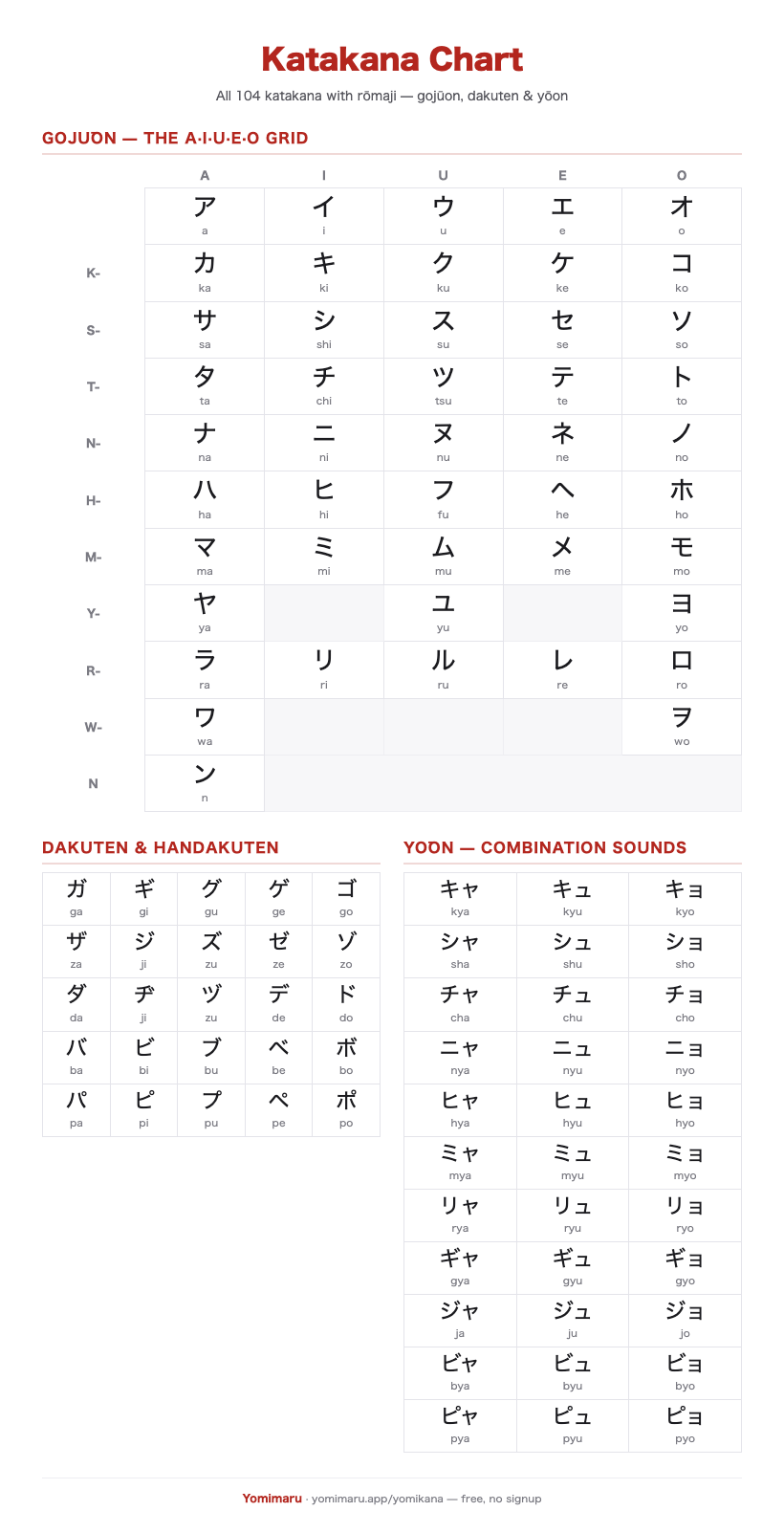
Katakana has 46 basic kana, 25 more with a dakuten or handakuten, 33 yōon combinations and 21 extended kana for foreign sounds: 125 in all. This chart from Yomikana, the free kana course in Yomimaru, shows every one. Tap a kana to hear it, see how it is written, and read a mnemonic and an example word.
Basic katakana: the 46 gojūon
| a | i | u | e | o | |
|---|---|---|---|---|---|
| Vowels | |||||
| K | |||||
| S | |||||
| T | |||||
| N | |||||
| H | |||||
| M | |||||
| Y | |||||
| R | |||||
| W | |||||
| The moraic n |
Katakana with dakuten and handakuten
| a | i | u | e | o | |
|---|---|---|---|---|---|
| G | |||||
| Z | |||||
| D | |||||
| B | |||||
| P |
Katakana yōon: combination sounds
| ya | yu | yo | |
|---|---|---|---|
| Ky | |||
| Sh | |||
| Ch | |||
| Ny | |||
| Hy | |||
| My | |||
| Ry | |||
| Gy | |||
| J | |||
| By | |||
| Py |
Extended katakana for foreign sounds
| Fa, Fi, Fe, Fo | |||||
|---|---|---|---|---|---|
| Va, Vi, Vu, Ve, Vo | |||||
| Ti, Di, Tu, Du, Dyu | |||||
| Wi, We, Wo | |||||
| She, Che, Je, Tsa |
The bar is your progress in the free course. A dot marks a kana you often miss.

Learn all 208 kana and your first Japanese words
Yomikana teaches them one row at a time, with no account needed.
Words from the second lesson
Everyday words you can already read, up to five at a time, from food and drink to places and travel.
Reviews on a spaced schedule
Spaced repetition brings each kana back after 1 day, then 3, 7, 21 and 60 days, and sooner when you miss it.
A real story after four rows
Finish four hiragana rows and you can already read your first short story.
Printable katakana chart and worksheets
Every sheet is a free PDF, ready for class. Use the blank chart as a warm-up, the kana-only chart as a quick check, and the writing sheets for handwriting. Each one has a QR code that opens this chart, so students can hear the sounds at home.
Page 1 of 1
- Full katakana chart
All 125 kana with rōmaji, extended sounds included.
- Blank chart
Rōmaji only: students write the kana.
- Kana-only chart
Kana only: students write the sound.
- Stroke order chart
Each basic and dakuten kana, stroke by stroke.
- Writing practice sheets
Row by row: stroke frames, tracing cells, empty squares.
- Mnemonic chart
All 46 mnemonics, each with an example word.
- Printable katakana test
A four-page test with its answer key.
Free to print, copy and share with your students. Keep the credit line. Not for resale. Stroke order and writing sheets use KanjiVG data and are shared under CC BY-SA 3.0.
Katakana stroke order chart
PrintKatakana strokes are short and mostly straight. The numbers mark where each stroke starts, in the order you write them on paper. Tap a kana in the chart to watch it drawn.
Dakuten and handakuten25
The small kana in yōon3
The small kana in extended katakana6
Stroke data: KanjiVG (CC BY-SA 3.0).
Katakana mnemonics
PrintA memory hook for each of the 46 basic kana, and a word to read it in.
| Kana | Mnemonic and example |
|---|---|
| アa | An axe: the blade bends down at the top right and the handle drops through the middle. マ's second stroke flicks right instead. アイス aisu: Ice Cream |
| イi | A lean-to shelter: one roof beam slants down to the left and a straight post holds it up. インク inku: Ink |
| ウu | Hiragana う's steaming udon bowl, made boxy: the steam tick on top, the bowl hooking down. Without the tick it is ワ. ウサギ usagi: Rabbit |
| エe | A steel I-beam for the engineer: a short top bar, a post, a longer base. It looks like a capital I. エアコン eakon: Air Conditioner |
| オo | An opera singer: arms thrown wide across, body straight down, one leg sweeping back to the left. オレンジ orenji: Orange |
| カka | Hiragana か without its puff of exhaust on the right. It also looks like the kanji 力, power. カメラ kamera: Camera |
| キki | An old key with two teeth: two crossbars and a slanted shaft, and no hook at the bottom. Hiragana き keeps the hook. キウイ kiui: Kiwi |
| クku | An arm bent at the elbow like a 7, ready to cook. Add a dash inside and it is タ; add a crossing leg and it is ケ. クラス kurasu: Class |
| ケke | A leaning letter K: a short slash, a bar out to the right, and a long leg dropping from the bar's middle. ケーキ keeki: Cake |
| コko | The corner of a box, open on the left. Close that side and it becomes ロ. コーヒー koohii: Coffee |
| サsa | A saddle: one long crossbar resting on two legs, the right leg sweeping back to the left. サラダ sarada: Salad |
| シshi | A smiling face lying on its side: two dots stacked on the LEFT, and the smile sweeps UP to the right. ツ's dots sit on top. シーソー shiisoo: Seesaw |
| スsu | A runner in mid-stride: the body bends forward and one leg kicks out behind. In ヌ the second stroke cuts through the body. スポーツ supootsu: Sports |
| セse | Hiragana せ with only one post: the bar hooks down at the right and the stem curls to the right at the foot. センター sentaa: Center |
| ソso | A needle sewing: a small stitch at the top left, then the needle plunges DOWN from the top right. ン's long line rises instead. ソーダ sooda: Soda |
| タta | ク with a small dash inside, like the kanji 夕, evening. Plain ク has nothing inside. タクシー takushii: Taxi |
| チchi | A cheerleader: a tilted cap, arms straight across, one leg swinging left. It looks like the kanji 千, thousand. テ has a flat cap. チーズ chiizu: Cheese |
| ツtsu | Two raindrops fall side by side from the TOP edge, and one long stream runs DOWN to the left. シ's drops sit on the left and its line rises. ツアー tsuaa: Tour |
| テte | A TV antenna on a roof: two flat bars and one cable drooping down to the left. テスト tesuto: Test |
| トto | A totem pole with a single twig sticking out to the right. トイレ toire: Toilet |
| ナna | The top-left corner of hiragana な on its own: a bar across and a leg bending down to the left. メ has no flat bar. ナイフ naifu: Knife |
| ニni | Two lines, like the kanji 二, two. They are also the right half of hiragana に. ニュース nyuusu: News |
| ヌnu | Noodles in a bowl: the rim bends down to the left and one chopstick stabs through it. In ス the stroke only kicks out below. ヌードル nuudoru: Noodles |
| ネne | A necktie on a peg: the knot tick on top, the tie bending left, a stripe down the middle and a small one on the right. ネクタイ nekutai: Necktie |
| ノno | A single slash, as if crossing out a word to say no: it runs from the top right down to the left. Add a tick and it becomes ソ. ノート nooto: Notebook |
| Kana | Mnemonic and example |
|---|---|
| ハha | Two strokes bursting apart like a laugh: manga writes 'ha ha ha' as three of them in a row. It comes from the kanji 八, eight, and looks just like it. ハム hamu: Ham |
| ヒhi | A hiker resting: back upright, legs stretched out along the ground, one arm pointing to the right. ヒーロー hiiroo: Hero |
| フfu | One stroke across and then down to the left, like the edge of a hood. ワ adds a post on the left; ス and ヌ add a kick. フランス furansu: France |
| ヘhe | The same single low peak as hiragana へ. The two look almost identical, so the words around them tell you which script it is. ヘリ heri: Helicopter |
| ホho | The kanji 木, tree, with its two lower branches cut into short stumps on either side. ホテル hoteru: Hotel |
| マma | A mat folded over: the top bends down to the left and the end flicks out to the right. ア's second stroke drops through the middle. マスク masuku: Mask |
| ミmi | Three slanted dashes, like the kanji 三, three, blown sideways. 'Three' is mittsu. ミルク miruku: Milk |
| ムmu | A small tent pitched on the ground, with a peg at its right corner. ムービー muubii: Movie |
| メme | A big X marking the spot on a treasure map. ナ has a flat bar across instead of a slash. メロン meron: Melon |
| モmo | Hiragana も straightened out: two bars across, and the stem drops then turns right along the floor. モニター monitaa: Monitor |
| ヤya | Hiragana や without its small tick: the knitting needle and the curve of yarn are all that is left. ヤシ yashi: Palm Tree |
| ユyu | A letter U knocked over onto its side, with the bottom line running past the corner: 'yu'. ユニコーン yunikoon: Unicorn |
| ヨyo | A capital E facing backwards. Take out the middle bar and it becomes コ. ヨーグルト yooguruto: Yogurt |
| ラra | Hiragana ら made angular: a short lid on top, then the back bending down to the left. ワ has a post on the left instead of a lid. ラジオ rajio: Radio |
| リri | Almost the same as hiragana り, only straighter: two streamers, the left one short. リボン ribon: Ribbon |
| ルru | Two tree roots side by side: the left one bends away and the right one curls up at its tip. レ is that right root alone. ルール ruuru: Rule |
| レre | A checkmark: a stroke down that kicks up to the right. It is the right half of ル. レモン remon: Lemon |
| ロro | A closed box, like the kanji 口, mouth. Open its left side and it becomes コ. ロボット robotto: Robot |
| ワwa | ウ without the tick on top: a short post on the left, then a roof that bends down. Remove the post and it is フ. ワイン wain: Wine |
| ヲwo | フ with an extra bar through the middle and a slash down. Katakana almost never uses it: loanwords write the sound with オ. ヲタ wota: Geek (slang spelling) |
| ンn | A shooting star: a small spark at the top left, then its long tail flies UP to the right. ソ's long line falls DOWN. ラーメン raamen: Ramen |
Questions
How many katakana are there?
Katakana has 46 basic kana. The 25 with a dakuten or handakuten and the 33 yōon bring that to 104, the same as hiragana. The 21 extended kana for foreign sounds, such as ファ and ティ, make 125 on this chart.
What is katakana used for?
Mostly loanwords such as コーヒー (coffee), foreign names and places. It also writes sound words, and it adds emphasis the way italics do in English.
What is the difference between hiragana and katakana?
They spell the same sounds in two scripts. Hiragana writes native words and grammar endings, and katakana mostly writes loanwords and foreign names. Katakana strokes are straighter and more angular.
Hiragana vs katakana, in fullWhat is the best way to remember katakana?
Learn one row at a time, keep a mnemonic for the shapes you miss, and test yourself with the rōmaji switched off. Short reviews over several days beat one long session.
How do you read ヲ?
ヲ is written wo in rōmaji but reads o, the same as オ. It is rare today, because the particle を is written in hiragana, so you meet it mostly in text set entirely in katakana. The real wo sound of loanwords is spelled ウォ, as in ウォッカ (vodka).
What does the long line ー mean in katakana?
It makes the vowel before it longer, as in コーヒー (kōhī, coffee), and takes one beat of its own. In vertical text the line runs down the page.
Keep learning
- The free Yomikana courseAll 208 kana, one row per lesson
- Hiragana chartAll hiragana with mnemonics, stroke order and a printable PDF.
- Free katakana quizTest yourself on all 104 katakana, then read 30 real loanwords.
- Dakuten, handakuten and small tsuHow two ticks and a circle change a kana, with a drill.
- Tell シ, ツ, ソ and ン apartHow to tell the four katakana look-alikes apart, with a drill.
- The Japanese alphabetHiragana, katakana and kanji in one page.
- Hiragana vs katakanaWhat each script is for, and which to learn first.
- Hiragana and Katakana: A Beginner's GuideWhy Japanese needs both scripts
From the chart to reading
Yomikana is the free kana course in Yomimaru. When the kana stick, your first stories are waiting.
Start the free course