

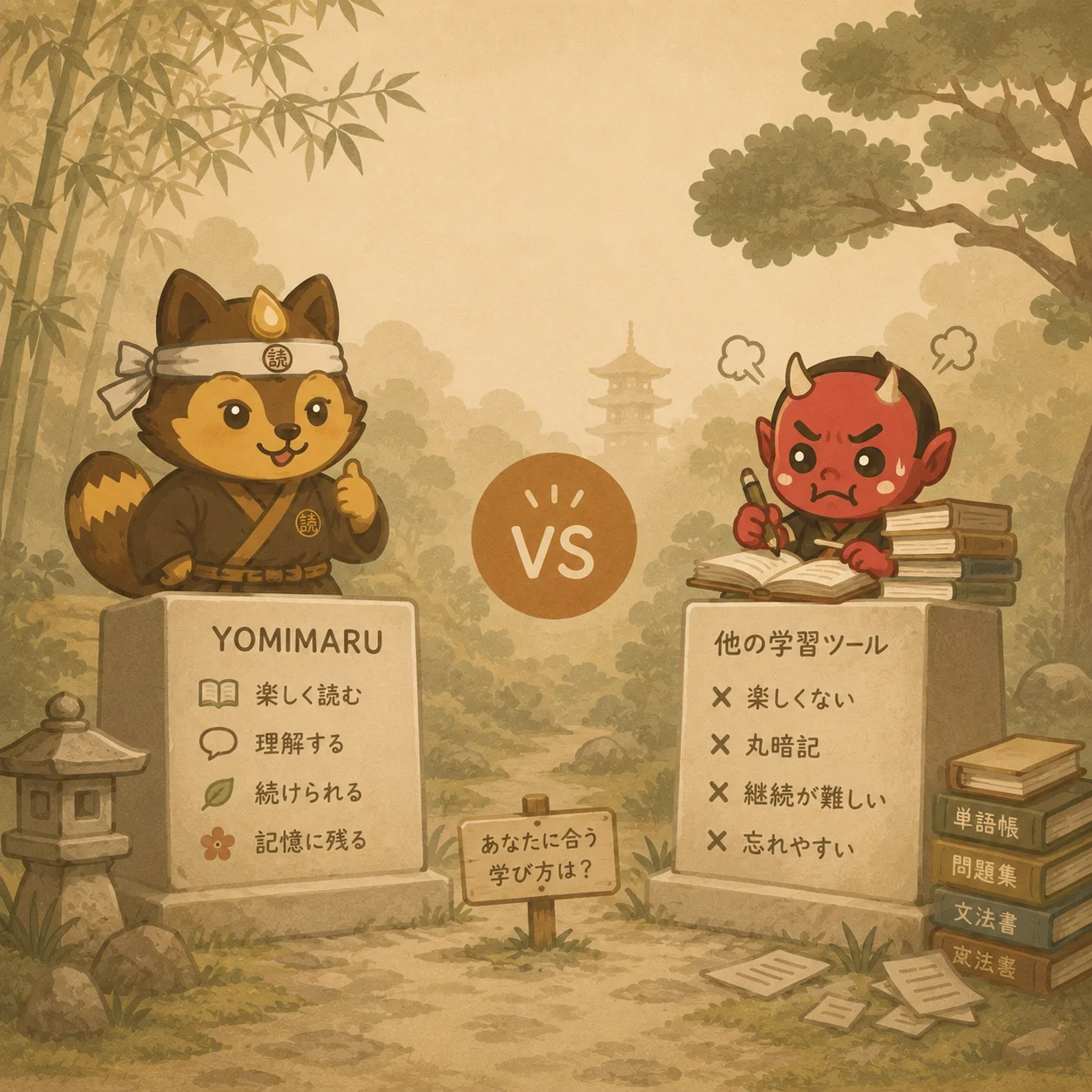
The best Satori Reader alternatives keep the parts you liked (tap-to-define vocabulary, real grammar help, difficulty that matches where you are) and fix the part you hit: a closed catalogue you can reach the end of. In 2026 the shortlist is LingQ for a bigger curated library, Todai for news-based reading, and Yomimaru for reading any Japanese text you bring, with adaptive furigana and AI grammar analysis applied on top of it.
Nobody goes looking for an alternative to a bad app. Satori Reader is not bad. It is finite, which is an entirely different problem, and it is the one this page is about.
| Tool | Best for | Where it stops |
|---|---|---|
| Satori Reader | Graded stories, human audio on every sentence, N4 to N2 | No custom import, and the hardest content caps around upper N2 |
| LingQ | A library bigger than Satori Reader's, vocabulary through volume | Content quality is uneven, and most of it has no sentence audio |
| Todai | Simplified news, N4 to N3 | Ceiling around N3, no import, no grammar analysis |
| Yomimaru | Reading whatever you choose, with AI grammar help | No human audio narration |
: The shortlist, with the honest ceiling on each one.
What is Satori Reader?
Satori Reader publishes its own library of original and curated stories for learners. Every sentence carries native speaker audio, the vocabulary is tap-to-define, and the grammar notes are written by hand rather than generated. The catalogue spans genres: slice-of-life, mystery, thriller, documentary-style essays, news summaries, all written or adapted for intermediate Japanese learners.
That combination is slow and expensive to produce, which is exactly why almost nobody else produces it. Satori Reader is genuinely one of the best-designed reading platforms for Japanese study, and the audio quality in particular sets a high bar. If you are at JLPT N4 to N2 and you want a guided, structured read with a human voice on every sentence, Satori Reader delivers it, consistently, episode after episode.
The reason learners look for alternatives is not that Satori Reader is bad. It is that a hand-made catalogue is finite by construction, and sooner or later you arrive at the end of it.
Where Satori Reader falls short

Every limitation below grows from one root. The catalogue is closed: you read what Satori Reader produced, in the order they produced it, and when you finish it you are done.
No custom content import
This is the single most common reason experienced learners leave Satori Reader, or start supplementing it. You cannot paste in a news article, a light novel chapter, or a recipe you found and read it with Satori Reader's features applied. Every text you read must come from Satori Reader's own library.
If you are N4 to N2 and happy reading structured learner content, this barely registers as a limitation. If you are N2 to N1 and you want authentic material (real novels, Japanese Twitter threads, articles about the thing you actually do for a living), one publisher's library turns into a wall that paying more will not move.
Content ceiling at upper N2
Satori Reader's most advanced content sits at roughly upper N2. There is not enough N1-level material to keep an advanced learner meaningfully challenged, and once you have worked through the available episodes at that level, there is nowhere left to go inside the platform. Whatever you read next, you will be reading it somewhere else, and that jump to native material is a skill of its own with a guide of its own.
SRS system limitations
Satori Reader includes a built-in study list and review system, but it has well-documented friction points: you can add words faster than the system handles them, reviews are capped at 20 cards per session (making it hard to clear a backlog), and the multiple-choice format makes it easy to accidentally pass on cards you do not actually know. Many learners end up exporting to Anki, and the export process is not always smooth.
Free tier is very limited
The free version gives access to the first two episodes of each series, approximately 42 episodes total across all genres. That is enough to decide whether you like the platform. It is not enough to study with.
The best Satori Reader alternatives
LingQ: best for a larger curated library
LingQ is a language learning platform with a large Japanese content library spanning news articles, podcasts, short stories, and graded mini-stories. It uses a highlighting system to track known and unknown words across everything you read, gradually building a personalised vocabulary database. Mark any unknown word, save it with its context sentence, and the platform keeps a running count of how many words you know and how many remain. If you want a quantified progress signal, that counter is the reason to be here.
It suits N3 to N2 learners who want a library bigger than Satori Reader's and whose primary goal is vocabulary acquisition through reading exposure. The trade is quality control. LingQ's content quality is uneven, user-uploaded material varies widely in difficulty labelling and formatting, and the interface is significantly busier than Satori Reader's. There is no sentence-by-sentence native audio on most content. Grammar explanations require the mini-stories or forum discussions. They are not built into the reading interface. Paid plans start around $12 to $15 per month.
Todai Easy Japanese: best for news-based reading
Todai compiles simplified Japanese news articles from various Japanese sources, organised by topic and difficulty. It includes a built-in dictionary, JLPT vocabulary tagging, and listening practice through article audio. Because the articles come from multiple news sources rather than a single publisher, you get more topic variety than NHK Web Easy alone, and the JLPT tagging ties what you are reading to the exam you are about to sit.
It fits N4 to N3 learners who want to stay with news-based reading but want more sources, topics, and built-in tools in one app. The limits arrive quickly. The free tier is limited, and the pro version is required for dictionary access and full content. Like NHK Web Easy, the simplified news format means a content ceiling around N3, so you will not find N2 or N1 material here. There is no custom import and no AI grammar analysis. It is a news aggregator with dictionary tools rather than a full reading platform, and if news is really what you want, the free NHK Web Easy alternatives deserve a look first.
Yomimaru: best overall alternative for N4-N1 learners
Yomimaru answers Satori Reader's one structural constraint: you are never reading out of somebody else's finished catalogue. Import any Japanese text (a news article, a novel chapter, a manga transcript, a recipe, the letter your landlord slid under the door) and the reading tools land on it. Paste it in, or hand over the file itself: .epub, .pdf, .docx, .odt, .md, .txt. Bring your own book, literally, as an .epub, and read it here with nothing retyped. Furigana tuned to your level, one-tap lookups, grammar analysis of any sentence you point at, on a text nobody graded for you.
That import is the feature Satori Reader users request most often, and here it is the whole design rather than a bolt-on. Paste the text or upload the file, and you are reading in seconds, in a browser, on any device including an iPhone. No extension to install. No Anki to configure first.
The furigana is what people notice second. Satori Reader lets you toggle furigana on or off globally. Yomimaru knows your JLPT level and puts readings only above the kanji sitting above it, so an N3 learner gets help on N2 kanji and nothing on the ones they already fought for. The kanji you know stay bare, which is the only honest way to find out whether you really know them.
And when a sentence stops you cold, you do not go hunting for a pre-written note that may not exist. Tomo-Sensei, the built-in AI tutor, takes the sentence you are actually stuck on, in the context you are actually reading it in, and pulls it apart.
母が子供のころに住んでいた家は、もう取り壊されてしまった。
Two clauses, a buried head noun, and a passive with nobody in it. Tomo-Sensei marks where the relative clause ends, explains what が is doing inside it, and points out that nothing here tells you who tore the house down. A static note cannot help you with this sentence, because it was written for a different one.
There is also no level to age out of. Satori Reader's hardest material caps around upper N2. Yomimaru works the same way on a beginner N5 set and on a dense N1 essay, because the difficulty comes from the text you picked rather than from what a publisher has shipped so far. The library is there for the evenings when you do not want to choose (Aozora Bunko in the original, Sōseki and Dazai and Akutagawa among hundreds of others; the day's real news from NHK, Mainichi and Asahi, rewritten to your level; curated per-level sets; AI-written stories about whatever you happen to care about), and your own texts are there for the evenings when you do. Star a word and it is saved in the form you met it in, conjugation and all, comes back on a spaced-repetition schedule, and exports to Anki if that is where you keep things.
Satori Reader vs. Yomimaru: side-by-side
| Yomimaru | Satori Reader | |
|---|---|---|
| Free tier | Free forever, no credit card (imports capped) | First 2 episodes of each series (~42 episodes) |
| Price (paid) | From $9.99/mo (or $7.99/mo billed annually) | ~$9/mo (less on annual) |
| Content library | Aozora classics, the day's news at your level, curated sets, plus anything you import | 1,200+ curated episodes |
| Custom import | ✓ | ✗ |
| Native audio | ✗ (text-based) | ✓ every sentence |
| Grammar help | AI analysis on any sentence (dynamic) | Pre-written notes (static) |
| Furigana control | By JLPT level | Global on/off |
| Best JLPT range | N4 to N1 | N4 to N2 |
| SRS / flashcards | Built-in study lists + SRS review | Built-in (limited) |
| Mobile | Web (any browser, iPhone included) | iOS + Android app |
| Anki export | ✓ | ✓ (can be finicky) |
: The audio row is the one Satori Reader wins outright, and it is not close.
Which should you choose?
If you are N4 to N2, you learn with your ears as much as your eyes, and you want a human voice on every sentence with a hand-written note underneath it, choose Satori Reader. Not as a fallback. It is the best product in the category at exactly that job, and no AI tool, this one included, has anything that sounds like a person reading to you.
If you do not want to pick your own material, choose Satori Reader as well. Some learners simply want to be handed the next good chapter, and a curated queue is a genuine feature, not a limitation. "Read whatever you like" is a real cost for a lot of people, and it is fine to refuse to pay it.
If you have hit upper N2 and run out of episodes, choose Yomimaru. The ceiling is the one problem Satori Reader cannot solve for you, because solving it means writing more books.
If the text you want to read already exists and is in nobody's catalogue, choose Yomimaru. Paste it in and it becomes the lesson.
If grammar rather than vocabulary is what keeps stopping you, choose Yomimaru. Pre-written notes answer the questions the author anticipated; Tomo-Sensei answers the one you actually have, about the sentence in front of you right now.
If price is the thing holding you up, start with Yomimaru: Ronin is free forever and does not ask for a card. Then pay for whichever tool you are still opening a month from now.
Test each one on the text you actually want to read

Take the thing you have actually been putting off, the chapter or the article or the untranslated game script, and try to get through one page of it tonight. The tool that carries you to the bottom of that page is the tool worth paying for.
Test each one on its demo content

Every reading app looks brilliant on its own sample text. Making the sample text feel easy is what the sample text is for.
Plenty of learners end up using both, and that is not a cop-out: Satori Reader for the audio experience on structured content, Yomimaru for the authentic material they bring themselves. The overlap is small enough that neither purchase wastes the other.
Further Reading
- Yominews: free leveled Japanese news with furigana (N5 to N1). Real daily Japanese news adapted to every JLPT level with English summaries, free and login-free. Read at N5 · N4 · N3 · N2 · N1.
- NHK Web Easy alternatives: free reading sites compared
- How to read native Japanese content: the complete guide
- JLPT reading comprehension strategies by level
- What to read after WaniKani
- The best Migaku alternatives, if you use Migaku alongside Satori Reader and are looking for a simpler no-extension alternative for reading.