
The best NHK Web Easy alternatives are tools that let you read Japanese at your level, with furigana support and vocabulary help, but without being locked into NHK's news-only content. In 2026, the top choices are NHK Easier, MATCHA Easy Japanese, Satori Reader, and Yomimaru, each suited to a different learner type and JLPT level.
Yomimaru vs. NHK Web Easy at a glance
NHK Web Easy and Yomimaru solve the same problem (reading Japanese with furigana support) in very different ways. Here is how they compare on the points learners ask about most: content, price, free tier, and difficulty range.
| Yomimaru | NHK Web Easy | |
|---|---|---|
| Free tier | Ronin: free forever, no credit card. Reading needs a free account | Completely free, no registration |
| Price (paid) | From $9.99/mo for heavier AI use (or $7.99/mo billed annually) | Free (no paid tier) |
| Content | Any Japanese text: news, novels, blogs, recipes, anything you paste in | Simplified news articles only |
| Difficulty range | N5 to N1, no ceiling; you choose the text | Fixed around N3-N4 |
| Furigana | Adaptive by JLPT level: shown only above your level | On all kanji (toggle on/off) |
| Built-in dictionary | Yes, instant lookup while reading | No, use a separate tab or extension |
| AI grammar explanations | Yes, on any sentence | No |
| Audio | No (text-based) | Yes, on most articles |
| Interface language | English UI | Japanese only |

NHK Web Easy is a great free N3-N4 news reader. Yomimaru removes the news-only limit, the N3 ceiling and the missing dictionary, so it keeps working from N5 all the way to N1.
What is NHK Web Easy?
NHK Web Easy (available at nhk.or.jp/news/easy/) is a free simplified news website run by Japan's national broadcaster. It rewrites real news stories using easier vocabulary and shorter sentence structures, and adds furigana (small hiragana characters above kanji) to every article. Audio playback by professional readers is available for most articles. The site has been a standard beginner and intermediate reading resource since 2012.
At its best, NHK Web Easy is genuinely useful, and the simplification is real work done well. A story that would take a paragraph of dense newspaper prose comes out like this:
きのう、東京でとても強い雨が降りました。
直訳 Word by word
Yesterday, in Tokyo, very strong rain fell.
One clause, common words, nothing hidden. At N4 this is readable on the first pass, and that is exactly the point of the site.
That sentence is a gift to a learner who has never finished a real Japanese text before. It is free, it arrives daily, and it is written at a difficulty you can actually clear. Nothing below is an argument that you should stop reading it.
But most learners who search for alternatives have already been using NHK Web Easy for a while, and they have hit a wall.
Why learners look for NHK Web Easy alternatives
NHK Web Easy does one thing exceptionally well. It does not, however, do many other things. Here are the limitations learners consistently report:
1. News-only content
Every article is a simplified news story: politics, weather, sports, international events. If you would rather read about Japanese food, travel, anime, history, or fiction, there is nothing for you here. For learners who are not naturally interested in current events, this makes it hard to stay motivated enough to read consistently.
2. No interactive vocabulary lookup
NHK Web Easy shows furigana when you hover over kanji, but there is no built-in dictionary. Looking up an unfamiliar word means switching to a separate tab or browser extension, which breaks reading flow. The workarounds work, but they are workarounds.
3. Content ceiling at N3
All articles are rewritten to a similar difficulty level, roughly N3. Once your reading ability exceeds N3, the content stops stretching you. You will still understand the articles, but you will stop growing. There is no harder tier to progress into within NHK Web Easy itself.
And the gap between the simplified version and the real one is not a small step up. Here is the same weather story as a regular Japanese news outlet would write it:
東京都内では昨日未明から断続的に激しい雨が降り、気象庁は土砂災害への警戒を呼びかけている。
直訳 Word by word
Within Tokyo, from before dawn yesterday, intermittently violent rain fell, and the Meteorological Agency is calling for vigilance against landslide disasters.
Same event. One sentence, two clauses joined mid-air, four compound nouns, and no pause for breath.
The vocabulary is not harder in some abstract way. It is a different register: words that only ever appear in news writing, and that simplified news deliberately removes:
- 未明
- the small hours, before dawn — a word you will never meet in easy news
- 断続的
- intermittent, on and off
- 警戒
- vigilance, being on alert
- 呼びかける
- to call on, to urge (the public to do something)

Reading "I get through NHK Web Easy comfortably" as evidence that you are nearly ready for native news. Comfort means you are below the ceiling, not near it. Once every article feels easy, the site has stopped teaching you and started confirming you.
4. Japanese-only interface
NHK Web Easy has no English UI. Buttons, headings, and navigation are all in Japanese. This is fine once you reach N3, but it creates a frustrating barrier for early N4 learners who are not yet comfortable navigating a purely Japanese interface.
These four gaps are exactly what the alternatives below address, in different ways and at different price points. The move that works is not swapping one easy site for another:
Read up, not sideways

Keep the daily habit, then spend ten minutes on one paragraph of the original, unsimplified article, with a dictionary and grammar help one tap away.
Wait until you "finish" easy news
There is nothing to finish. The articles are rewritten to the same level forever, so waiting to feel ready is waiting for a day that never arrives.
1. NHK Easier: best for staying with NHK articles
NHK Easier is a free third-party tool that re-presents NHK Web Easy articles with a better reading interface. You get the same daily news content from NHK, but with one addition that matters: hover over any word to see its definition and reading in a pop-up, without needing a browser extension.
Who it is for: N4-N3 learners who enjoy NHK Web Easy's content and just want a built-in dictionary so they do not have to open a separate tab for every unfamiliar word.
Standout feature: Zero setup. Visit nhkeasier.com, click any article, and hover-to-define works immediately.
Limitations: NHK Easier only works with NHK Web Easy articles. It does not provide its own content library, audio features, or grammar explanations. It solves the dictionary problem but not the content variety or difficulty ceiling problem.
2. MATCHA Easy Japanese: best for cultural content
MATCHA (matcha-jp.com/easy) is a free Japanese lifestyle magazine written for foreign visitors and learners. Articles cover Japanese food, travel destinations, traditional culture, seasonal festivals, and daily life topics, all written in simple Japanese with furigana.
Who it is for: N4-N3 learners who are bored by hard news topics and want to read content that reflects the Japan they are actually interested in (food, culture, travel) rather than political or economic news.
Standout feature: The topics are inherently more engaging for many learners than NHK's news focus. Reading about ramen or cherry blossom festivals in Japanese stays motivating in a way that political news does not.
Limitations: There is no built-in dictionary or vocabulary lookup. The simplified writing style works well at N4-N3 but does not grow with you. Once you pass N3, you will outgrow the content. There is also no audio.
3. Satori Reader: best for structured story reading
Satori Reader is a paid reading application ($9/month) that offers serialised stories and essays written specifically for Japanese learners at multiple difficulty levels. Each episode comes with sentence-by-sentence audio by native speakers, click-to-define vocabulary, and detailed grammar notes that explain why a sentence is structured the way it is.
Who it is for: N4-N2 learners who want to read engaging serialised stories (mysteries, slice-of-life narratives, historical essays) rather than news articles, and who want grammar support built into the reading interface.
Standout feature: The audio + grammar note combination is unique. Hearing a sentence read aloud by a native speaker while reading a detailed explanation of its grammar is genuinely effective for grammar intuition-building.
Limitations: You are restricted to Satori Reader's library. You cannot import your own articles or paste in content from elsewhere. The library, while high-quality, has a ceiling. Advanced N1-level readers tend to finish the available content and move on. At $9/month, the value depends on how quickly you work through the material. For a detailed comparison, see our full Satori Reader alternative guide.
4. Yomimaru: best overall alternative for N4-N1 learners
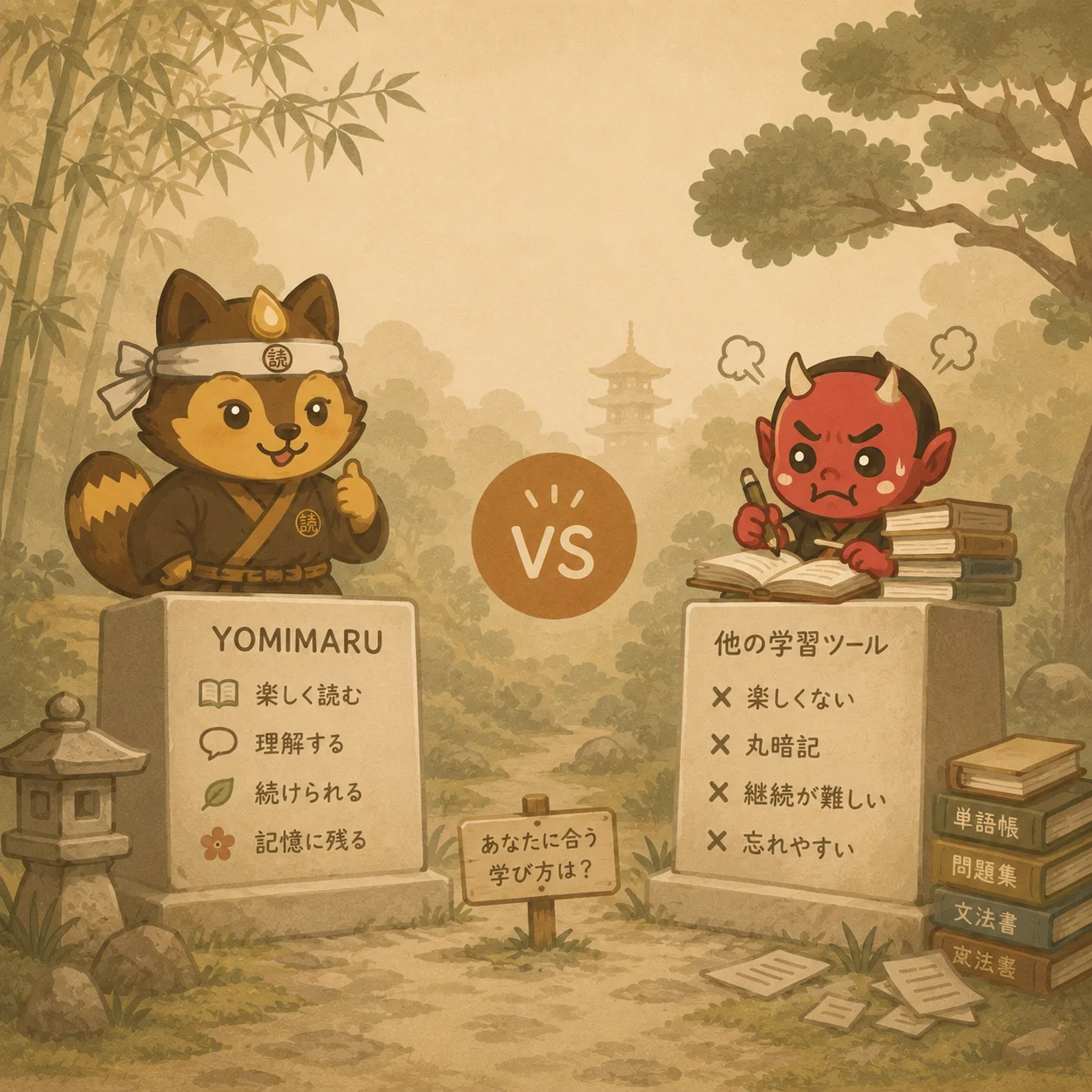
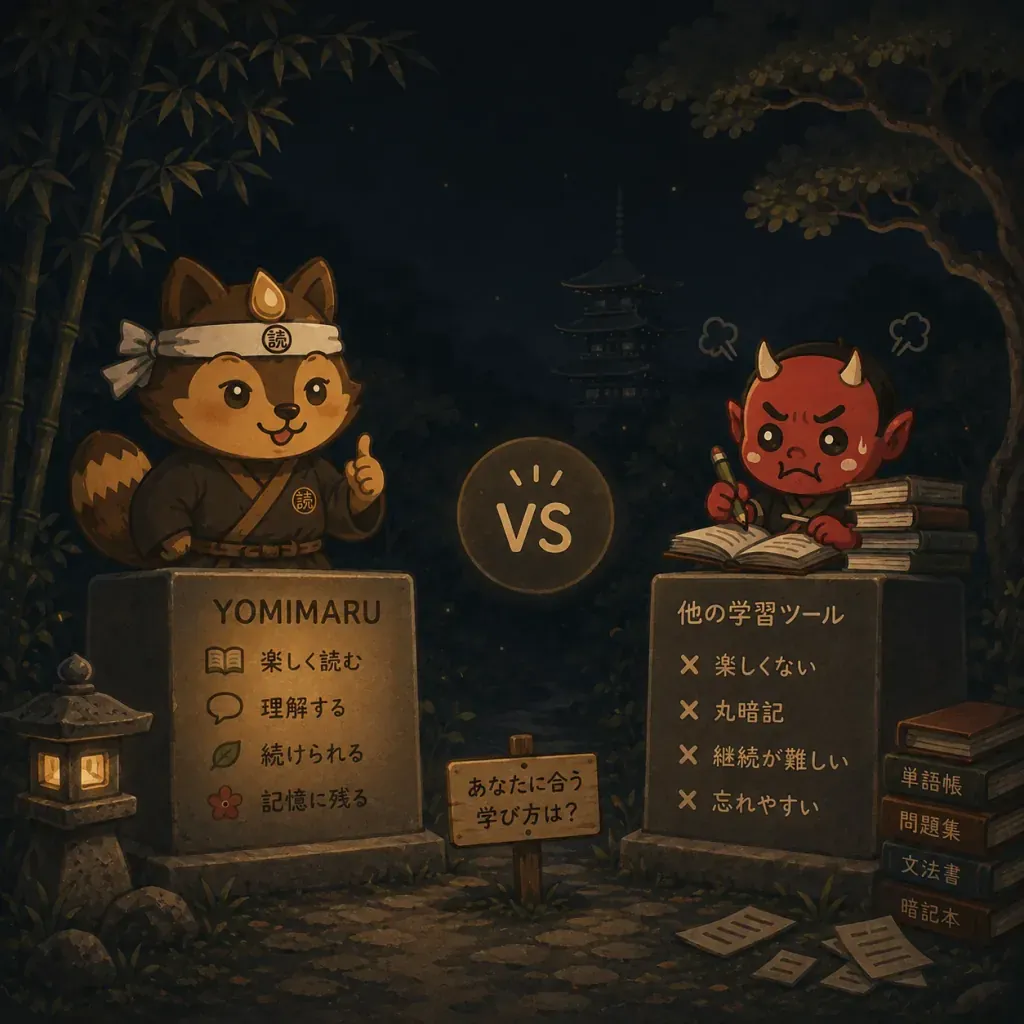
Yomimaru is a web-based Japanese reading platform that removes every limitation described above. You can read any Japanese text: NHK Web Easy articles at N3, news articles at full native difficulty, light novel chapters, blog posts, anything you paste in. AI grammar explanations, adaptive furigana, and instant vocabulary lookup are built in.
Why it resolves NHK Web Easy's core limitations:
Any content. There is no content library ceiling because Yomimaru does not restrict you to its own library. You import whatever you want to read. Paste in a recipe, a Wikipedia article, a manga chapter's text, or a full news article from any Japanese source. The reading interface applies the same features regardless of what you put in.
Adaptive furigana. Instead of showing furigana on every kanji (NHK Web Easy's approach), Yomimaru shows furigana only for kanji above your JLPT level. Set your level to N3, and you will see reading guides only for N2+ kanji, the ones you have not yet learned. As you improve and raise your level, the furigana fades away naturally rather than all at once.
AI grammar explanations. When you hit a complex sentence with embedded relative clauses or an unusual conjugation (the 気象庁は土砂災害への警戒を呼びかけている kind), highlight it. Tomo-Sensei, Yomimaru's AI tutor, explains the grammatical structure in English, identifies hidden subjects, and gives you a natural translation. This is something a hover-over dictionary cannot do.
No content ceiling. The same interface that works for a beginner reading N4-level news works equally well for an advanced learner reading dense N1-level essays. The tool grows with you across all JLPT levels.
A daily edition, already levelled. If you want the NHK Web Easy habit without the ceiling, Yominews publishes real Japanese news rewritten at five JLPT levels every week — N4 reads about where NHK Web Easy sits, N2 is close to unsimplified, and every story carries furigana and an English summary. Free, no account.
Best for: N4-N1 learners who have outgrown simplified sites and want to read authentic Japanese at their actual level, with full vocabulary and grammar support.
So the switch does not have to be a switch at all. It can be an afternoon:
- Read today's NHK Web Easy article the way you always do. Keep the habit. It costs you nothing.
- Find the original, unsimplified version of the same story and paste it into Yomimaru.
- Set your JLPT level, read one paragraph, and let Tomo-Sensei take apart the sentence that stopped you.
Which alternative is right for you?
Start with the honest case for staying put. If you are early N4 and what you want is a free, short, furigana'd news story every morning and nothing more than that, NHK Web Easy is already the right tool and you should not switch. Every other row below is for the learner who wants something NHK Web Easy cannot give them: a dictionary inside the page, topics that are not the news, or a text that is actually hard.
| Your situation | Best choice |
|---|---|
| You are early N4 and want free, short, furigana'd daily news, nothing else | Stay on NHK Web Easy |
| You love NHK Web Easy but want hover-over definitions | NHK Easier |
| You want to read about Japanese culture, not news | MATCHA Easy Japanese |
| You want structured stories with audio and grammar notes | Satori Reader |
| You want to read any Japanese text at your level | Yomimaru |
| NHK Web Easy is starting to feel too easy | Yomimaru |
| You are studying for N2 or N1 | Yomimaru |
 確認
確認You have read NHK Web Easy every day for a year, and a regular Japanese news article is still unreadable. What is the most likely reason?
The ceiling is structural, not a question of volume. Every story is rewritten into short single-clause sentences at a fixed N3-N4 level, so no amount of it exposes you to the long multi-clause sentences, compound nouns and news-only vocabulary a native article is made of. The only cure is reading the harder text, with enough support that you survive it.
Further Reading
All four tools above work best alongside a broader reading strategy. If you want to understand how to progress from simplified sites to fully native Japanese content, these guides pick up where this article leaves off:
- Yominews: free leveled Japanese news with furigana (N5-N1). Real daily Japanese news rewritten at every JLPT level with English summaries, our free NHK Web Easy alternative. Read at N5 · N4 · N3 · N2 · N1.
- How to read native Japanese content: the complete guide
- Satori Reader alternative: full feature comparison
- JLPT reading comprehension strategies by level
- What is furigana and how does it help your reading?
- Best furigana reader tools online, if you want to apply furigana to Japanese texts beyond what these reading sites offer.
- Migaku alternatives, if you use or are considering Migaku and want to compare it with simpler no-extension reading tools.