
The best app to learn Japanese depends on your goal. To learn through reading and build your vocabulary, start with Yomimaru: it takes you from your first kana to native content, and reviews every word you keep in the same app. For the other goals, our picks are Rocket Japanese for a lesson-by-lesson course, WaniKani for kanji, MaruMori for grammar and a tutor on italki for speaking.
What is the best app to learn Japanese? Our pick for each goal
We make Yomimaru, so here is how we checked. The facts about the other eight apps come from their own pricing pages, store listings and help pages, and from our own signed-in tests of Duolingo and LingoDeer, and each entry links its main sources. Prices are US-dollar list prices, checked on 12 and 13 November 2026, and we mark every sale as a sale. If you mostly want something to read, our comparison of Japanese reading apps covers the reading tools in more depth.
| App | Best for | Price model | Price (USD) | Audio | Review |
|---|---|---|---|---|---|
| Yomimaru | Our pick for learning through reading, and for vocabulary: first kana to native content, every word you keep reviewed | Kana course, news and library previews free with no account; paid plans | From $9.99 a month or $95.88 a year; 14-day free trial | Narrated stories and news; audio for 17,343 dictionary readings | FSRS; type, flip or pick |
| Rocket Japanese | Our pick for a course: audio-led, to N4, bought once | Free trial lessons, then a one-time purchase | Levels 1 to 3 $449.85; Level 1 $149.95 | Audio lessons by Japanese speakers (its statement) | Flashcards you rate Easy or Hard |
| LingoDeer | A structured course with grammar explained | Unit 1 free, then a subscription | $14.99 a month, $95.99 a year | A recording for every word and sentence (its statement) | Its own scheduler; you rate each card |
| Duolingo | A short game-like lesson every day | Free with ads; Super subscription | No Super price on Duolingo's own pages | Generated speech in character voices | Tap, word bank or multiple choice in our test |
| WaniKani | Our pick for kanji: mnemonics and typed answers | Levels 1 to 3 free, then a subscription or lifetime | $9 a month, $89 a year, $299 lifetime | Two recordings for each vocabulary word | Fixed stages; typed |
| MaruMori | Our pick for grammar: written lessons to N2, then review in sentences | 14-day trial, then a subscription or lifetime | $8.99 a month, $83.88 a year, $349.99 lifetime | Audio on example sentences and readings | Fixed stages; typed fill-in or sentence blocks |
| Bunpro | JLPT grammar drilled in sentences | Grammar pages free, no SRS; subscription or lifetime | $5 a month, $50 a year, $150 lifetime | Recordings on grammar sentences; generated speech on vocab sentences | Fixed schedule; typed or self-graded |
| italki | Our pick for speaking: live lessons with a tutor | Pay per lesson; teachers set prices | $5 to $120 a lesson | Live video with your tutor | A summary and practice after recorded Classroom lessons |
| Pimsleur | Speaking out loud, from lesson one | One free lesson and a 7-day trial; subscription | $19.95 a month, $149.95 a year | 30-minute audio lessons | Spaced recall inside each lesson |
Yomimaru: learn through reading and build your vocabulary, from your first kana
Yomimaru is a Japanese learning app built on reading and vocabulary: stories at your level that lead on to native content, and every word you keep reviewed in the same app. It starts before you can read a single kana. A learner starting from zero goes through it like this:
- Learn the kana on Yomikana. All 208 kana, then 310 first words in themes you pick, with no account.
- Take the level check at sign-up, and read your first whole story after four rows of hiragana.
- Build your vocabulary on the Yomimaru 6k and the JLPT decks, reviewed on FSRS, typing your answers if you want to.
- Follow the guided path, a daily trail of short stops on every level from Beginner to N1: read, review, quiz, news or roleplay.
- Look up anything. Tap a word, or select a sentence to translate or explain it.
- Ask Tomo about grammar, take a practice quiz, or write back in Japanese in a roleplay scene.
- Move on to native Japanese: Aozora Bunko literature, your own texts and manga pages, in the same reader.
- Bring what you already know from Anki, WaniKani, MaruMori or Renshuu.
Kana and your first words
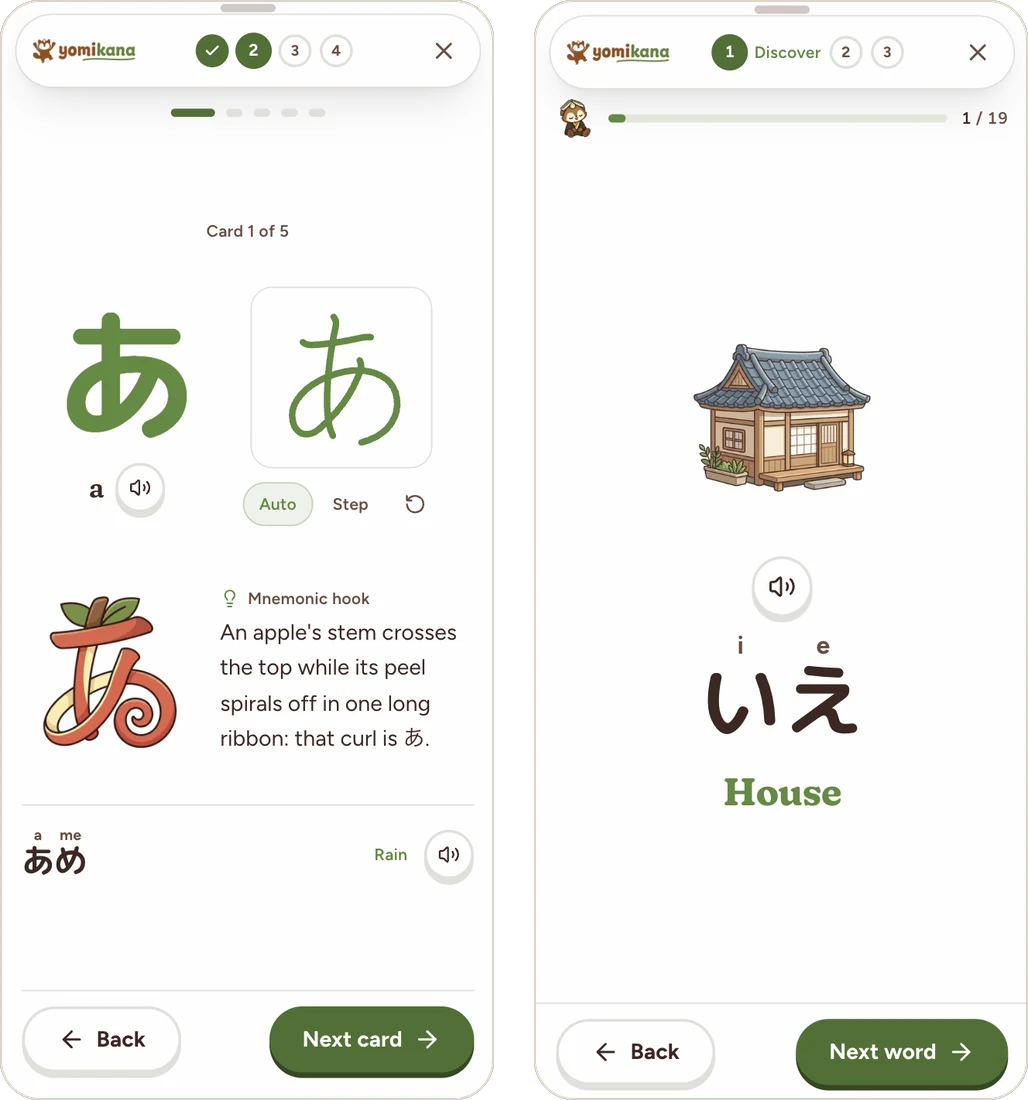
Yomikana, Yomimaru's kana course, is free and needs no account. It teaches all 208 kana in 52 lessons across 6 chapters, each kana with its mnemonic, its sound and its stroke order, and drills them with quizzes, a match game, a lookalike drill and typed answers. Then come 310 first words in 8 themes you pick, from Food & drink to Doing & describing, and every word it offers is one you can already read. Every theme has a picture, 98 words have their own illustration, and the words come back in typed reviews. If you make an account later, your guest progress moves into it. For how the two scripts differ before you start, see our beginner's guide to hiragana and katakana.
Vocabulary: the Yomimaru 6k, the JLPT decks and FSRS
Yomimaru's vocabulary comes in decks. The Yomimaru 6k holds the 6,000 most useful words in 24 levels of 250, each level with its own yokai, and a level passes when 90% of its words reach Glow. Its order ranks each word by how often it is used: in Jiten's frequency list of anime, drama, novels and visual novels, in wordfreq's list of subtitles and the web, in the Tatoeba sentences that use it, and in Yomimaru's own texts. A beginner starts it at level 1. Beside it sit JLPT decks for every level, from N5 (757 words) and N4 (772) up to N1 (2,500), and together the 6k and the JLPT decks hold 8,563 different words.
Every word you keep is scheduled with FSRS, the modern open algorithm Anki also ships, as a recognition card (日本 to its meaning) and a production card (the meaning to 日本). Review has three modes. In Show you flip and grade, in Type you type the meaning, or the word in rōmaji or kana, and in Pick you choose from four tiles against a 10-second timer. Every grade button shows when the word will come back, and you can undo a grade. Each word wears one of six Lantern tiers, from New through Flicker, Glow, Shine and Blaze to Known. Lessons teach 15 new words a day by default, and Today's Review deals what is due in short sittings.
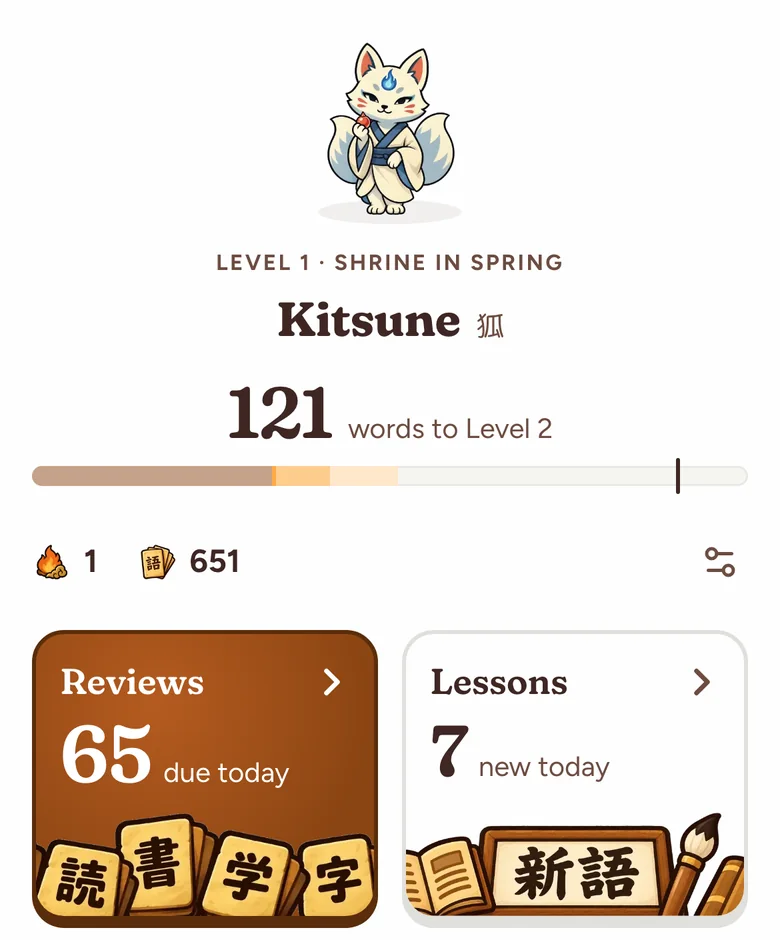
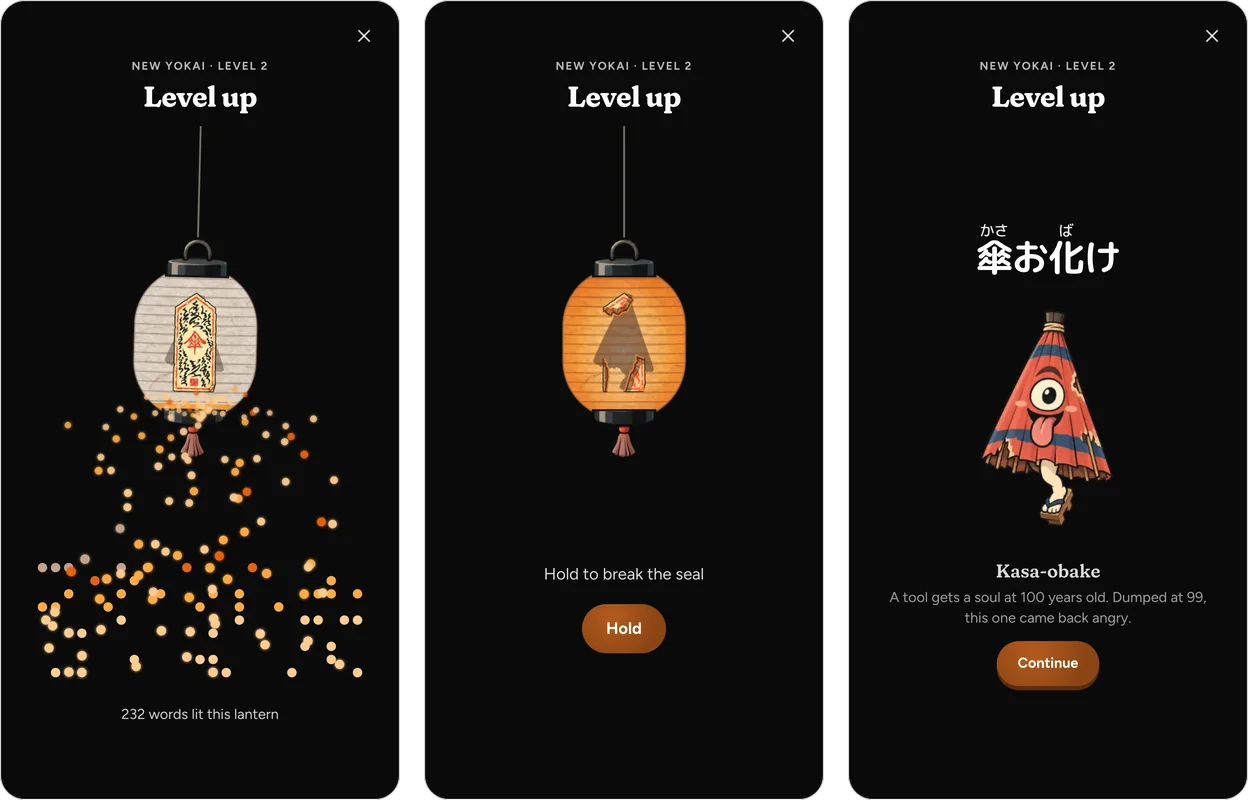
Passing a level of the 6k plays a reveal of the next level's yokai, which can become your avatar. Today's Quests set three goals a day, and the level ladder climbs 15 rungs from Hiragana to N1+, reached by the words you learn and the texts you finish. A reading streak and a vocab streak keep count, and holiday mode pauses the vocab streak for up to 90 days while you're away. Progress here is your own: there are no leaderboards or leagues.
Bring your Anki decks, WaniKani, MaruMori and Renshuu

Bring your Anki decks with their review history, or connect WaniKani, MaruMori or Renshuu, and Yomimaru already knows the words you know. Words you've learned in Anki count as learned: adaptive furigana hides them, and they fill the 6k, your decks and your stats.
An Anki import takes .apkg or .colpkg files, up to 30,000 words at a time, with their images and audio, and each word keeps its schedule; you can undo the import for 30 days. The WaniKani and MaruMori syncs bring in your vocabulary and kanji stages, and the Renshuu sync brings words, kanji and grammar with their mastery, tags the grammar you study there in the reader, and sends the words you star in Yomimaru back to Renshuu. The syncs don't schedule your reviews in Yomimaru: they change your furigana, your decks and your stats. Going the other way, Send to Anki puts a word into Anki in one click from desktop Chrome, Edge or Firefox with AnkiConnect (not Safari).
Your first story, and a path at your level
At sign-up a level check offers three ways in: a one-screen kanji check, a route for people new to Japanese that asks which kana you read, or straight to reading. From zero, after four rows of hiragana, you can read a whole story: くさい たこThe Stinky Octopus, written with the あ, か, さ and た rows. It is one of the kana starter stories for beginners that open the library.
For a beginner, Yomimaru's library holds 10 Beginner texts, 14 at N5 and 31 at N4, and 22 of them are Yomimaru originals written for beginners. All 10 Beginner texts end with a comprehension quiz, as do 12 of the 14 at N5 and 14 of the 31 at N4, and most stories flag their grammar points before you start. The library runs on to N1, where most texts are Japanese originals from Aozora Bunko, and long stories come in episodes, over 450 of them in 150 series, each with an English recap of the story so far.
Reading at your level matters because of how much of a text you need to know. Studies of reading in a second language put comfortable reading at 95 to 98% of the words known (Laufer 1989; Hu and Nation 2000), so every Yomimaru story shows its JLPT word mix and difficulty before you open it. Our guide to moving from graded readers to native Japanese explains how to use that number.
Every word one tap away
In Yomimaru's reader, a tap on any word shows the meaning that fits the sentence, from a dictionary of 32,882 entries, with its pitch accent drawn on the reading, its frequency, an example sentence and its audio. Furigana is adaptive: it hides the readings you know, going by your reviews, your imported Anki history and your WaniKani, MaruMori and Renshuu progress.
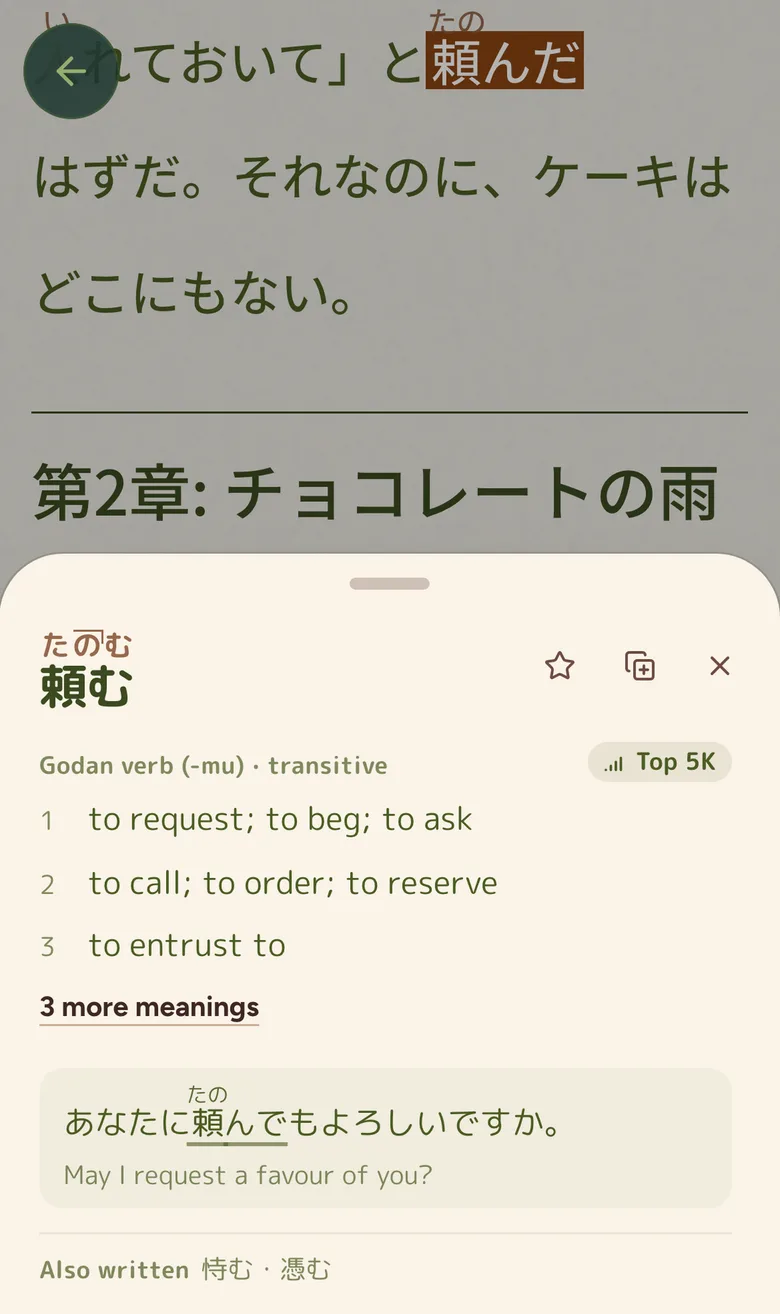
Select a sentence that stops you to translate or explain it, for 2.7 credits. The card gives the translation, then each word with its level and frequency, the grammar points, other ways to say it and the cultural context. Here is the kind of sentence you might select:
母に駅まで迎えに来てほしいと頼んだ。
直訳 Word by word
Mother to, station as far as, to meet come want, (that) asked.
てほしい turns a request into "I want you to": everything you ask for comes before と頼んだ.
The reader has 11 paper themes and 5 fonts, scroll or paged reading, and furigana and rōmaji each set to Off, Adaptive or Always.
Native content: Aozora Bunko, your own texts and manga
Past the graded library, Yomimaru's search reaches the Aozora Bunko archive of Japanese literature, and each work opens in the same reader, with furigana and a tap on any word. You can also bring your own reading: paste a text, or import a .txt, .md, .docx or .odt file, a PDF with a text layer or a DRM-free EPUB, and an optional analysis adds key words, grammar points and a quiz, on credits. Manga pages and visual-novel screenshots go in as images or a PDF, on credits, and the text is read off the page so you can look words up. When you want something new at your level instead, the Content Studio writes a story, a news report or a lecture from N5 to N1, on a topic you pick, from 1 to over 10 minutes of reading, then keeps the story going.
Tomo: grammar, quizzes and roleplay
Ask Tomo, Yomimaru's tutor, about any grammar point in your own words, and the answer comes back as a card with the construction, examples, nuances and a "Your turn" exercise at your level, for 4.5 credits (how the AI grammar explainer works). Tomo's shelf holds 48 N5 and N4 practice quizzes, 480 questions in all. For output practice, step into one of 16 ready-made roleplay scenes, four for each level from N5 to N2, or into a scene from a story, and write back in Japanese, for 4.5 credits a reply. In a story's scene, your typed replies come back with language notes.
The news, and stories read aloud
Yomimaru's news comes at N4, N3 and N1, in three desks, about 10 new articles a week, and inside the app the guided path mixes news stops into your day. You can also read the news without an account: Yomimaru's news pages carry the full article at each level, with a gloss on every word you tap. On those pages, 35 articles already have a narration player, with 88 level versions and about 5 hours of audio that play without an account, and Yomimaru narrates about 10 new articles a week.
Yomimaru's narrated stories have voices cast to each story and to each role, and every take is checked for misread words before it ships, so it sounds like real Japanese, with natural intonation. The read-along player highlights each word or sentence as it is read and scrolls with the voice.
What a subscription opens
A Yomimaru subscription opens the whole app:
- the library of 379 graded texts, Beginner 10, N5 14, N4 31, N3 80, N2 74 and N1 170, and over 450 episodes in 150 series;
- a comprehension quiz on 313 of the 379 texts, and 302 grammar points from N5 to N1, flagged in 327 of the texts;
- review on FSRS, with the 6k and the JLPT decks, 8,563 words between them;
- Tomo's 48 practice quizzes and 16 roleplay scenes, and the narrated stories;
- the Aozora Bunko archive, your own texts and manga pages, and the Content Studio;
- your Anki decks with their review history, and the WaniKani, MaruMori and Renshuu syncs.
Tomo's answers, sentence explanations, roleplay replies, imports with analysis and the Studio run on credits. Plans start at $9.99 a month, or $95.88 a year ($7.99 a month), and there is a 14-day free trial (Yomimaru's plans and prices).
Free without an account
Three parts of Yomimaru are open to anyone, with no account. Yomikana teaches the kana and 310 first words, the whole course. The news pages carry each article at N4, N3 and N1, and the narrated ones play there too. And every library text has a public page with an excerpt of about 400 characters, and most pages add up to 8 key words, 6 grammar points, 4 cultural notes and a sample quiz question; the 10 Beginner kana stories appear there whole.
- Best for: learning Japanese through reading, from your first kana to native content, and building your vocabulary, with every word you keep reviewed in the same app.
- Not built for: speaking practice, since nothing in the app listens to your voice and roleplay replies are typed; watching shows or anime; or anyone who wants an app from the App Store or Google Play.
- Free: with no account, Yomikana, the whole kana course; the news pages at N4, N3 and N1; a public page for every library text, with an excerpt and, on most, study notes.
- Price: from $9.99 a month, or $95.88 a year ($7.99 a month), and a 14-day free trial.
- Audio: narrated stories with read-along; narrated news; audio on dictionary words.
- Review: FSRS, recognition and production cards, Show, Type and Pick, six Lantern tiers.
- Works on: the web, as a web app built for phones and installable to your home screen. There is no native app yet.
For a structured course: Rocket Japanese, our pick, with LingoDeer and Duolingo
A course takes you through set lessons in a fixed order. Our pick is Rocket Japanese: you buy it once and keep it, its lessons are built on audio, and its free trial has no time limit. LingoDeer is a subscription course that explains its grammar, and Duolingo is free with ads.
Rocket Japanese: an audio-led course you buy once
Rocket Japanese teaches through audio lessons "delivered in podcast style", Language and Culture lessons, Survival Kit lessons and writing lessons for the strokes of each character (its help page). By Rocket's own map, Level 1 covers JLPT N5, and Levels 2 and 3 together cover N4; its pricing page counts 451 hours in Levels 1 to 3, with 86 audio lessons, 89 language lessons and 71 writing lessons. Its audio is "recorded by real Japanese speakers", says its Japanese page. Rocket Record checks the phrases you say with voice recognition. Its flashcards ask you to rate each card Easy or Hard; we found no mention of spaced repetition on its pages.
The free trial needs no credit card, and the App Store listing says it has no time limit. After that you buy levels once, with lifetime access: Level 1 at $149.95, Levels 1 and 2 at $299.90, and Levels 1 to 3 at $449.85, or $75 a month for six months for all three, with a 60-day guarantee. In the App Store, Levels 1 to 3 cost $249.99.
- Best for: an audio-led course from N5 to N4 by Rocket's own map, paid once.
- Not built for: going past N4 within its three levels, by Rocket's own map.
- Free: the Intro Module and the first Audio and Language and Culture lessons of each level; no card needed.
- Price: Level 1 $149.95, Levels 1 to 3 $449.85 once (list); $249.99 for Levels 1 to 3 in the App Store.
- Audio: audio lessons, with recordings of Japanese speakers (Rocket's statement).
- Review: flashcards you rate Easy or Hard, and Rocket Record for phrases you say.
- Works on: web, iPhone, iPad, Android.
Rocket's three levels stop at N4 by its own map; Yomimaru's library runs from Beginner to N1, so the reading goes on where the course ends.
LingoDeer: a course that explains its grammar
LingoDeer teaches Japanese as a course of units that build on each other: Japanese I has 66 units, with tests you can take to skip ahead, and its course page puts its courses at A1 to B1. In our signed-in test, the first lesson showed a hiragana reading over every word and rōmaji under it, and you can turn kanji and rōmaji on or off. Each word and sentence plays its own recording, "voiced by actual native speakers" by LingoDeer's own statement.
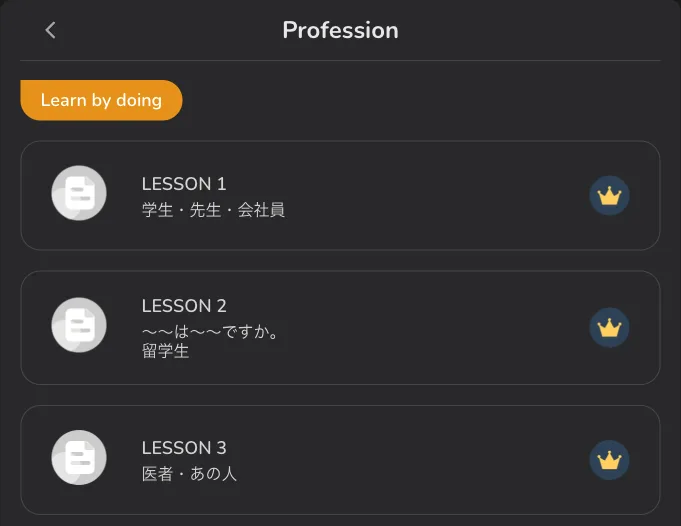
The free plan opens Unit 1 of Japanese I and the Alphabet unit; from Unit 2 on, every lesson carries the premium crown. LingoDeer reviews with its own scheduler, and you rate each card yourself after the exercise (its help article). On its pricing page, Premium is $14.99 a month, $39.99 a quarter or $95.99 a year, and a 3-year plan is $189.99 once. It no longer sells lifetime memberships to new buyers.
- Best for: a structured course that explains grammar lesson by lesson.
- Not built for: studying past Unit 1 without paying.
- Free: Unit 1 of Japanese I's 66 units, plus the kana unit.
- Price: $14.99 a month, $39.99 a quarter or $95.99 a year; no lifetime plan for new buyers.
- Audio: a recording for every word and sentence, by native speakers (LingoDeer's statement).
- Review: its own scheduler; you rate each card yourself.
- Works on: iPhone, Android, web; the course downloads for offline use.
Beside a course, or after one, Yomimaru gives you whole stories at your level and keeps the words you meet in them on a schedule.
Duolingo: a short lesson every day
Duolingo's Japanese course is free: "Every course is free," says its App Store listing. Lessons are short and game-like, on a path of 8 sections; in our signed-in test, the section cards labelled sections 1 to 3 A1 and section 4 A2, and Duolingo's advanced content takes Japanese to B2. A Characters tab teaches hiragana, katakana and kanji, and a "Show pronunciation" setting puts readings over kanji, in rōmaji or in kana. Duolingo runs weekly leagues: you climb or drop through 10 leagues by how much you study.
The free plan has ads. Super removes them and lifts the cap on mistakes, and there is a 14-day free trial of Super in the app; Duolingo publishes no Super price on its own pages, so we give none here. Lesson audio is generated speech in the voices of Duolingo's characters, built from voice actors' performances (its blog). In our test of the first Japanese lesson, every exercise was tap, word bank or multiple choice.
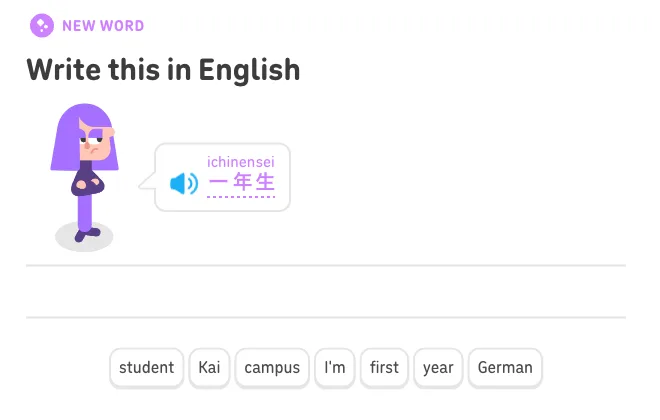
- Best for: a short, game-like lesson every day on a fixed path, with weekly leagues to compete in.
- Not built for: studying without ads or a cap on mistakes, unless you pay for Super.
- Free: every course, with ads and a cap on mistakes that Super lifts.
- Price: no Super price on Duolingo's own pages; a 14-day free trial of Super in the app.
- Audio: generated speech in character voices.
- Review: its own model of what you're forgetting; tap, word bank and multiple choice in our test.
- Works on: iPhone, Android, web.
Yomimaru is the app to add to Duolingo if you want to read whole stories at your level and type your review answers.
For kanji: WaniKani, our pick
WaniKani is a kanji course. It teaches kanji through their radicals, gives every radical, kanji and word a mnemonic, and orders it all across 60 levels: "over 2,000 kanji" and "over 6,000 Japanese words" by its home page. Answers are typed: readings turn into kana as you type, and meanings stay in English (its help centre). Reviews climb fixed stages from Apprentice to Burned, from 4 hours to 4 months apart, and a wrong answer drops a word back (its SRS page).
WaniKani is free until level 4: levels 1 to 3 hold about 200 words and, by WaniKani's count, around 55% of the kanji you need for JLPT N5. After that it costs $9 a month, $89 a year or $299 for lifetime access (its premium page). Each vocabulary word has two recordings by voice actors, one female and one male, and radicals and kanji have no audio. WaniKani shows no furigana anywhere, by design. It runs on the web, and has no official iPhone or Android app; community apps use its public API.
- Best for: learning to read kanji in a fixed order, with mnemonics and typed answers.
- Not built for: learners who want furigana, which it never shows, or an official phone app.
- Free: levels 1 to 3, about 200 words.
- Price: $9 a month, $89 a year or $299 lifetime.
- Audio: two voice-actor recordings for each vocabulary word; none for radicals or kanji.
- Review: fixed stages from 4 hours to 4 months; typed answers.
- Works on: web; community apps through its public API.
Connect WaniKani to Yomimaru and your vocabulary and kanji stages flow in: a word counts as learned once it reaches Guru, and by default its reading hides in the reader once it passes Apprentice 3. The sync doesn't move your WaniKani reviews into Yomimaru; they stay on WaniKani. If WaniKani is where you learned your kanji, here is what to read after WaniKani.
For grammar: MaruMori, our pick, with Bunpro
For grammar from your first steps to N2, our pick is MaruMori: each grammar point comes in a long lesson written by people, and then comes back in review, where you finish real sentences or build them from blocks. Bunpro also covers N1, and drills grammar in sentences on a schedule.
MaruMori: grammar lessons, then review in sentences
MaruMori is a course laid out as a map of islands, one region for each JLPT level, from an introduction before N5 up to N2. Its lessons are "written and double-checked by a team of language experts and native speakers (NO AI!)", says its home page. A grammar lesson is a long explanation with a structure box and numbered example sentences, each with audio and an English line, then a short multiple-choice check. Finishing it sends its grammar points into review (its help centre), where you type the missing part of a sentence, or build the sentence from blocks with fake ones mixed in, across 12 sentences for each point. When your answer differs from the one it wanted, MaruMori explains what your version changed. After every five lessons comes a reading exercise with the grammar, kanji and words you just learned, and the same course teaches 2,000 kanji and 8,000 words. Its lessons stop at N2 for now: MaruMori lists "Expert (N1)" as "coming soon" (its help centre).
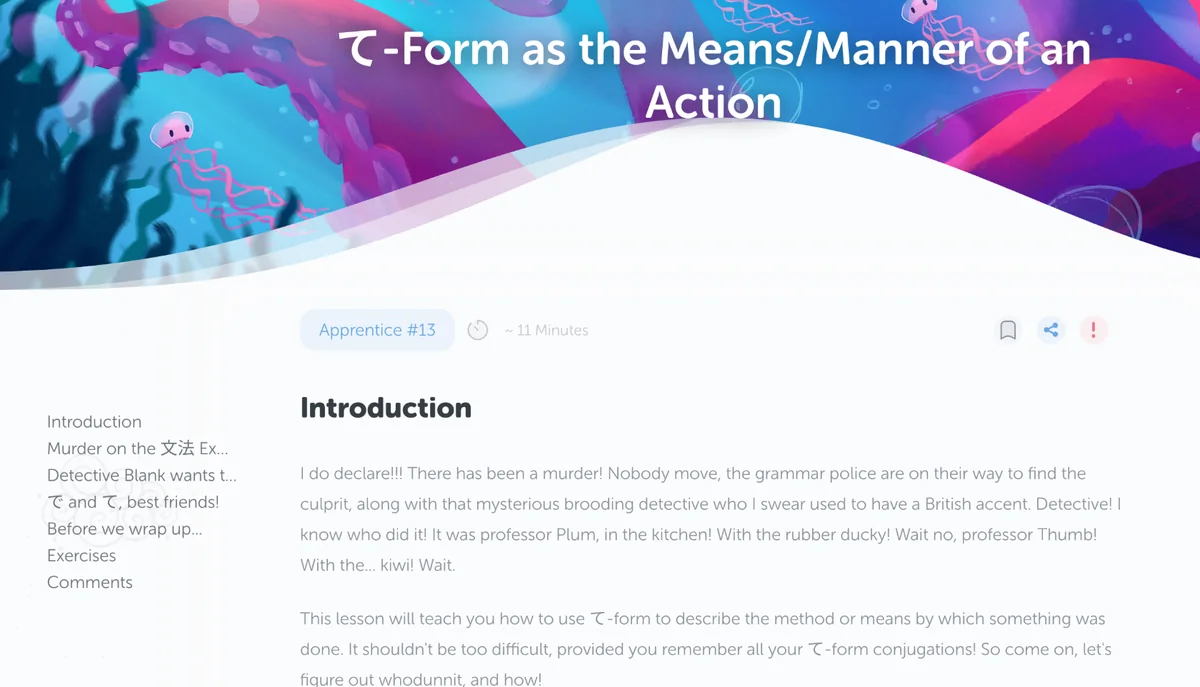
The 14-day trial opens every feature, with a limit on how much of the course you can go through (its help centre). After it, a free account keeps the grammar library, the dictionary, the trainers, the introduction island and the first five tiles of each region; review isn't on that list. On its pricing section, a plan costs $8.99 a month, $83.88 a year ($6.99 a month) or $349.99 for lifetime access, paid on the web, and the iPhone and Android apps are free downloads. Lifetime goes on sale once a year, from about mid-December to January (its help centre).
- Best for: grammar from your first steps to N2, in long lessons written by people, each point then reviewed in sentences.
- Not built for: N1 grammar yet, which MaruMori lists as coming soon; or its grammar alone beside another kanji app, since its lessons and grammar review assume its own kanji and vocabulary track (its help centre).
- Free: a 14-day trial with every feature; after it, the grammar library, the dictionary, the trainers and the first five tiles of each region.
- Price: $8.99 a month, $83.88 a year or $349.99 lifetime, on the web.
- Audio: audio on lesson example sentences and reading exercises.
- Review: fixed stages from 4 hours to 4 months; grammar as typed fill-in or sentence blocks, kanji and words typed, Japanese to English.
- Works on: web, iPhone, iPad, Android.
Connect MaruMori to Yomimaru and your vocabulary and kanji stages flow in, so the reader already knows the words you've learned there. The sync doesn't move your MaruMori reviews into Yomimaru; they stay on MaruMori.
Bunpro: JLPT grammar drilled in sentences
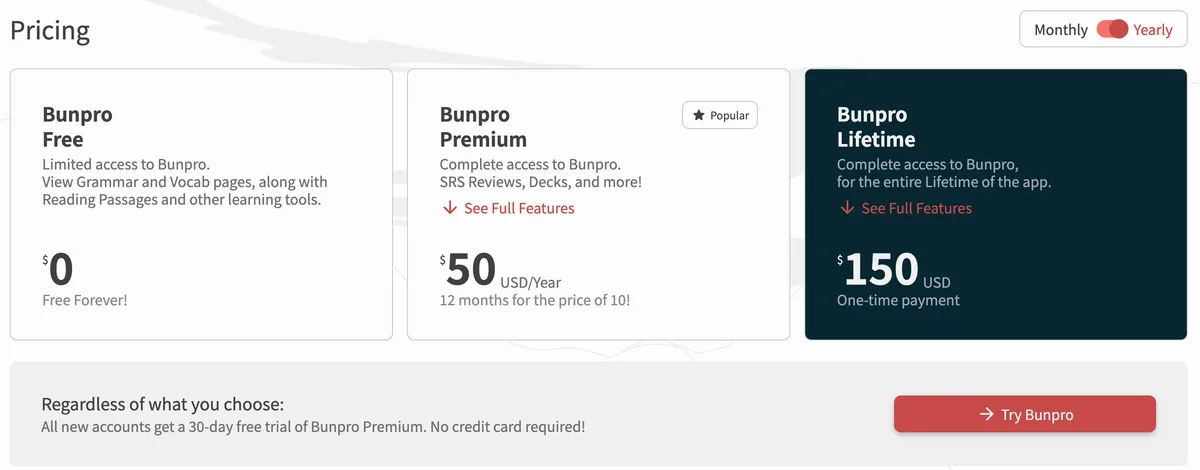
Bunpro drills Japanese grammar in sentences. It lists "900+" grammar points in decks from N5 to N1, and a review asks you to finish a sentence with the right form, typed in full or revealed and graded yourself (its review settings). Reviews follow Bunpro's own fixed schedule. It also has vocabulary decks and over 120 graded reading passages.
The free plan opens the grammar and vocabulary pages and the reading passages, and has no SRS reviews or decks: those are Premium. Every new account gets a 30-day Premium trial, with no card needed. On its pricing page, Premium is $5 a month, $50 a year or $150 for lifetime access on the web; through the App Store it is $6.49, $64.99 and $194.99. Bunpro says its grammar example sentences carry native audio recordings, and its staff wrote in October 2026 that vocabulary sentences use generated speech (its forum).
- Best for: drilling JLPT grammar from N5 to N1 in sentences, on a schedule.
- Not built for: reviewing on the free plan, which has no SRS reviews or decks.
- Free: grammar and vocabulary pages and graded reading passages; a 30-day Premium trial with no card.
- Price: $5 a month, $50 a year or $150 lifetime on the web; more through the App Store.
- Audio: recordings on grammar sentences (Bunpro's statement); generated speech on vocabulary sentences.
- Review: its own fixed schedule; fill-in sentences, typed or revealed and self-graded.
- Works on: web, iPhone, Android.
When you want to meet that grammar in stories, most Yomimaru stories flag their grammar points before you start, and Tomo explains any point you ask about.
For speaking: italki, our pick, with Pimsleur
Nothing in Yomimaru listens to your voice, so for speaking we send you elsewhere. Our pick is a tutor on italki: a live lesson is a conversation with a person who answers what you actually say. Pimsleur is the one to use between lessons, or without a tutor: an audio course you answer out loud.
italki: live lessons with a tutor
italki is a marketplace of tutors, and it listed 1,215 Japanese tutors when we checked, as professional teachers and community tutors (its Japanese tutors page). Lessons are live video, in italki Classroom or on Zoom, Google Meet and other tools, and every teacher offers a 60-minute lesson, with 30, 45 and 90 minutes as options. Each teacher sets their own price, within italki's limits: at least $5 for a community tutor or $10 for a professional teacher, and at most $120 (its help centre).
Trial lessons cost less, you get three of them with three different teachers, and not every teacher offers one (its trial lesson page); italki says it doesn't offer completely free lessons. After a lesson in italki Classroom with recording on, Smart Lessons write a summary and a practice set (its help centre), though we couldn't confirm that they cover Japanese lessons.
- Best for: live, spoken lessons with a tutor you pick.
- Not built for: free study: italki doesn't offer completely free lessons.
- Free: none; trial lessons cost less, three per student.
- Price: set by each teacher, from $5 to $120 a lesson by italki's limits.
- Audio: live video with your tutor.
- Review: Smart Lessons, a summary and practice after recorded lessons in italki Classroom (not confirmed for Japanese).
- Works on: web, iPhone, Android.
Between tutor lessons, read stories at your level in Yomimaru and review the words you keep.
Pimsleur: speaking out loud
Pimsleur's Japanese course is audio: 30-minute lessons in which you listen to native speakers and answer out loud (its Japanese page). The course runs five levels and 150 lessons, about 80 hours, in the polite Japanese "appropriate for most situations in Japan", and reading lessons teach hiragana, katakana and selected kanji. New words come back inside the lessons on a schedule, and a Practice tab adds flash cards, quizzes and a Speed Round; we found no typed review. Its Conversation Coach, an AI speaking partner, came to Japanese in November 2026, with an All Access subscription (its App Store notes). It also works hands-free, in Apple CarPlay and Android Auto.
There is no free plan: you get one free lesson and a 7-day trial, and a 30-day guarantee. Japanese Premium costs $19.95 a month or $149.95 a year, and All Access, every language with Conversation Coach, $20.95 a month or $164.95 a year.
- Best for: speaking and listening, answering out loud in polite everyday Japanese.
- Not built for: trying it free past one lesson; we found no typed review.
- Free: one lesson and a 7-day trial.
- Price: Japanese Premium $19.95 a month or $149.95 a year; All Access $20.95 a month or $164.95 a year.
- Audio: 30-minute audio lessons with native speakers (Pimsleur's statement).
- Review: spaced recall inside each lesson, plus flash cards and quizzes.
- Works on: iPhone, Android, web, Alexa, CarPlay, Android Auto.
Beside a Pimsleur course, Yomimaru covers the reading and the vocabulary.
For immersion: reading Japanese, and where video fits
Yomimaru's immersion is reading: the graded library up to N1, the Aozora Bunko archive, your own texts and manga pages, all in one reader with a tap on any word. It doesn't play video or take subtitle files. If you learn from anime and shows, Migaku's browser extension works on Netflix, YouTube, Disney+, Rakuten Viki and Animelon, by its own FAQ (checked 12 November 2026); our comparison with Migaku sets it beside Yomimaru.
Which Japanese learning app should you pick?
- Choose Yomimaru if:
- you are starting from zero: begin with the kana on Yomikana, with no account, then read your first story;
- you want to build your vocabulary from the 6,000 most useful words and the JLPT decks, reviewed on FSRS, typing your answers if you like;
- you want to learn through reading, from kana starter stories to native content;
- you already study in Anki, WaniKani, MaruMori or Renshuu and want that progress to count from the first page;
- you want to ask Tomo about grammar, or write back in Japanese in a roleplay scene.
- Choose Rocket Japanese if you want a lesson-by-lesson course to N4, built on audio, that you pay for once.
- Choose WaniKani if you want a kanji course with mnemonics and typed answers; its progress then carries into Yomimaru.
- Choose MaruMori if you want grammar taught in long written lessons, from your first steps to N2, then reviewed in sentences; the kanji and words you learn there then carry into Yomimaru.
- Choose italki if you want to speak Japanese with a person, in live lessons with a tutor you pick.
These apps also work side by side. Yomimaru imports your Anki decks and syncs WaniKani, MaruMori and Renshuu, so a course, a kanji or grammar app or a tutor can sit beside it while you read at your level and review your words in one place. Once you have picked, browse all our Japanese learning guides for what to read and study next.