
Yomikana is Yomimaru's free course for learning to read hiragana and katakana, and it assumes you can't read a single Japanese character yet. It teaches the two alphabets every learner starts with, a few characters at a time. You hear each one, watch how it's written and get a little trick to remember it by, then play quick games until it sticks. If you learned them once and a few have slipped, it works just as well for getting those back. It all runs in your browser, and you can start without an account.
You can open the first lesson in another tab and follow along.
What will you learn in Yomikana?
Japanese uses three sets of characters. Hiragana and katakana, together called kana, are the two alphabets, with one character per sound. Kanji are the characters borrowed from Chinese. You learn the kana first, because every Japanese sentence uses them (our beginner's guide to hiragana and katakana explains what each one is for). Yomikana teaches both, hiragana first:
| Chapter | What you learn | Lessons |
|---|---|---|
| Hiragana basics | The 46 basic characters, from あ a to ん n | 10 |
| Hiragana with marks | Small marks that change a sound: か ka → が ga, は ha → ぱ pa | 5 |
| Hiragana combinations | Two characters read as one sound: き + ゃ = きゃ kya | 11 |
| Katakana basics | The same 46 sounds in katakana, from ア a to ン n | 10 |
| Katakana with marks | ガ ga, パ pa and the rest | 5 |
| Katakana combinations | キャ kya, シュ shu and the rest | 11 |
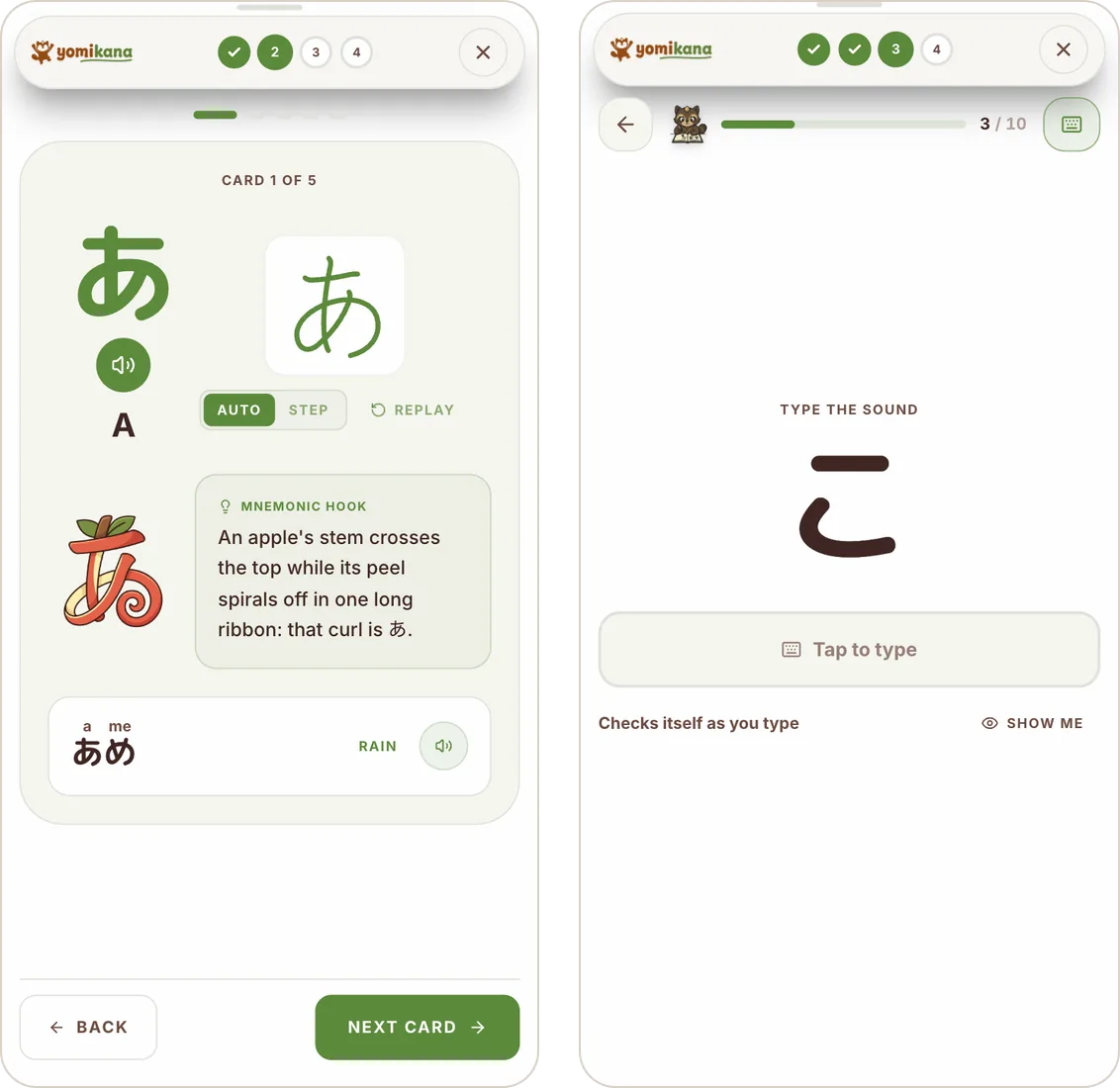
Each lesson teaches about five characters that sound alike, like か き く け こ (ka ki ku ke ko). You meet each one with its sound, an animation of how it's written, a memory trick and a first word that uses it. Then a short quiz checks that they stuck.
How does the Yomikana course work?
The course is a single path, and the next step is always highlighted, so you never have to wonder what to do next. You can replay anything you've finished.
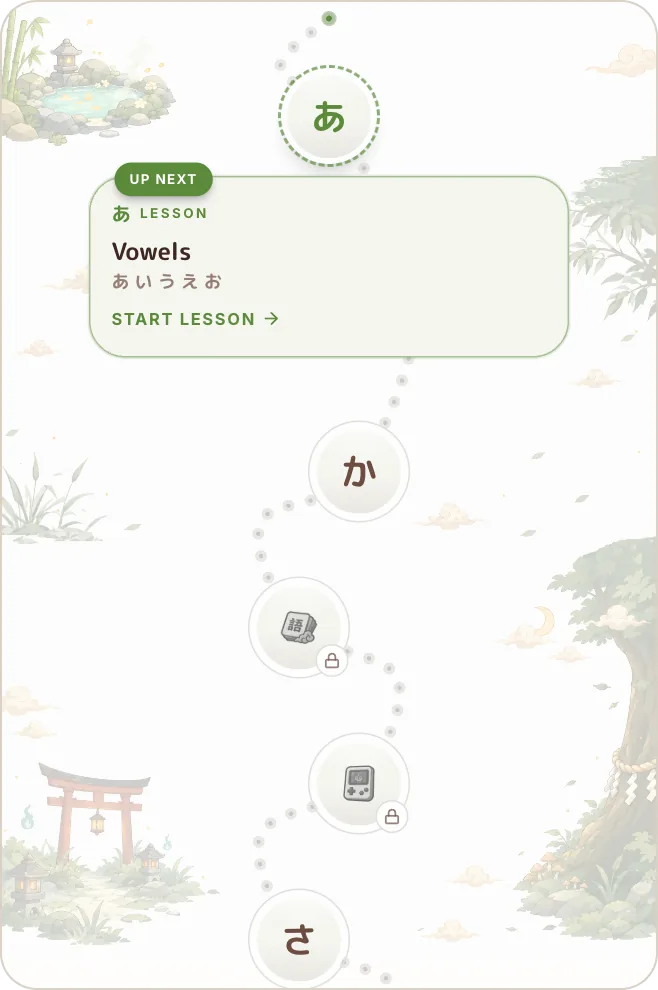
- Lessons. A few new characters, then a short quiz on them.
- Matching games. Every two lessons, a game mixes all the characters you've learned so far, and never one you haven't. Later games add look-alike answers, so guessing stops working.
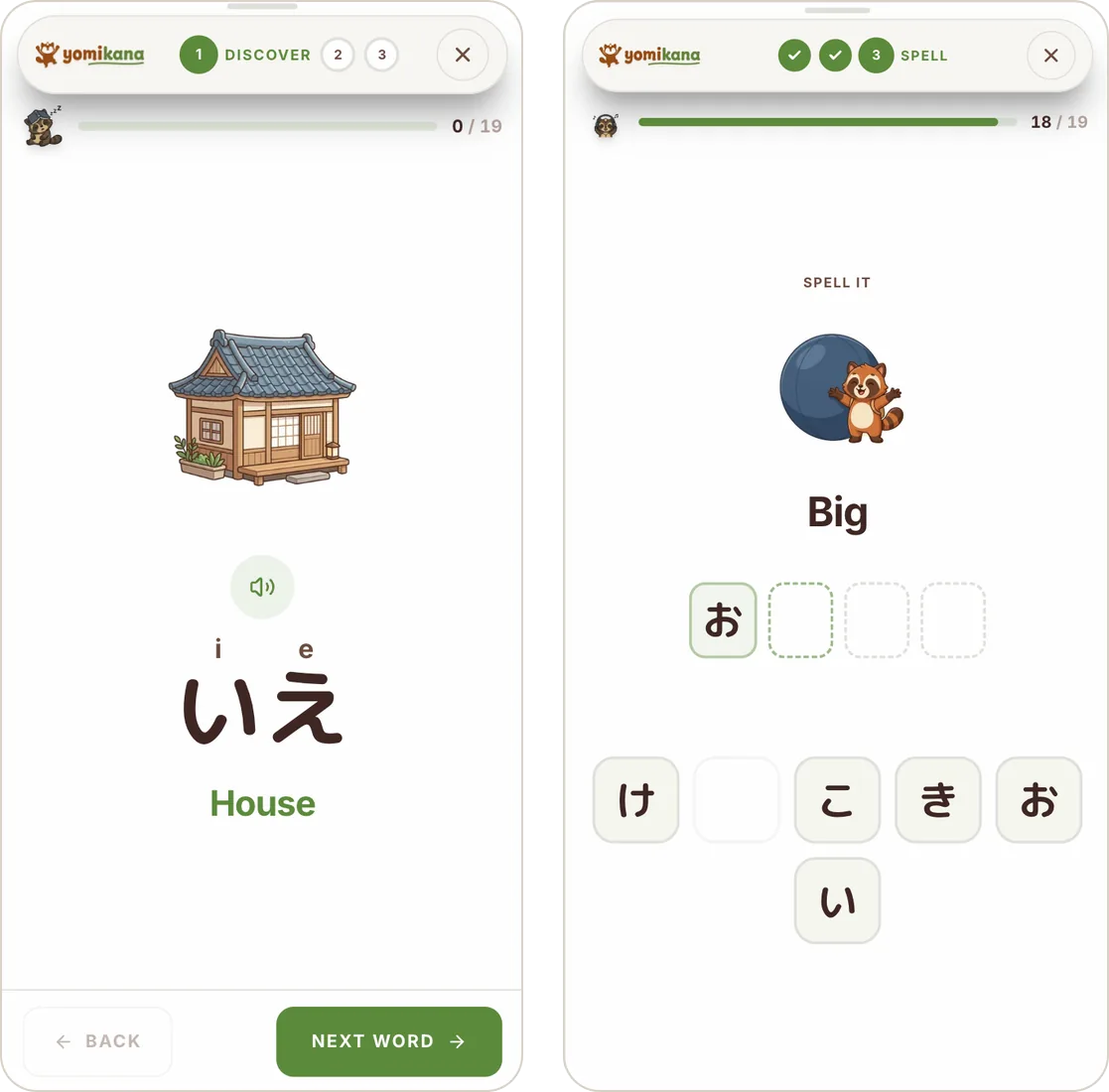
- Your first words. After the second lesson, you start learning everyday words you can already read, five at a time, each with a picture: いえ (house), かさ (umbrella), ねこ (cat). You see each word, pick its meaning, then build it from character tiles.
- Typing words from memory. Further along, you see a word's meaning and type it with your normal keyboard, and it turns into kana as you type: neko becomes ねこ.
- A review at the end of each chapter, including a drill on the characters beginners mix up most, like さ and き, or シ and ツ.
How does Yomikana help you remember the kana?
By showing you each character again, less and less often as you get it right. That method is called spaced repetition, and in Yomikana it happens inside the games: every time you answer, Yomikana notes whether you knew that character and decides when you'll see it again. A character you just learned, or keep getting wrong, comes back soon. One you keep getting right comes back after a day, then three days, a week, three weeks, and finally two months.
There's no separate pile of flashcards to get through: reviewing is just playing the next game.
- You play. A lesson quiz, a matching game or a review.
- Each answer counts. A right answer pushes the character further away, a wrong one brings it back sooner.
- Yomikana waits. Ten minutes for a new or missed character, up to two months for one you know well.
- What's due comes back. On your path, in the quiz, or by email if you asked for it.
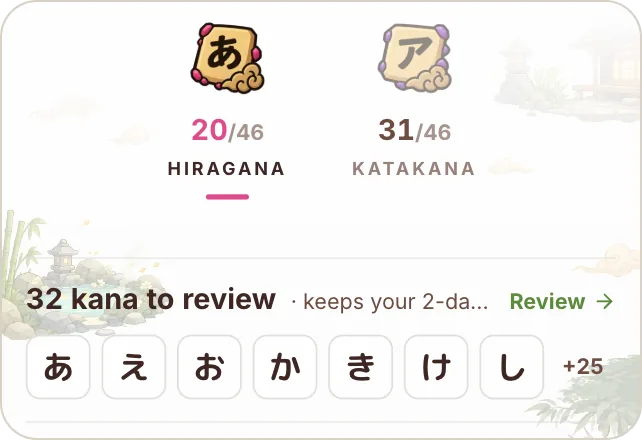
When ten or more characters are due, a card at the top of your path says how many, and one tap starts a quiz of exactly those.
The schedule in detail, for spaced-repetition fans
Each kana sits in one of six boxes, the system Sebastian Leitner described in 1972 (the Leitner system). A right answer moves it up one box, a miss moves it down two, and each box has its own wait:
| Box | The kana comes back |
|---|---|
| 0 | In 10 minutes |
| 1 | Tomorrow |
| 2 | In 3 days |
| 3 | In a week |
| 4 | In 3 weeks |
| 5 | In 2 months |
A kana climbs at most one box a day, except out of box 0, so three games in one evening move it no faster than one. Without that cap, a kana could go from new to "mastered" in ten minutes, which would measure recognition in the moment and not memory. So a kana counts as mastered after right answers on three separate days, which is day five at the earliest. A kana waiting for review stays waiting until you answer it: nothing expires.
Can I use Yomikana if I already know the kana?
Yes. Lessons never lock, so you can go straight to katakana or to the combinations, and "I already know these" at the start of a lesson marks it done in one tap. From there, Yomikana is a place to practise whatever slips:
- The ones you forget. Open the full chart, tap a line such as ナ ニ ヌ ネ ノ, and quiz yourself on just those. Every miss goes into your reviews, so a shaky ヌ or ヲ keeps coming back until it sticks.
- The ones you mix up. The look-alike drill asks only the pairs people confuse most, like さ and き, ぬ and め, わ, ね and れ, or シ and ツ.
- The harder combinations. The chart and the quizzes cover every combination too, so you can drill きゃ, しゅ or ちょ on their own.
- A quick warm-up. The quiz takes any set: all hiragana, all katakana, the hiragana you get wrong most, or whatever is waiting for review. You can tap the answer or type it. The match game leans toward the characters you miss.
For a test on paper, the hiragana quiz page and the katakana quiz page each have one you can print.
What does Yomikana save without an account?
Everything, in the browser you study in. A free Yomimaru account adds your progress on every device, and lets you carry what you learned into Yomimaru's reading app.
| What | Without an account | With a free account |
|---|---|---|
| Your progress through the course | Saved in this browser | On every device |
| Your review schedule | Saved in this browser | On every device |
| Your daily streak | Saved in this browser | On every device |
| Words you've practised | Saved in this browser | Added to your Yomimaru vocabulary |
| Email reminders | Yes | Yes |
| After the kana | The free library and news | Yomimaru's step-by-step reading course starts where you left off |
Signing up from inside the course doesn't start you over: everything you did as a guest moves into your new account.
Can Yomikana remind me to practise?
Yes, by email, with or without an account: a card at the end of a lesson offers it. It arrives the day after you study, at the same time you started studying. If you take a break, it slows to once a week, and after four of those with no study, it stops until you come back. Every email has a link to turn it off, and asking for reminders doesn't sign you up for anything else.
When can I read a real story?
After four lessons. The first four lessons teach the あ, か, さ and た groups of hiragana, and that's enough to read a whole short story in Yomimaru's library: くさい たこ, a story about a stinky octopus. It also uses a couple of characters you'll meet a bit later, like が, which is just か with two small marks.
ちいさい たこ が いた。
直訳 Word by word
little octopus (subject) was
The first line of the story.
Once you've finished the chart, the library's beginner shelf has more short stories, free to read, with the pronunciation printed above every kanji.
Who makes Yomikana?
Yomikana is part of Yomimaru, made by Maxime Pitaval and published by Redmoon Systems OÜ, the Estonian company he founded in 2026 to build it. Yomimaru earns its money from paid plans in the reading app, and nothing in Yomikana is behind them.
A word from me, since my name is on this page: I'm a French developer who learned Japanese the slow way, alone at first and then at a language school in Tokyo. I'm not a linguist, so I checked every claim here against the code that runs the course. If something is wrong, or the course breaks on you, write to me at [email protected]. I read everything that comes in.
How does Yomikana compare with Anki, Tofugu, RealKana and Kana Pro?
Anki, Tofugu's Kana Quiz, RealKana and Kana Pro each do something better than Yomikana. We tried all four on 1 October 2026, and prices change, so check before you pay.
| Tool | Cost | How it works |
|---|---|---|
| Yomikana | Free, no account, no ads | Lessons and games, with your reviews planned for you |
| Anki with a kana deck | Free; $24.99 on iPhone | You grade your own recall, and it schedules every card |
| Tofugu Kana Quiz | Free, no account | Checks typed rōmaji, and saves nothing |
| RealKana | Free with ads; $5 to remove them | Checks typed rōmaji, and keeps high scores |
| Kana Pro | Four stages free, with limits; Premium $4.99 | Checks taps, pairs and typing (drawing in Premium), and syncs when you sign in |
Where each one is better:
- Anki with a kana deck, if you want one review schedule for kana, kanji and vocabulary, for years. It is free on desktop and Android (AnkiMobile costs $24.99 on iPhone) and works offline. You grade your own answers (Again, Hard, Good or Easy), and you hear audio only if the deck has it. Shared decks such as "Tofugu: Learn Hiragana Deck" are free to download.
- Tofugu's Kana Quiz, for a fast test of a whole script in one sitting. Every kana of the set sits on one screen and you type the rōmaji, with no account, no audio and nothing saved. It tests one script at a time, includes the extra katakana used for foreign words, and sits beside Tofugu's free Learn Hiragana guide.
- RealKana, for reading kana in many typefaces. Each card is drawn in one of nine fonts, a native speaker's recordings can be switched on, and there are drills on words, sentences and kanji. It is free with ads, $5 once to remove them, and its iPhone app sells extra packs.
- Kana Pro, for handwriting and listening. Four stages are free (multiple choice, the reverse, pairs and typed answers), and Premium ($4.99 on the US App Store) lifts the free version's limits and adds listening, stroke order and drawing the kana, in apps for iPhone, iPad, Mac and Android and on the web.
- Yomikana, if you're starting from zero and want a course that teaches the kana in order and plans your reviews for you, free and with no account. Your first words and your first story come along the way.
What Yomikana does not do
Yomikana doesn't check your handwriting, so writing practice happens on paper. Its voice is your device's built-in text-to-speech, which can sound flat next to a real recording. It skips the extra katakana combinations used only for foreign words, like ファ (fa). There's no app in the stores, though it works in any modern browser. And it stops at the kana and your first words: for kanji and vocabulary after that, Yomimaru's reader or Anki take over.